

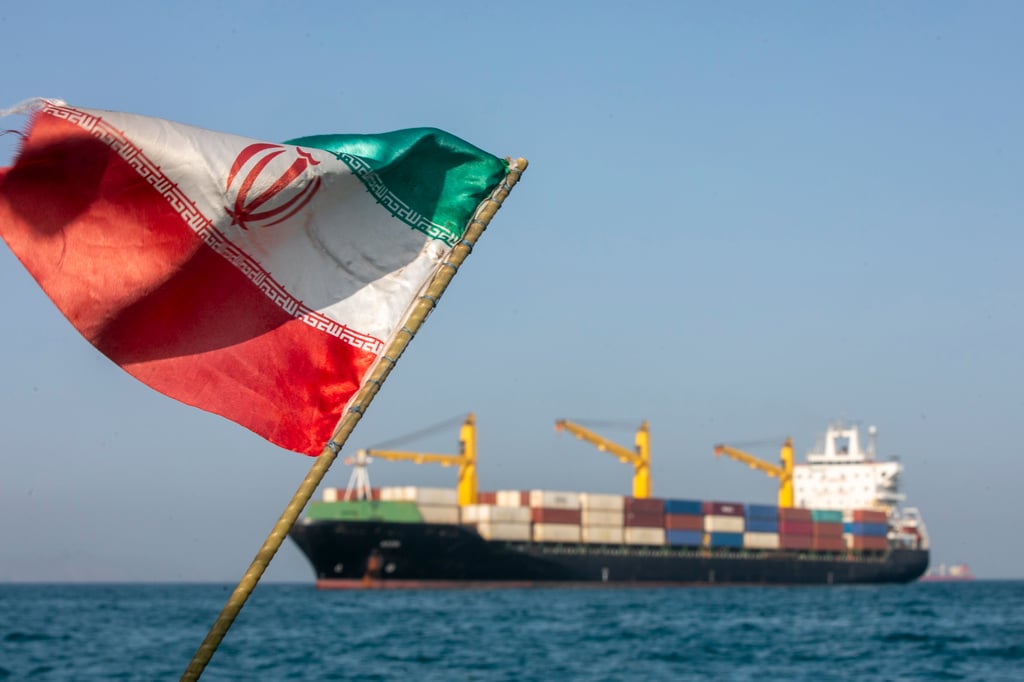
Oil plunges to $89 per barrel after Iran reports that peace deal would reopen Strait of Hormuz in 1 month
Right
Oil prices plunged to $89 a barrel Wednesday following reports that the proposed Iran-US peace deal would see the Strait of Hormuz being reopened in just one month.
The National Republican Senatorial Committee quietly deleted several posts attacking Republican Texas Attorney General Ken Paxton Tuesday after he won his Senate runoff race in a landslide. […]
A report from Groundwork Collaborative reveals how fossil fuel companies are not merely scoring windfall profits from President Donald Trump’s illegal war with Iran, but also using that money to reward shareholders rather than providing relief to consumers.The price of gas has soared since Trump attacked Iran without any congressional authorization in late February, going from an average of under $3 per gallon at the start of the war to $4.49 per gallon as of Tuesday. As US drivers have paid more at the pump, however, fossil fuel firms have been concerned with paying out dividends and conducting stock buybacks, expanding production to lower prices, Groundwork Collaborative’s report finds.Among other things, the report notes that ExxonMobil is on pace to deliver $20 billion worth of stock buybacks in 2026, even as CEO Darren Woods has insisted that the company’s decisions on production will be “grounded in value, not volume.”Additionally, the report documents how Shell recently announced “another 5% dividend increase and more than $3 billion in buybacks,” with CEO Wael Sawan describing the company’s commitment to paying shareholders as “sacrosanct.”Chevron has pledged roughly $3 billion in quarterly stock buybacks, while also saying increasing dividends for shareholders is its “first and foremost” priority.Chevron CFO Eimear Bonner, the report adds, recently revealed that the company has no plans to boost output in response to high energy prices, stating that “capital spending and production outlooks are consistent with previous guidance.”Lindsay Owens, executive director of Groundwork Collaborative, accused Big Oil of using Trump’s illegal war as cover to keep prices high without taking any steps to reduce pain at the pump.“These companies want Americans to believe price spikes are simply the unavoidable result of global events,” said Owens, “but their own executives are openly telling investors that volatility, conflict, and supply disruptions are good for business. They are choosing buybacks over production, shareholder payouts over affordability, and corporate profiteering over the economic security of working families.”The high fuel prices aren’t being felt just in the US, but across the world.Karthik Sankaran, senior research fellow at the Quincy Institute for Responsible Statecraft, explained in a Tuesday analysis how oil prices are hitting nations in the Global South particularly hard.“A recent story in The New York Times described how the price for transporting corn into refugee camps in Somalia had doubled or even tripled, as had the price of water at diesel-powered public tubewells,” Sankaran wrote. “Meanwhile, protests this week in Kenya against fuel price hikes have led to four deaths, and political and financial stresses are mounting across the continent.”Sankaran also pointed to problems in India, where “sharp jumps in the price of liquid petroleum gas have hit urban households hard, particularly those whose breadwinners work in small-scale industrial establishments.”Despite the actue global economic pain, energy experts who spoke with CNN on Tuesday expressed skepticism that the crisis would abate anytime soon, despite Trump’s regular hyping of a deal to end the conflict.Rory Johnston, an oil market researcher and founder of Commodity Context, told CNN that he wasn’t buying optimism from commodities futures markets after Trump claimed to have made significant progress on an agreement with Iran.“Nothing has fundamentally changed,” Johnston said. “The strait remains closed.”Sultan Al Jaber, the CEO of Abu Dhabi National Oil Company, said that a deal to end the war wouldn’t instantly bring energy prices back to where they were before the war began, estimating it could take months just to get 80% of the pre-war oil supply flowing through the Strait of Hormuz.
Former Attorney General Pam Bondi was diagnosed with thyroid cancer shortly after President Donald Trump removed her from the Justice Department last month, according to Axios.Bondi, 60, underwent treatment and is recovering, a source told the outlet. The diagnosis came weeks after Trump ousted her as AG in early April — a departure he framed warmly in a Truth Social post calling her "a Great American Patriot and a loyal friend."Katie Miller, a former White House communications staffer and wife of Deputy Chief of Staff Stephen Miller, effectively confirmed the news Tuesday evening when she posted on X: "Pam has been quietly kicking cancer's ass the last few weeks."Miller added that Bondi "has a heart of gold."Despite the health battle, Bondi is now returning to the fold. Trump has appointed her to the Presidential Council of Advisors on Science and Technology, a high-profile AI policy panel co-chaired by White House AI and crypto czar David Sacks and science adviser Michael Kratsios. The panel also includes tech heavyweights like Nvidia co-founder Jensen Huang, Meta CEO Mark Zuckerberg, and Oracle co-founder Larry Ellison.Bondi will be tasked with facilitating coordination between the federal government and the tech executives on the panel. She will also serve in a newly established advisory role focused on national infrastructure."Pam has been an enormously valuable asset to the president's team, and I'm thrilled for her and for all of us that she's going to remain involved," Vice President JD Vance said in a statement to Axios.Deputy Attorney General Todd Blanche has served as acting attorney general since Bondi's departure in early April.
Donald Trump has handed Iran a stunning victory while simultaneously raising questions about his stability to American allies with a proposal so "divorced from reality" that it exposes the administration's complete lack of strategic planning.So wrote New York Times columnist Tom Friedman, a Middle East expert, who said on Tuesday that Trump's misguided Iran war strategy has already inadvertently given Tehran a far more potent weapon than any nuclear capability: the realization that it can hold the global economy hostage at will with no end in sight.Trump and Prime Minister Benjamin Netanyahu gambled that multibillion-dollar weapons systems could bomb Iran into surrendering its nuclear program. They relied entirely on Netanyahu's promise that the Iranian regime would collapse like "a house of cards after a few weeks of heavy bombing," Friedman wrote.Instead, they enabled Iran to discover what Friedman calls a weapon of "mass disruption" — cheap drones capable of closing the Strait of Hormuz, the world's most critical oil chokepoint."Now, and forever, Iranians will know that we know that Tehran can shut off the world's most important oil tap anytime it wants. This new source of leverage for the Iranian regime is priceless," the columnist explained.Trump's latest proposal in a Truth Social Memorial Day post exposed the catastrophic consequences of waging war without scenario planning or expert input with the president writing that he is "mandatorily requesting that all Countries [in the region] immediately sign the Abraham Accords." The columnist pointed out that Trump even claimed allies told him they "would be honored" if Iran itself joined the accords. "If Iran signs 'it will be the most important Deal that any of these Great, but always in Conflict Countries, will ever sign,'" he wrote. "Nothing in the past, or in the future, will surpass it."Friedman posed the question: "On what planet of the Milky Way Galaxy would this regime in Tehran, which is practically founded on hatred of Israel, just up and make peace with it after this war?"The proposal was so unexpected and so divorced from Middle Eastern political reality that Friedman labeled it as "unhinged" and a cause for concern."The whole thing was so ridiculous, juvenile and unvetted by any experts that it had to have left our Israeli and Arab allies deeply worried that their American protector is led by a truly unstable man," Friedman concluded.
Texas state Rep. James Talarico‘s Democratic Senate campaign raked in record donations on Tuesday, when his rival secured the Republican nomination, setting the pair up to face off in November. Tuesday evening, Texas Attorney General Ken Paxton trounced Sen. John Cornyn (R-TX), securing a resounding victory in the Republican primary that ended the incumbent’s decadeslong […]
Conservative Bo French has declared victory in the Republican primary runoff election for a seat on Texas‘ Railroad Commission after campaigning on opposing diversity, equity, and inclusion policies. French ousted incumbent commissioner Jim Wright, who was backed by major oil companies and Republican state leaders. The Texas Railroad Commission, despite its name, does not regulate […]
As President Donald Trump's Board of Peace – the international body established to oversee Gaza's reconstruction, with Trump as its lifelong chairman – approaches its six-month anniversary, not a single dollar has been deposited into its fund, or spent towards Gaza projects, several insiders told the Financial Times.“Zero dollars have been deposited,” one person familiar with the matter told the Financial Times in its report Tuesday regarding the Board of Peace’s fund, despite there being $17 billion in pledges.The Board of Peace was announced by Trump in late 2025, officially established in January and endorsed by the United Nations to carry out its stated goal of overseeing the Gaza peace plan and aiding in reconstruction efforts. And yet, despite Trump boasting that the board “has the chance to be one of the most consequential bodies ever created,” and despite the billions of dollars in supposed pledges, the organization's fund has “received no money from donors,” four insiders told the Financial Times, and “not one US dollar” has been allocated toward projects to aid Gaza, two other insiders confirmed.The State Department has previously claimed that around $1.25 billion in U.S. aid spending would be redirected toward the Board of Peace to assist in its reconstruction of Gaza. That too, according to a senior congressional aide, remains in limbo.“None of that money [has gone to the board],” the aide told the Financial Times, speaking on the condition of anonymity. “None of that money is being managed by the Board of Peace. And State tells us there’s no intent to have any of that money managed by the Board of Peace.”
Both U.S. and Iranian press suggest a deal is near between Tehran and Washington to end the war. Tasnim News, close to the Islamic Revolutionary Guard Corps, said the regime is demanding the release of the country’s frozen assets as a first step. Nour News, close to the Supreme National Security Council, describes $11 billion […]