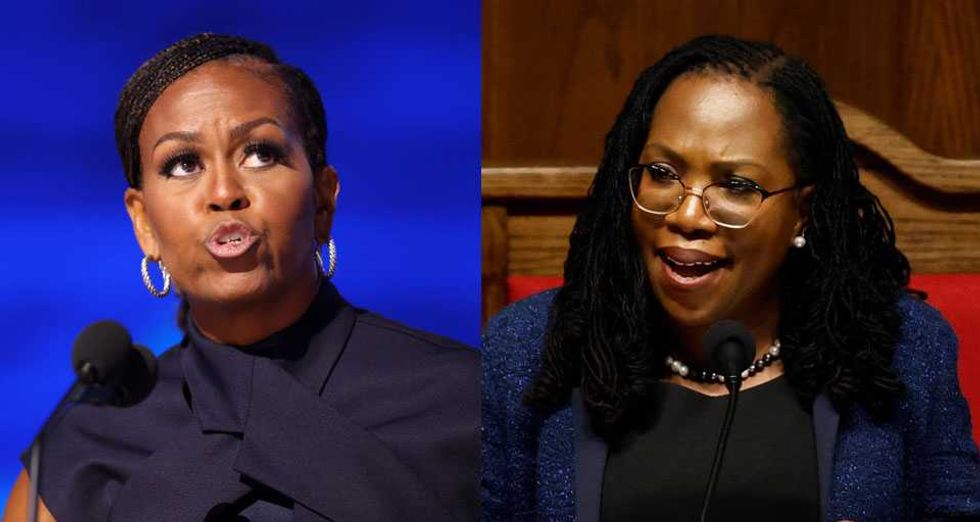
This week, U.S. Supreme Court Justice Ketanji Brown Jackson discussed with Michelle Obama, of all people, the importance of justices appearing impartial — and so far, the reactions to their conversation have been just about what you'd expect. She told the hosts on the Wednesday episode of "IMO with Michelle Obama & Craig Robinson" that "we all have to believe that there is a judicial system that is going to be fair, that is going to be neutral, that when you bring your dispute to the court, that judge doesn't have any pre-existing stake in the particular issue."'Can't make this up.'It's a surprising take, considering Jackson's background.For one thing, former President Joe Biden explicitly chose Jackson for the Supreme Court on the basis of her race and sex, though she said during her confirmation hearing that she could not define "woman" because she's "not a biologist." Jackson has also made a habit of penning bias-saturated jeremiads that have in some cases been extreme enough to raise the eyebrows of even other liberals on the bench. For instance, she:insinuated in her lone dissenting opinion in Trump v. American Federation of Government Employees that President Donald Trump was some sort of power-hungry menace and that those on the bench who failed to stop his "wrecking ball" were sycophantic enablers whose decision was both "hubristic and senseless";claimed in her dissenting opinion for Trump v. CASA Inc. that the Trump administration's request to address universal injunctions — which the high court found "likely exceed the equitable authority that Congress has given to federal courts" — amounted to a request "to engage in unlawful behavior";accused her colleagues in Students for Fair Admissions v. Harvard of "let-them-eat-cake obliviousness" for their colorblind approach and claimed that race-based college admissions address "the well-documented 'intergenerational transmission of inequality' that still plagues our citizenry" to the "benefit of us all"; andechoed LGBT ideologues in her lone dissenting opinion in Chiles v. Salazar, claiming that "a robust professional consensus now acknowledges that sexual orientations and gender identities range widely" and that reality-affirming therapy for trans-identifying kids was ineffective and harmful.Despite these opinions, Jackson and Obama seem to believe that Jackson has been a relatively neutral jurist. RELATED: Platner's replacement in Maine is a family man — just not in the way voters might expect Obama pressed Jackson about whether she has to closely monitor her exposure to news, media, and other content "so that there isn't a bias."After noting that certain individuals employed at the court screen her invitations for various appearances and events "to make sure that there are no ethical conflicts," Jackson replied that "there are lots of limits on what judges can do, and I try to be very, very mindful and scrupulous with respect to that because, as you say, our obligation is to be unbiased in our approach.""And, so, you have to then navigate all the sources that could make for an appearance of partiality, which you want to avoid," the Biden nominee continued. "So there are lots of things that I end up not accepting for that reason. News sources, I think, you know, I don't have a lot of time — unfortunately, you know — but I do, you know, the normal, general media sources are made available, and I think it's harder when you're talking about — there's so much social media now."Jackson's expression of concern about bias and perceptions of bias while in the company of a rank partisan like Michelle Obama struck some critics as insincere or at the very least tone-deaf.House Republican Conference Chairwoman Lisa McClain (R-Mich.) highlighted the cognitive dissonance, writing, "Justice Ketanji Brown Jackson says SCOTUS must avoid even the appearance of political bias ... while appearing on Michelle Obama's podcast."Sen. Marsha Blackburn (R-Tenn.) wrote, "Ketanji Brown Jackson finds a way to inject political bias into just about everything she does. Whether it's attending the Grammys, joining Michelle Obama's podcast, or refusing to define the word woman, she couldn't care less about remaining impartial.""DEI hire justice Ketanji Brown Jackson says she's careful about which public engagements she accepts because she has to be impartial ... As she appears on MICHELLE OBAMA's podcast," Libs of TikTok tweeted. "Can't make this up."Like Blaze News? Bypass the censors, sign up for our newsletters, and get stories like this direct to your inbox. Sign up here!
The right-wing media ecosystem that has spent years building up President Donald Trump's image and promoting his causes is now splintering, according to a new report.Many of the most prominent right-wing personalities have seen their platforms shrivel up, according to an analysis by The New York Times published on Friday.Podcaster Benny Johnson has lost millions of YouTube views since Trump's re-election high, while Dan Bongino's livestream audience has shrunk by roughly half since he briefly left broadcasting to serve as FBI deputy director before resigning months later. Ben Shapiro's YouTube numbers cratered from 27 million weekly views in 2024 to about 4 million, and his outlet The Daily Wire has seen web traffic collapse by half. Nick Fuentes, architect of the neo-Nazi "Groyper" movement, admitted in an email last year, “It seems that everyone in the space is experiencing a drop-off in views from 2025.”One of the very few exceptions who has managed to buck the trend is Candace Owens, a far-right influencer who has maintained relevance by seizing on a string of conspiracy theories — including many about fellow influencers on the right, like the murder of Charlie Kirk supposedly being a covert operation by shadowy world-spanning forces.Experts say the shake-up stems partly from Republicans controlling Washington, making it harder to stoke the outrage that fueled these creators' rise, along with new competition from apolitical influencers pulling audiences toward gaming and lifestyle content. A growing split between pro- and anti-Trump voices on the right — supercharged by backlash to Trump's war with Iran — has only deepened the fractures, with once-loyal figures like Fuentes turning openly critical of the president.Media watchdogs warn the splintering couldn't come at a worse time for Republicans, who've relied on a unified influencer army to drive turnout each election cycle. With the midterms looming, GOP strategists may soon find out whether a fractured MAGA media machine can still deliver votes.Ryan Broderick, who runs the Garbage Day newsletter covering online culture, bluntly said, “A lot of the propaganda that they’re pushing out just isn’t really connecting the way it would have even three or four years ago” — a danger sign for the GOP in the midterms.
President Donald Trump's preoccupation with personal legacy projects frequently disrupts official business, according to New York Times reporter Maggie Haberman. Speaking to colleague Ezra Klein, Haberman said, "This I will say about getting into his mind: Seventy percent of it would be on his renovations." "It’s a legacy thing... It’s, 'What am I leaving behind so the world can’t kick me off the world or deplatform me or take my name off buildings in Manhattan or take away my Bronx leased golf course?'"Trump's monument fixation has prompted strange interruptions during meetings, Haberman explained, including contemplating whether to place a gold "fight, fight, fight" fist from Butler atop a planned arch. In another instance, Trump called French President Emmanuel Macron mid-meeting to ask about the Arc de Triomphe, asking if it has a visitor's desk and if people jump off it. Haberman noted Trump views these projects as essential to his historical legacy, to be "remembered by one name" with a distinctive mark on the world. "That doesn’t involve the boring work of trying to pass a bill," Haberman added, "That doesn’t involve the boring work of going to Iowa...This is fundamentally less interesting to him."Watch the video below. Your browser does not support the video tag.
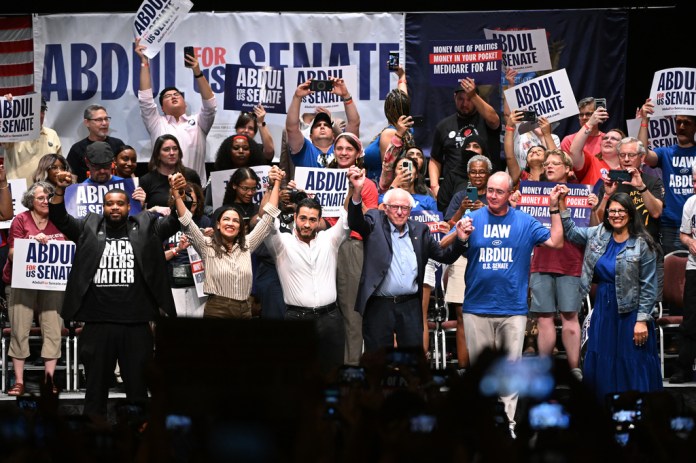
They’re not elected to Congress yet, but the socialist candidates who won Democratic primaries earlier this year have already hit the campaign trail to stump for like-minded candidates across the country in an effort to reform the Democratic Party image. Ahead of the Aug. 4 primaries in Michigan and Missouri, candidates backed by the Democratic […]
Sen. Bernie Moreno (R-OH) was confronted about the brutal domestic violence allegations against his son-in-law, Rep. Max Miller — but couldn't say whether they're disqualifying.His daughter, Emily Moreno, has accused Max Miller, her ex-husband, of abuse in court filings and police records, alleging he burned her with hot water, held a gun to her head, shoved her hard enough to cause injury, and broke their daughter's collarbone. Her lawyers filed for a new restraining order against Miller this week, also alleging he harassed her attorneys and physically placed his hands on one of them.Miller is also facing a lawsuit alleging he broke the terms of his own hush deal, and this week, Emily Moreno filed a restraining order against him, revealing even more allegations.Asked directly whether Republicans should yank Miller off the November ballot, Moreno gave a two-word non-answer, according to NOTUS."I don't know," Moreno said.Miller, for his part, continues to deny all allegations and filed a lawsuit against Emily Moreno for defamation. He also made a counter-charge of domestic violence against her, but dropped that case this week amid growing backlash.Republican leadership has largely remained silent on the matter, but faces growing pressure to try to remove Miller from the ballot, as the deadline to do so is rapidly approaching and his suburban Cleveland congressional district might be vulnerable with him continuing to run.