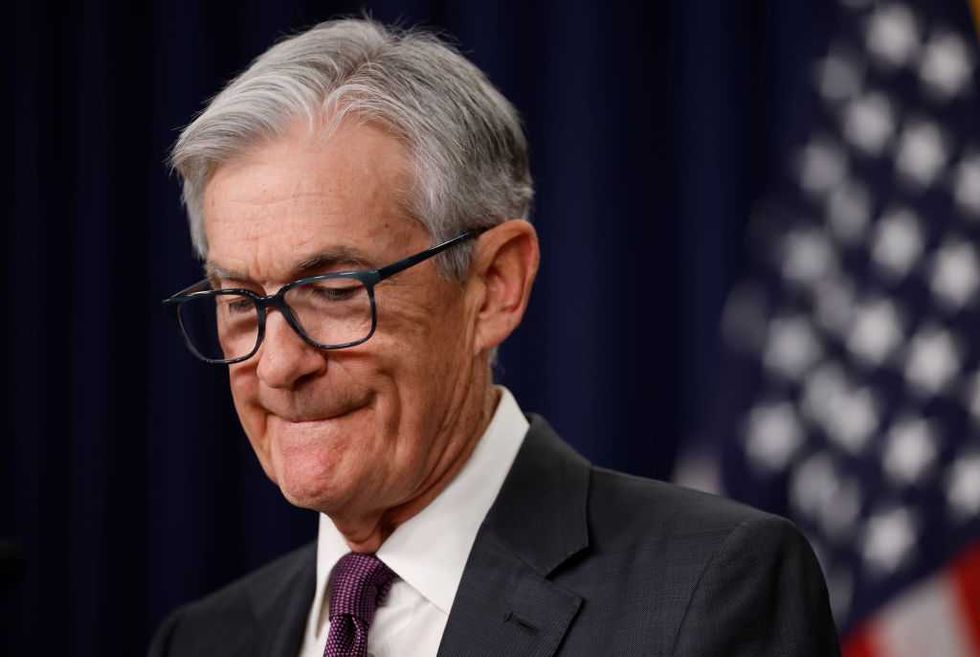
Jerome Powell's out and for good reason. Here are 4 of his top blunders.
Source: Blaze Media · Bias: Right
Summary
Kevin Warsh, the primary intermediary between the Federal Reserve and Wall Street during the 2008 financial crisis, was confirmed on Tuesday to a 14-year term as Federal Reserve governor and confirmed on Wednesday as Jerome Powell's successor as chairman of the U.S. central bank.Powell, who was first nominated to the Federal Board of Governors by former President Barack Obama and whose term as chair ends on Friday, wished Warsh well. However, he also provided his replacement with something more valuable than a nice sentiment: examples of what not to do, or at least, what to avoid doing. Powell has, after all, dropped the ball on numerous occasions — sometimes with catastrophic consequences for the country. Here are just four examples.1. Don't worry, it's 'transitory.'Powell stated on March 4, 2021, in the second year of the pandemic, that inflation might increase but that it would likely be "transitory" and not enough for the central bank to raise record-low interest rates — a decision some suspect was geared toward pleasing then-President Joe Biden and thereby securing Powell's reappointment.'Most of the expected GDP slowdown — from over 3% to 1.5% — was due to Powell's blunder.'MarketWatch's Greg Robb noted that Powell's wrong-headed "transitory" view of inflation — one that would define his eight years as Fed chair — precluded the Fed from raising interest rates until 2022 while the Fed was also buying up bonds "and swelling its balance sheet." Thanks to Powell's mistake — which economist Mohamed El-Erian, former PIMCO chief executive, said was "probably the worst inflation call in the history of the Federal Reserve" — the Fed was consistently on the back foot.RELATED: Your bank can shut you down overnight — here’s how to protect yourself Elif Acar/Anadolu/Getty ImagesFacing the highest inflation Americans had seen in 40 years — inflation that no longer appeared to be "transitory" — Powell ended up raising interest rates 11 times between March 2022 and July 2023, when its benchmark rate reached a range of 5.25% to 5.5%.Powell told "60 Minutes" in a Feb. 1, 2024, interview:In hindsight, it would've been better to have tightened policy earlier. I'm happy to say that. Really, it was this. We saw what we thought was that this inflation, which seemed to be mostly limited to the goods sector and to the supply chain story. We thought that the economy was so dynamic that it would fix itself fairly quickly. And we thought that inflation would go away fairly quickly without an intervention by us. That it would be transitory.Powell leaves office with inflation well above the Fed's 2% target for five consecutive years.2. Betting against Trump's tariffs, tax cutsWhile reluctant initially to raise interest rates when Biden was in office, Powell previously demonstrated an eagerness to raise rates in 2018 when President Donald Trump was in office and the economy was booming."Every time we do something great, he raises the interest rates," Trump said at the time. Powell "almost looks like he's happy raising interest rates."The repeated hikes, which Trump blamed for coinciding stock market turmoil, were supposedly prompted by concerns that the Republican president's tariffs and tax cuts, the latter of which were framed as a $1.5 trillion fiscal stimulus, might together contribute to inflation. Powell stated that "fiscal policy is becoming more stimulative. In this environment, we anticipate that inflation ... will move up this year."Economist Donald Luskin, chief investment officer for Trand Macrolytics LLC, recently noted that "there is no evidence that Mr. Trump’s tariffs in 2018 and 2019 led to any inflation at all."Economist and Trump trade adviser Peter Navarro wrote last year, "Powell's audition for 'worst Fed chair' began shortly after his February 2018 appointment. Promising President Trump in the Oval Office a supportive posture to secure his nomination, Powell instead aggressively raised rates into the low-inflation, high-growth Trump economy. Powell wrongly believed Trump's tax cuts and tariffs would spark inflation — they didn't."Powell's bet against Trump's tariffs and tax cuts proved consequential."As Powell's Fed hiked interest rates four times in 2018 — despite muted inflation and strong labor market gains — economic momentum slowed sharply," wrote Navarro. "According to the Fed's own September Tealbook, most of the expected GDP slowdown — from over 3% to 1.5% — was due to Powell's blunder.""It would cost the American economy hundreds of thousands of jobs and hundreds of billions of dollars in lost economic output and tax revenues," added the trade adviser.3.
Related Coverage
- Trump, ballot seizures and a ‘declaration’: Gavin Newsom teases tiresome July 4 address to the state (Right — New York Post)
- ‘The second-most good-looking president’: Trump entertains on Usha Vance’s program (Far Right — WorldNetDaily)
- Wes Moore: Trump on July 4 has ‘tried to make this moment about him’ (Center — The Hill News)
- Europe Has Replaced Most US Cuts Within NATO, Top Commander Says (Center — Bloomberg Politics)
- Mamdani blasts ICE agents, Elon Musk and 'supremacy' in America 250 speech ahead of July 4 weekend (Right — Latest Political News on Fox News)
- Of course Mamdani takes opportunity to blast America in July 4 speech focused on ‘flaws’ (Right — New York Post)
- How the world's top AI models were revived (Center Left — Axios)
- Heat Wave Forces Washington, DC to Alter July 4 Festivities (Center Left — NBC News Politics)
Daily Analysis
Read the full Parallax Pulse for May 13, 2026 — an AI-powered analysis of how Left and Right media covered the biggest stories this day.