A Pennsylvania state representative is calling out Democrats after he was kicked off the House floor for wearing patriotic clothes. Rep. Eric Davanzo showed up to work […]
Resistance is mounting across the United States against the increasing use of surveillance tech company Flock Safety’s cameras, with a growing number of cities canceling contracts as the artificial intelligence-powered license plate readers are quietly being installed in thousands of locations nationwide.State and local police departments first used the Atlanta-based company’s automated license plate reader (ALPR) systems for standard law enforcement purposes, but they are now being employed for a much broader range of uses, including immigration-related searches and other actions supporting US Immigration and Customs Enforcement (ICE) during the Trump administration’s deadly anti-immigrant crackdown.“We have cameras that are used for everything from illegal dumping to drug houses to hotels that are just big problems,” Flock Safety engineer Kevin Cox told prospective customers during a demonstration of the company’s Condor Camera, according to a Thursday report in The Washington Times.“There are endless, endless uses for what we can do with these things,” Cox added.Those uses include spying on constitutionally protected protest activity and enforcing abortion bans by tracking pregnant people’s travel across states—even ones in which the medical procedure is legal.The ACLU—which recently launched a “Get the Flock Out” campaign to “fight creepy ALPR cameras”—says there are currently between 80,000 and 100,000 Flock devices installed nationwide that conduct more than 20 billion scans per month. More than 5,000 law enforcement agencies use the cameras, and some of them keep their locations a secret.“Flock’s ALPR cameras aren’t like your normal traffic cameras,” the ACLU explained. “This surveillance technology records and tracks every car that comes into view, and then an AI algorithm catalogs the make, model, color, license plate number, bumper stickers, and even scratches. This personal information is then uploaded into a nationwide database that any law enforcement agency with a Flock contract can search—with few regulations or oversight on how they use what they find.”The backlash against creeping state surveillance has even transcended the partisan divide.“I think our country is in a kind of uniquely anti-surveillance environment right now, which is to say that, in a time where it seems there is nothing that is not partisan, opposition to government surveillance is nonpartisan,” ACLU privacy and surveillance attorney Chad Marlow told The Washington Times on Thursday.There is growing action—both legal and otherwise—to end the use of ALPRs across the country.According to the public information project Ban Flock Cameras, 82 Flock contracts were terminated across 28 states between August 2021 and May 2026, with 39 of those cancellations occurring in the first five months of 2026 alone.Even Amazon-owned Ring announced earlier this year that it would stop doing business with Flock Safety.Susie O’Hara, a member of Santa Cruz, California’s nominally nonpartisan City Council, told WBUR earlier this year that she grew increasingly concerned about local use of eight Flock cameras last year after learning that police were sharing data gleaned from the cameras with the company’s national network without city officials’ knowledge, a violation of state laws banning the practice.O’Hara became increasingly convinced that Santa Cruz should cancel its Flock contract after an ICE agent fatally shot Renee Good, a US citizen, in Minneapolis in January.“I have goose bumps on my arms thinking about the absolute chaos that was happening in Minneapolis,” she said. “And just the absolute insanity of what we were seeing... It was totally clear to me that we should in no way consciously be in this system at all—just no way.”Less than a week after Good’s killing, the Santa Cruz City Council voted to terminate the city’s Flock contract, becoming the first municipality in California to do so.“For us, the threat to our civil liberties was greater than any benefit we could get from the flawed product,” Santa Cruz Mayor Fred Keeley told KQED at the time.Chad Kemp, who represents District 32 on the nonpartisan Dane County Board of Supervisors in Wisconsin—which in April voted to stop funding two dozen cameras leased from Flock—told The Washington Times that “there’s a public safety issue here, but there is also a privacy issue.”“There are serious concerns about individuals who can be monitored without their knowledge, or if it is even constitutional or ethical to track people without a warrant,” he added.At the national level, US Reps. Robert Garcia (D-Calif.) and Raja Krishnamoorthi (D-Ill.) last year launched an investigation into the use of Flock cameras to track pregnant people across state lines for abortion care and to conduct unauthorized immigration enforcement operations.Krishnamoorthi and Sen.
People across the country are preparing to celebrate America’s 250th birthday this weekend — a process that has been made more challenging as event organizers scramble to deal with the extreme heat. President Trump is headed to South Dakota late on Friday, where he’s expected to make remarks at the Mount Rushmore National Memorial and…
As Americans prepare to celebrate the country’s 250th birthday this holiday weekend, organizers of Freedom 250 events in Washington are scrambling to deal with the extreme heat. Some 200,000 people have attended the Great American State Fair and FIFA Fan Fest so far, according to a Freedom 250 spokesperson, and even more are expected to…
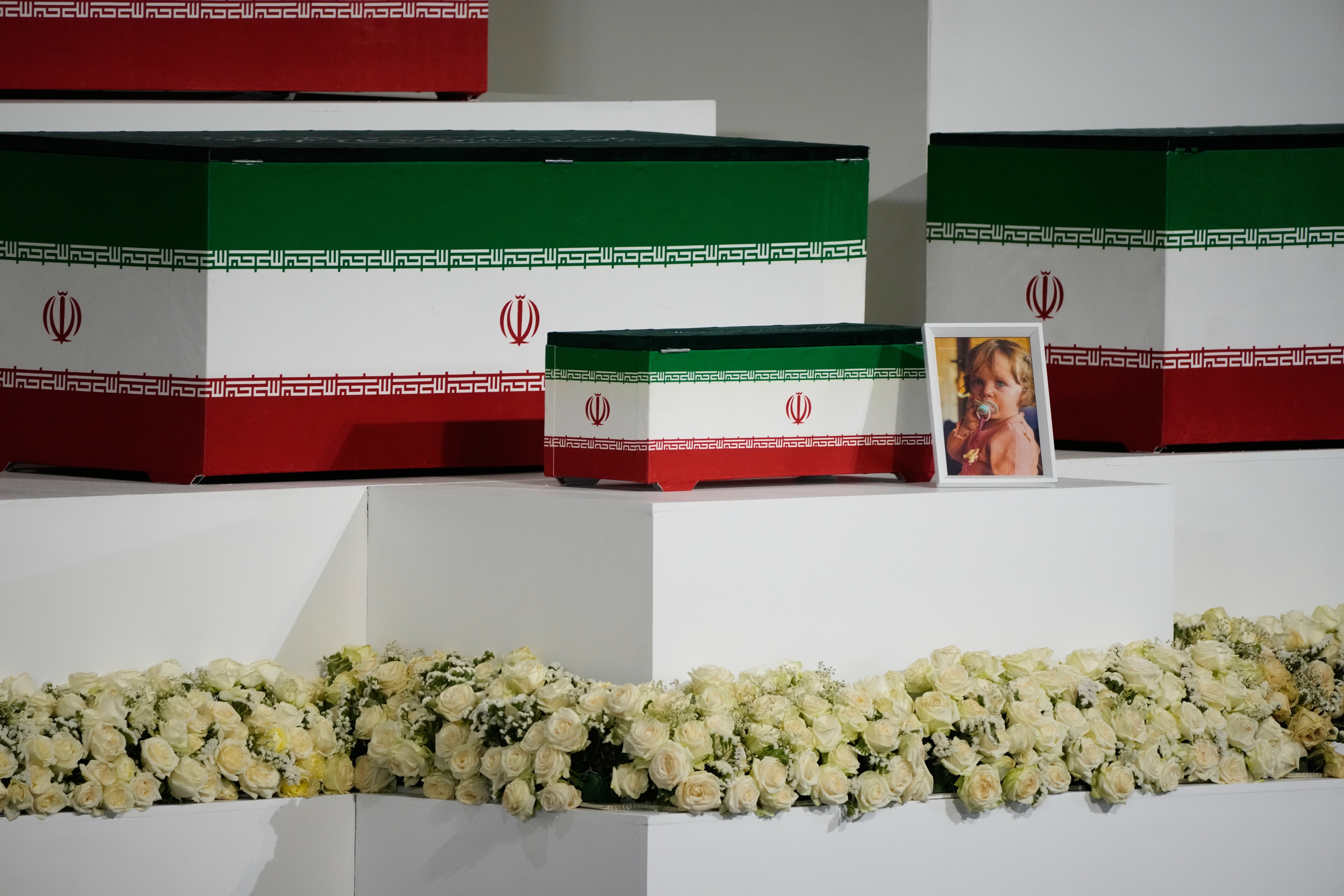
The country's theocracy hopes to see millions flood the streets of the capital beginning Saturday in scenes reminiscent to the burial of the late Supreme Leader Ayatollah Ruhollah Khomeini in 1989.
Democrats are preparing a hostile audit of President Trump and his inner circle, intent on exposing — and ultimately ending — the most lucrative presidency in American history.Why it matters: Since winning the 2024 election, Trump has operated in a Wild West of his own making — monetizing the office to the tune of billions, while enabling family, friends and donors to cash in along the way.He and the White House have denied any conflicts of interest. Republicans, who spent years investigating the Biden family's business dealings, have shielded Trump from the same scrutiny.But Democrats see the presidential gold rush as corruption personified — and plan to bury Trump's orbit in subpoenas if they win the House in November's midterms.Zoom in: Trump's $2.2 billion financial disclosure is a 927-page roadmap for the coming investigations, itemizing every known venture that made 2025 the richest year of his life.A crypto business that barely existed when Trump took office minted him roughly $1.2 billion — eclipsing, in a single year, the real estate empire he spent decades building.His biggest single payday was $635 million in royalties from the $TRUMP meme coin, which has crashed roughly 95% from its inauguration-week launch — destroying billions for the small investors who bought in.Trump also reported tens of millions from legal settlements with major media and tech companies, plus new income from branded watches, sneakers, Bibles, fragrances and foreign licensing deals.Zoom out: For Democratic investigators, the ripest targets are the people around Trump: family, appointees and allies who, unlike the president, can be compelled to testify under oath.World Liberty Financial, the crypto venture launched by the Trump and Witkoff families, has become a magnet for foreign money, including a secret $500 million investment from a senior Emirati royal.A New York Times investigation found that Donald Trump Jr., Eric Trump and the sons of Commerce Secretary Howard Lutnick have ties to at least 14 companies seeking $8.9 billion in federal support for critical-minerals deals.Jared Kushner, Trump's son-in-law, has raised billions from Gulf governments while leading Middle East peace talks. In Albania, Kushner's firm won "strategic investor" status for a $1.4 billion luxury resort on a protected island — igniting mass protests dubbed the "flamingo revolution."What they're saying: Trump dismissed criticism of his financial disclosure on Wednesday, telling reporters his money is run by outside advisers in what he called a "blind account.""Everybody is profiting," Trump said, because "the stock market's going up."In a CNBC interview Thursday, Trump said he didn't know about many of the crypto gains disclosed in the filing because his son Eric and outside firms handle his investments. But he also argued that even if he had known, "there's nothing illegal with that," saying presidents cannot realistically recuse themselves from every decision that might affect their finances.Reality check: Trump's defense focuses on who manages his investments. Democrats are preparing to scrutinize the much bigger ecosystem around them: a portfolio that made more than 21,000 securities transactions in 2025, a family crypto empire, foreign business deals and other ventures that expanded alongside his presidency.The explanation also sidesteps broader ethics questions, including Trump's acceptance of a $400 million Qatari jet that entered service as Air Force One on Wednesday.Trump plans to keep the luxury plane — the largest foreign gift in U.S. history — for his presidential library after he leaves office.White House spokesperson Anna Kelly said in a statement: "President Trump only acts in the best interests of the American public — which is why they overwhelmingly re-elected him to this office, despite years of lies and false accusations against him and his businesses from the fake news media. There are no conflicts of interest."The big picture: Scrutiny of Trump's finances comes amid a growing anti-billionaire current in U.S. politics, exacerbated by a cost-of-living crisis the president repeatedly has downplayed.The number of democratic socialists in Congress is poised to more than double after the midterms, giving the left's anti-oligarchy message a bigger platform inside the Democratic Party.Sen. Jon Ossoff (D-Ga.) has made corruption the central theme of his re-election message, drawing 2028 chatter for his viral speeches detailing the Trump family's foreign windfalls.For Democrats, the bet is that Trump's profits can become part of a broader affordability argument: Washington works for the well-connected, while everyone else pays the price.The bottom line: It's no secret that Democrats intend to make life miserable for Trump and his inner circle if they win the midterms."They will turn every committee of Congress into an investigative body, and they'll go after the president's family, the Cabinet, his donors and friends," House Speaker...