
RealClearPolitics - Homepage
Platner & 'New Wave Left' Detest Western Exceptionalism
Graham Platner would have been dismissed as unacceptable in the Democratic party just a decade ago.
Center Right

Platner, who is married and faces a primary-election race Tuesday, was accused last week of allegations of deeply disturbing behavior toward female partners and him harboring fantasies about raping home intruders.
Graham Platner would have been dismissed as unacceptable in the Democratic party just a decade ago.
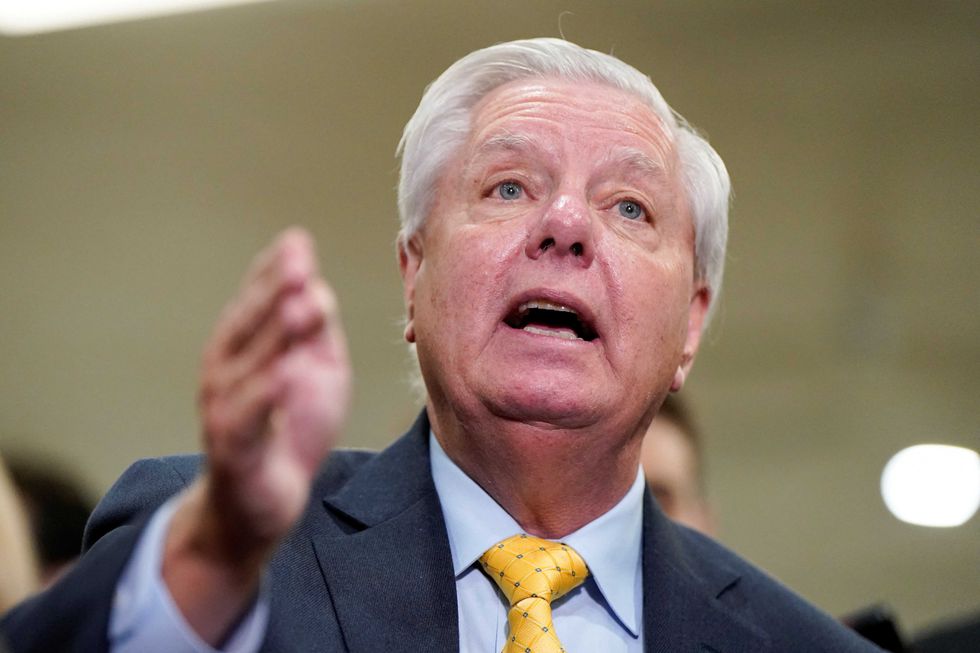
With his grip on the South Carolina Republican primary suddenly less certain than anyone anticipated, Sen. Lindsey Graham (R-SC) is calling in the biggest favor he has — President Donald Trump.Graham announced Monday that Trump has agreed to join a last-minute tele-rally Monday evening ahead of Tuesday's GOP primary, urging supporters to dial in at 5:30 p.m. "I'm proud to be endorsed by President Trump, and I'd be honored to have you join us for a Tele-Rally TONIGHT at 5:30 PM," Graham wrote on X.The move underscores an uncomfortable reality for the four-term incumbent: heading into Tuesday's vote, Graham cannot be certain he will clear the 50% threshold South Carolina requires to avoid a June 23 runoff.The most recent polling tells a mixed story. A late-May Citadel Poll of likely Republican primary voters had Graham at just 46% — four points short of the runoff barrier — with challenger Mark Lynch at 36%. A Trafalgar Group survey conducted around the same time showed a more comfortable 52%-28% edge, and a poll released Saturday by The Public Sentiment Institute put Graham at 51% to Lynch's 26%.The wild card is Graham's hawkish support for the U.S.-Israel war against Iran. Lynch has made it the centerpiece of his challenge, arguing Graham is focused on prolonging a conflict South Carolinians are growing tired of. "People are tired of him getting [the United States] into endless, needless wars," Lynch told the Christian Science Monitor in a piece published Monday.The TPSI poll found that among voters who believe Israel has too much influence in American politics — roughly 36% of the Republican electorate — Lynch actually led Graham, 37% to 33%.Graham has shown no sign of backing down. "If you're scared of losing your job, you cannot be a very good senator," he told the Post and Courier, according to the Christian Science Monitor.Trump formally endorsed Graham on June 4, urging South Carolina Republicans to vote for him, and Graham has leaned hard into that alliance. But with Lynch self-funding his campaign to the tune of $5 million and anti-establishment energy running high, Trump's voice on a phone line may be the deciding factor between a clean win and two more weeks of political headaches for the Palmetto State's senior senator.
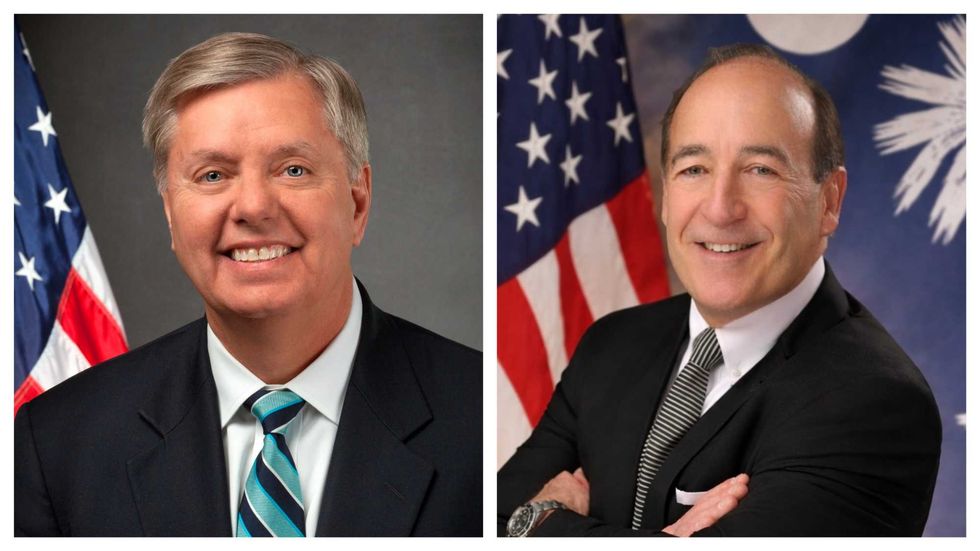
Sen. Lindsey Graham, an enthusiastic backer of President Donald Trump’s war in Iran, faces an anti-interventionist insurgency at home in South Carolina, where he’s fending off a challenge from businessman Mark Lynch in the state’s June 9 primary.A self-styled “America First” candidate, Lynch has attacked Graham by calling him a “warmonger” who cares more about “a fancy ballroom than he does your sons and daughters dying in the Middle East.”Differences over foreign policy aside, Lynch’s candidacy taps into the more extreme tradition of far-right politics, compared to Graham’s relative moderation.Graham is running with the endorsement of Trump, who dismissed Lynch as a “lunatic” while expressing annoyance that Graham’s challenger supported Rep. Thomas Massie (R-KY), a critic of the war against Iran.“Mark Lynch would be a DISASTER for the Republican Party, and Lindsey Graham just, GETS THE JOB DONE,” Trump wrote on his Truth Social platform.Lynch has racked up endorsements from retired Lt. General Michael Flynn, Trump’s former national security advisor; former Border Patrol chief Gregory Bovino; Joe Kent, former director of the National Counterterrorism Center; Turning Point USA spokesman Andrew Kolvet; and Ivan Raiklin, the self-styled “secretary of retribution.”Graham has become a target of anger for the restive MAGA faction, which sees the war with Iran as a betrayal of Trump’s promise to avoid getting the United States into new wars. Among Trump’s Republican allies in Congress, Graham distinguished himself by urging the U.S. to seize Iran’s Kharg Island and saying he would be willing to send South Carolina’s “sons and daughters” to the Middle East.Speaking at an anti-war rally in Michigan last month, Raiklin dangled a red cap inscribed with the words “Dump Lindsey” from a mic stand.“Do you want your president listening to Lindsey Graham?” Raiklin asked.“No!” the crowd thundered in response.“If you’re in South Carolina, primary this scumbag,” Raiklin said, “so he’s no longer golfing down at Mar-a-Lago promoting the war machine.”The Graham campaign did not respond to questions concerning this story.Lynch, who trails Graham by about 20 points in recent polls, has attempted to strike a delicate balance between supporting Trump and appealing to the MAGA dissidents.“I believe that the job of a U.S. senator is to uphold their oath to the Constitution, represent the interests of the constituents, and promote America First principles,” Lynch told Raw Story. “And I would support everything President Trump does to those ends.”At the same time, Lynch is staking positions markedly to the right of Graham by vocally supporting white Christian nationalism, while embracing a theocratic doctrine that critics view as anti-constitutional.Lynch has used his X account to argue that “white replacement is real,” while expressing agreement with a call for religious exclusion by a violent Jan. 6 rioter who has faced multiple criminal charges since Trump pardoned him for his conduct at the Capitol.During an angry tirade directed at a city council in the Dallas suburbs last month, Jake Lang accused the city of replacing “white people” with Muslims and Hindus, while declaring that the United States “is a Christian country” and suggesting that Muslims and Hindus can’t be Texans.“Gotta say, I agree with Jake Lang here,” Lynch wrote on X.Asked how he reconciles Lang’s views with the First Amendment guarantee of freedom of religion, Lynch told Raw Story, “Islam is not a religion; it is a theocratic construct that should be banned in the United States.”Lynch’s friendliness with Lang and other Jan. 6 rioters who participated in the insurrection at the U.S. Capitol lines up with his ultraconservative activism as founder of a group called United Patriots Alliance that has promoted the controversial “doctrine of lesser magistrates.”Lynch introduced the Rev. Matthew Trewhella, a Wisconsin pastor who popularized the doctrine, during an event sponsored by United Patriots Alliance in Greer, S.C. in September 2024.Trewhella, who advocates for the criminalization of abortion and homosexuality, described the doctrine in an interview with United Patriots Alliance tactical strategist Ethan Mulch as holding that “when the higher-ranking civil authority makes unjust or immoral law, policy, or court opinion, the God-given right of the lesser civil authority is not to obey.“They’re to stand between the tyranny of the superior civil authority and the people they represent,” Trewhella continued. “It’s called interposition. You can do it verbally, or physically, or both. And it’s massively needed in our day.”Trewhella published his book, The Doctrine of the Lesser Magistrates, in 2013 following more than two decades in the anti-abortion movement.

The scandal-plagued Maine Democrat has no record to run on, so voters have only his word. But he has left them no reason to trust anything he says.

Platner's rocket to stardom reflects something ugly that's developed, not only on the right but the left as well. As of Wednesday morning this week, even after his sexting scandal broke, I knew two things about Maine Senate candidate Graham Platner: I was glad I didn't have to vote in Maine, and that if I did, I would probably hold my nose and vote for Platner.

Many are sticking by the presumptive Democratic Senate nominee Graham Platner. But some have soured, and others are anxious about how recent revelations could affect a close race.

I’m guessing you have a pretty good idea of what Graham Platner was getting up to last week—fending off yet another round of allegations about his character. But what about Susan Collins, Maine’s incumbent GOP senator and the person almost sure to be Platner’s opponent this November? You probably didn’t hear a word about her. The only significant news story of the week in which she figured (aside from being mentioned in all the Platner stories) is that she cast her 10,000th consecutive vote in the Senate—a milestone, to be sure, but something of a double-edged one as it serves to remind voters that she’s been in the Senate since Christ left Chicago.This is just how Collins wants things. As long as the subject is Platner’s boozing and his ex-girlfriends, Collins may skate to reelection. So, the key thing Platner has to do, assuming he wins tomorrow’s primary and stays in the race, is to maneuver things such that come October, the topic is Collins’s record, not his past.We’ll get to that record in a bit, but first, let’s deal with the Platner question. Two big stories came out last week. The first was about his sexting with several women in the early days of his current marriage. He married Amy Gertner in 2023. Early in the campaign, Gertner told an aide who was a friend about the messages, and the friend—now presumably an ex-friend—told a lot of people and shared some screen grabs with The New York Times. Gertner denounced the friend, Genevieve McDonald, and defended her husband and marriage. On that one, I think your average person would say Well, if his wife doesn’t care, why should I?The second story was potentially more damaging and concerned Platner allegedly twisting the arm of a former girlfriend and slamming a door shut on her; also, that he “regularly grabbed her by the shoulders,” according to The New York Times, which broke the story last Thursday. It’s disturbing, no doubt. It’s worth noting that this woman is, or was at the time, apparently a very committed conservative Republican—the cofounder of “Ladies for Kavanaugh,” which she formed to confront what she termed the “baseless, 11th-hour accusations orchestrated to stop [the justice’s] confirmation.” (One question the Times left on the table but crossed my mind and maybe yours was how Platner could have said “you are literally everything to me” to someone who, according to Newsweek, worked at the Heritage Foundation at the time.)Two other exes told the Times of similar treatment from Platner. On the other hand, “several” other exes (dude got around!) described him as “a fun and caring partner,” and some remain friends with him to this day. Platner denies all the physical stuff, so someone is lying.Personally, I don’t know what to make of the guy. I suspect he’s not telling the truth about his Nazi tattoo and I’d bet you that he knew what it meant, but I also don’t think that makes him a Nazi. He has obviously lived a life that we would at the very least call picaresque. Balzac would have had fun with him. There’s also the question of, as it is often said in politics, what else is out there. Any good campaign—and Susan Collins does run good campaigns—knows to sit on the really bad stuff until after Labor Day, although campaigns can’t always control when things are disclosed, and anyway, all the revelations about Platner seem to be coming from establishment Democrats who are unnerved by his lefty swagger.There’s a lot we don’t know, and a chance we’ll find out all about it. I do, however, know these two things. One, Platner is almost certain to be the Democratic nominee. Two, short of revelations involving murder, rape, or a taste for child pornography, Platner needs to be backed by Democrats to the hilt. That may seem like a really low bar, and maybe it is. But I’m less interested in his personal life than I am in Collins’s public one, because that’s what really matters here.So let us now return to the question of Collins’s week. The Senate cast a bunch of votes last week. And Collins did what she always does when she’s up for reelection—she voted with the Democrats on the ones people pay attention to, and as a Republican on the others. There were a number of votes related to Donald Trump’s $1.8 billion slush fund. On most of those, like this one for example, she was one of maybe two or three Republicans (Thom Tillis and Bill Cassidy, who are both retiring) voting with the Democrats. On other less highly visible matters, though, she went with her party and with Trump. Last Wednesday, the Senate rejected a resolution that would have overturned Trump’s rollback of Biden-era emissions standards for coal- and oil-fired power. She went party-line on that one. The day before, she voted to confirm a federal judge for Kansas who, at his confirmation hearing, refused to say that Trump lost the 2020 election. Ah, judges: This brings us to where Platner needs to direct attention in this campaign.

Recent Supreme Court decisions have eased the way for states to enact more partisan gerrymanders. Now legislatures are racing to redraw their congressional maps in rare mid-decade redistricting efforts that may reconfigure the calculus of who will win the majority in the U.S. House of Representatives after the midterm elections this November.These endeavors were inspired by President Donald Trump, whose exhortations last year for Texas lawmakers to redraw their maps in favor of his party kicked off a frenzy of tit-for-tat redistricting from both GOP-controlled and Democratic-led states, with Republicans in particular benefiting under the aegis of the conservative-majority Supreme Court. Meanwhile, Trump has successfully challenged some of the GOP state legislators that stood in the way of his redistricting plan, supporting primary opponents more likely to follow his bidding.Legal experts worry that the end result of this partisan gerrymander scramble will be a reduction in fair representation in the U.S. House, with Republican voters in blue states and Democrats in red states less likely to have their voices heard. Moreover, Democratic-leaning nonwhite voters could see their political power considerably diluted—if not wiped out entirely in the red states racing to delete majority-minority districts.“By 2028, I think we are likely to be looking at a radically and maximally gerrymandered national map, in which blue states elect almost entirely blue delegations, red states elect just about entirely red delegations,” worried David Daley, a senior fellow at the civic organization FairVote and the author of Ratf**ked: Why Your Vote Doesn’t Count. “It’s the kind of map we’ve seen before in this country. It’s just that back then, we called it the Union and the Confederacy.”Since Trump called on Texas to redraw its maps last year, several states have undertaken this process, resulting in new districts ahead of the midterms. These efforts could add up to a dozen or more new Republican House seats after the November elections. Although some Democratic states—notably California, the most populous state—have punched back, other efforts have been rebuffed. An attempt to redraw Virginia’s electoral map to add new Democratic seats in 2026 was struck down by the state Supreme Court. Meanwhile, both Republican- and Democratic-majority states will take up redistricting ahead of the 2028 cycle. (In their gerrymandering efforts, some Democratic-led states have argued that this is a temporary measure intended to counter Republican mid-decade redistricting.)Omar Noureldin, senior vice president of policy and litigation at Common Cause, a government watchdog group that supports national redistricting reform, said allowing politicians to “choose their voters” would skew lawmakers’ incentives away from the constituents they purport to represent.“When politicians don’t believe that there is accountability, that allows for those politicians to advance either their personal interests or very narrow political interests—by the wealthy, the well-connected, corporations,” said Noureldin. As a result, he continued, Congress will become “less and less responsive to the needs of everyday Americans.”In April, the Supreme Court’s decision in Louisiana v. Callais weakened the 1965 Voting Rights Act, making it much more difficult to challenge partisan gerrymanders that dilute the power of minority voters. Piling onto the preexisting map-redrawing efforts in states such as Ohio, Texas, and Missouri, additional GOP-controlled Southern states moved this spring to redraw their congressional maps with the goal of reducing the number of Democratic districts. This will result in reduced representation for Black voters.In early June, the Supreme Court paved the way for Alabama to eliminate one of two majority-Black districts, in an unsigned shadow-docket decision. This proposed map had been struck down by a lower court, which included two Trump-appointed judges. To Kareem Crayton, a vice president for the Brennan Center for Justice, a think tank focused on democracy and voting rights, this decision demonstrates how the conservative majority on the court believes drawing maps to benefit Republicans is wholly divorced from how it might affect minority voters—who overwhelmingly vote for Democrats.“This court seems way more attentive to the concerns of protecting power than they are to the Constitution’s attention to assuring that voters have their say,” said Crayton.The current race to gerrymander congressional districts is not unprecedented in the modern era. Republicans underwent a concerted effort ahead of the 2010 election to win state legislative majorities with the goal of controlling redistricting after that year’s census.