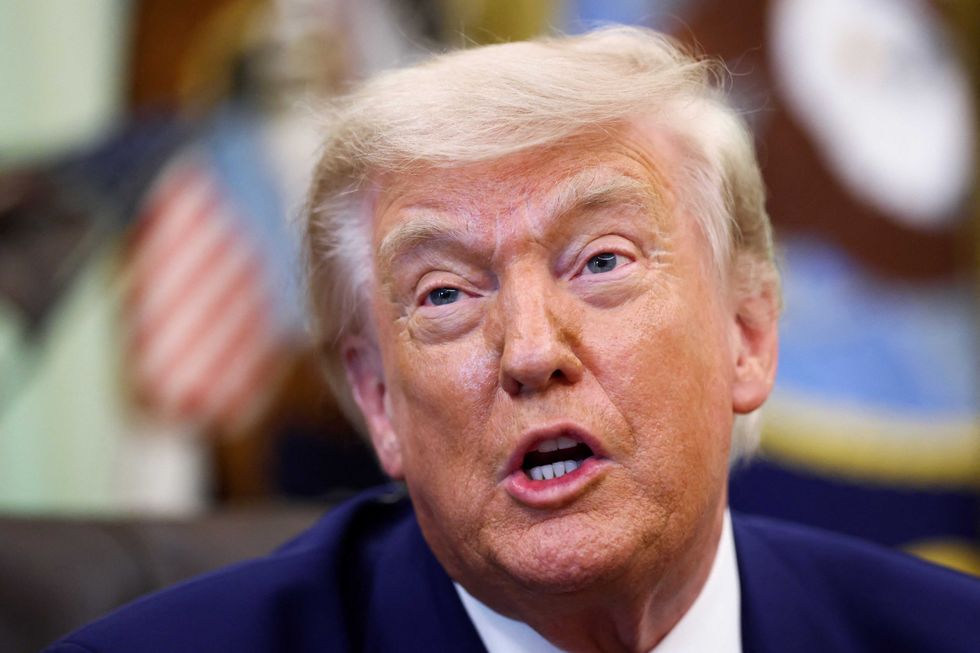
If there is a single idea that President Donald Trump holds with conviction, it is that the 2020 election was stolen.Millions of Americans agree with him. How it was stolen, and by whom, is still being investigated six years later. That is a problem, because another national election arrives this fall, and Americans deserve an answer as to whether the way we now conduct elections can actually produce honest results.Normal legislative remedies have failed. Congress has not passed the SAVE Act to ensure that only citizens vote, nor does it appear likely it will. It has done nothing about mass mail-in balloting or the vulnerabilities of electronic voting systems. Yet these are precisely the parts of the system that millions of Americans no longer trust — and for good reason.The notion that the federal government has no role in federal elections is plainly wrong.Consider what happened this past April. Treasury Secretary Scott Bessent and Federal Reserve Chairman Jerome Powell summoned the chief executives of America’s largest banks to an unannounced meeting, alarmed by a new artificial-intelligence model capable of finding and exploiting security flaws faster than any human defender could patch them. If the men charged with protecting the nation’s financial system feel compelled to convene Wall Street on short notice over what artificial intelligence now makes possible, our election systems — built with similar computer technology but with far less security — are open to the same threat and worse.Our electronic voting systemsFor most of American history, Americans voted on paper ballots, counted by human beings, watched by other human beings. Electronic voting promised speed and accuracy. What it delivered is elections that take weeks instead of a day, accuracy that is openly in doubt, and a counting process that has lost the transparency a republic requires. Citing proprietary software, the major vendors have become black boxes. The public is told to trust the output. Oversight is inadequate, and skepticism is the rational response.The deeper problem is the very idea that voting and tabulation should be done electronically. The major suppliers — Election Systems & Software, Dominion Voting Systems (now Liberty Vote), and Hart InterCivic — all record and tabulate American votes on networked digital equipment running proprietary software. The vulnerability is, in part, that many of the electronic components are made in communist China. But even if all the components were made in the United States, they are not immune to a remote intrusion, a firmware exploit, or a software supply-chain attack. The vulnerability is the architecture itself: an opaque, software-driven counting process exposed, directly or indirectly, to any determined bad actor, most especially a nation-state adversary. That is not a vulnerability at the margin. It is a structural compromise of the most sensitive function of self-government.This is not theoretical. The People’s Liberation Army fields a cyber force approaching one million men, and American critical infrastructure is one of its principal targets. In 2019, federal officials seized a Chinese-built power transformer destined for Colorado; analysis at Sandia National Laboratory revealed what appeared to be a hardware back door enabling remote disablement. In 2023, Microsoft identified Volt Typhoon, a Chinese campaign pre-positioning malware inside U.S. critical infrastructure to enable sabotage. To imagine that our election systems are immune to the same treatment is folly, more so now that the aforementioned use of artificial intelligence has become another weapon in the adversary’s arsenal.Some will point to the recent Reuters account of a federal examination of Dominion machines seized from Puerto Rico, in which investigators reportedly found no Venezuelan code and only one chip sourced from China. They will conclude that the foreign-component concern has been overstated. But that misses the point entirely. The question is not whether a particular batch of machines, examined on one occasion, contained components from a designated adversary. The question is whether a computerized voting system, however sourced and however audited, can be defended against the cyber capabilities of a nation-state intelligence service.The honest answer is no. The same Chinese cyber force that pre-positioned malware in our power grid, water systems, and ports does not require a chip stamped in Shenzhen to reach an American voting machine. It requires only that the machine exist, be connected to a network at some point in its life, and run software that can be updated. All three conditions are met.RELATED: John Cornyn’s defeat could be the end of the GOP establishment Antranik Tavitian/Bloomberg/Getty ImagesNew evidenceDirector of National Intelligence Tulsi Gabbard has declassified the Jan. 15, 2020, National Intelligence Council memorandum “Vulnerabilities in U.S.