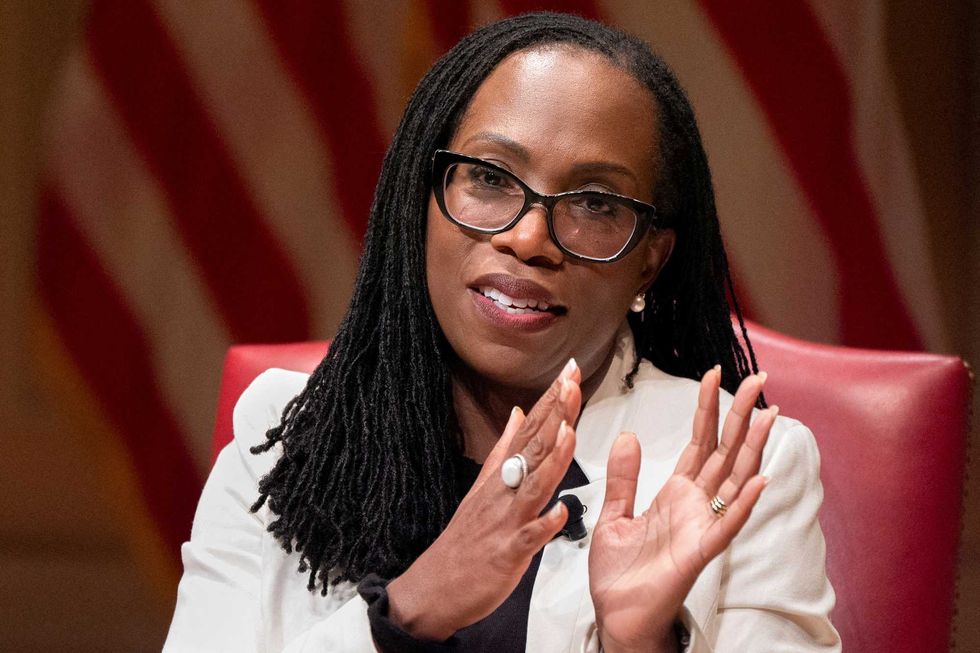
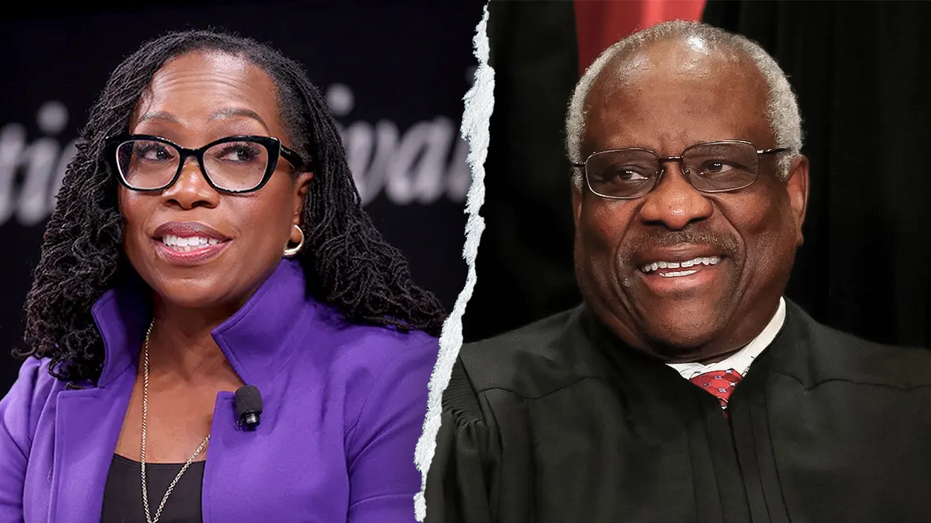
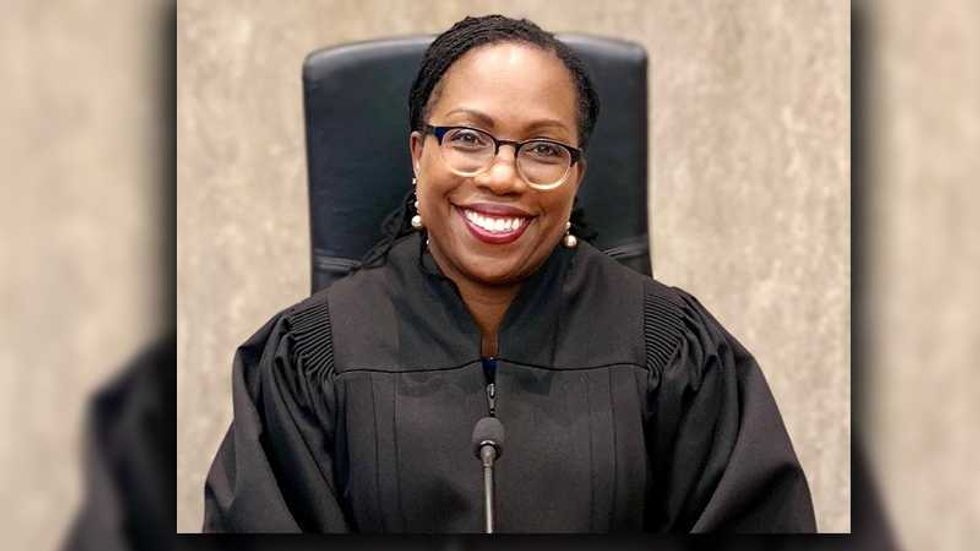
Supreme Court Justice Ketanji Brown Jackson invoked 'the dark stain of slavery' in an explosive reprimand of fellow Justice Clarence Thomas on Tuesday.
President Donald Trump may have built the Supreme Court’s supermajority, but it was the Reagan Revolution that prevailed during the just-completed term.
Supreme Court Justice Ketanji Brown Jackson admonished fellow Justice Clarence Thomas for his dissent to the high court’s decision upholding birthright citizenship on Tuesday. In a 20-page concurring opinion, Jackson accused Thomas of applying a “narrow vision” of the 14th Amendment in dissenting from the six-justice majority. “Despite his longstanding endorsement of a ‘colorblind’ Constitution, Justice…
As the Supreme Court handed down a landmark ruling on the last day of its term protecting birthright citizenship and invalidating a signature policy of President Donald Trump's administration, Justice Clarence Thomas took a swipe at the majority in his dissent, stunning legal experts with an argument that would have effectively rewritten 14th Amendment protections out of the Constitution for millions of people.But Justice Ketanji Brown Jackson went out of her way in her concurrence with Chief Justice John Roberts' majority opinion to demolish Thomas' argument — and in particular, point out that he was talking out of both sides of his mouth on how to interpret constitutional rights."I write separately to respond to some of the themes in the principal dissent," wrote Jackson. "Despite his longstanding endorsement of a 'colorblind' Constitution, Justice Thomas now surprisingly suggests that the Citizenship Clause was a race-conscious remedial measure, relating only to 'freed slaves such as Dred Scott,' ... and those who shared with them certain characteristics ... It is for this reason, he says, that 'children who were born in the United States but [to parents] not domiciled here' are not entitled to claim birthright citizenship."This, noted Georgia trial lawyer and legal analyst Andrew Fleischman in a post to X, is a "pretty good burn here.""Justice Thomas says that the 14th Amendment does not allow us to treat people differently on the basis of their race to help them (affirmative action, voting rights). But then he says it was also laser-focused on restoring citizenship for black Americans," he wrote. Ultimately, Jackson's concurrence noted, Thomas is wrong on the latter point anyway."That narrow vision of the 14th Amendment bears little relationship to the history of its ratification," she wrote. "Even worse, Justice Thomas's telling elides the entire point of the Second Founding: The Reconstruction Amendments were an anticaste, antisubordination reset for the Nation, not a mere spot treatment for the dark stain of slavery."The majority opinion by Roberts agrees with this assessment, noted Slate's Mark Joseph Stern, detailing the history that proves Congress in the 1860s understood and affirmed birthright citizenship would apply to the children of immigrants.
Justice Ketanji Brown Jackson, who is 55, included the TikTok slang phrase “understood the assignment” in her concurring opinion in the Supreme Court’s major birthright citizenship ruling issued Tuesday.
The post Justice Ketanji Brown Jackson Used Trashy TikTok Slang ‘Understood the Assignment’ in Supreme Court Birthright Citizenship Opinion appeared first on The Gateway Pundit.
The U.S. Supreme Court issued a decision striking down President Donald Trump's birthright citizenship executive order in an opinion that was written by Chief Justice John Roberts. However, Justice Ketanji Brown Jackson issued her own concurrence that targeted Justice Clarence Thomas by name. After 31 pages of Roberts walking through the long history of birthright citizenship in the law, Jackson wrote a response to the dissent that Thomas penned along with Justices Samuel Alito and Neil Gorsuch. "Despite his longstanding endorsement of a 'colorblind' Constitution, Justice Thomas now surprisingly suggests that the Citizenship Clause was a race-conscious remedial measure, relating only to 'freed slaves such as Dred Scott,' post, at 56, and those who shared with them certain characteristics ... It is for this reason, he says, that 'children who were born in the United States but [to parents] not domiciled here' are not entitled to claim birthright citizenship. ... But that narrow vision of the Fourteenth Amendment bears little relationship to the history of its ratification. Even worse, Justice Thomas’ telling elides the entire point of the Second Founding: The Reconstruction Amendments were an anticaste, antisubordination reset for the Nation, not a mere spot treatment for the dark stain of slavery."She goes on to allege that Thomas has a "myopic treatment" of the 14th Amendment. "The Amendment caused a paradigm shift in the trajectory of our Nation; the teacher who scolds a student for bullying a classmate hopes the student learns the broader lesson of treating everyone with kindness, not just that one kid," she says. She even went so far as to add an extensive footnote of cases "denied by this court" that refers back to Thomas' slavery argument. "It is common ground that the Fourteenth Amendment was 'enacted ... with the one pervading purpose of securing equal citizenship for the freed slaves.' Also true is the fact that this Court 'has time and again denied Americans that promise.'"Her footnote for that comment reads: "I suspect, though, that Justice Thomas and I disagree about when and how that promise has been denied by this Court. My list is long (and sadly only getting longer)." She cited 11 separate cases, the most recent of which refers back to a decision earlier this term in Louisiana v. Callais.Jackson closes by saying, "Thankfully, a majority of the Court remembered this today, and has dutifully preserved the most basic animating principle of our Nation’s founding — that all human beings are created equal — once more."Bill Shein called it a "blistering concurring opinion/takedown of Clarence Thomas's dissent."Northwestern University School of Law Professor Paul Gowder said, "Justice Jackson knows what's up." He later added, "God bless Justice Jackson actually talking about what the Black folks who won the clause had said and done."Loyola University School of Law Professor Justin Levitt wrote, "Justice Jackson is absolutely on fire in her birthright concurrence, unloading on the dissent not only for their votes in this case, but its apparent inconsistency with most of the 'colorblindness' jurisprudence of the past few terms."