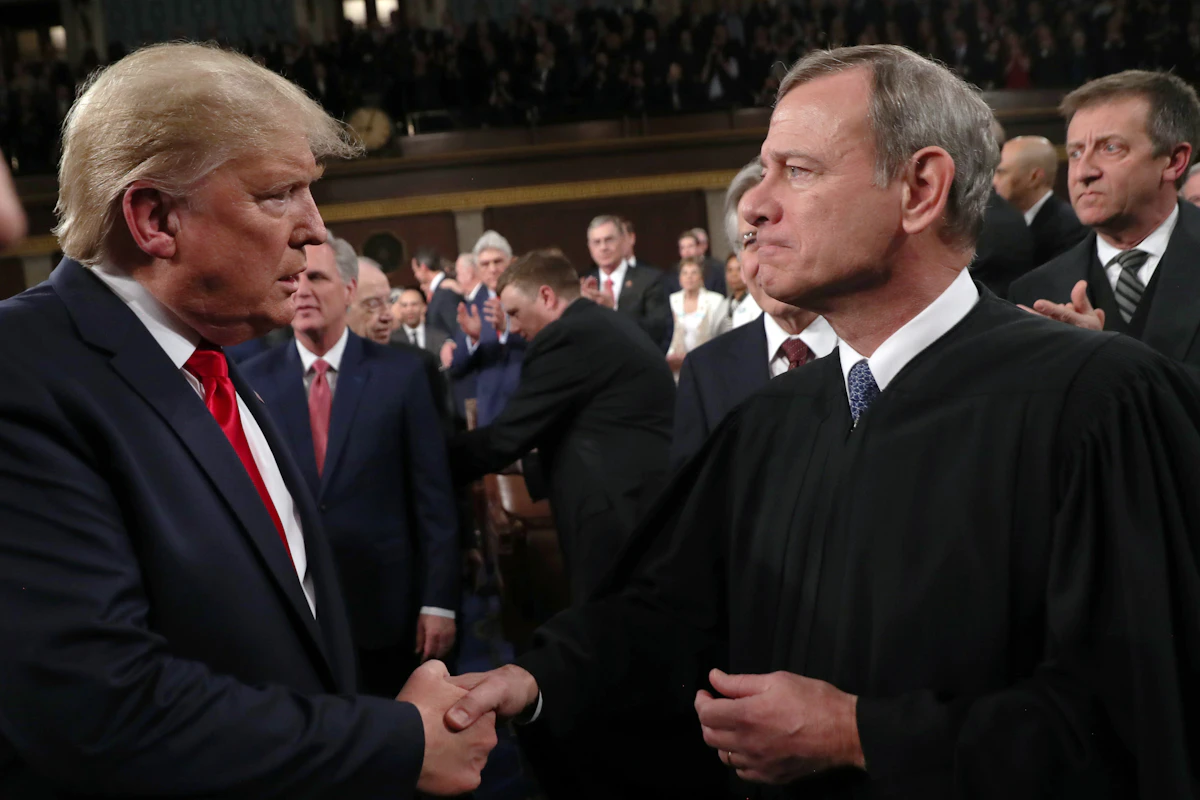
The Supreme Court Gave Trump Almost Everything He Wanted
There was good news and bad news from the Supreme Court on Monday. We’ll start with the former. In an extraordinary 5-4 ruling in Trump v. Cook, the court held that President Donald Trump cannot summarily fire a Federal Reserve governor without cause, thereby shielding the nation’s central bank from direct presidential control.Chief Justice John Roberts, who wrote for the court, held that Congress could lawfully shield Federal Reserve members from removal without cause because of the Fed’s unique role in American governance. In doing so, he and the other justices in the majority—Justice Brett Kavanaugh and the court’s three liberal members—sidestepped some of the court’s normal procedural hurdles.“We see no reason to leave the public in limbo, or to sow doubt as to the status of one of our nation’s (and the world’s) most important financial institutions,” he explained in his majority opinion, quoting from precedent. “Although we appreciate that others may see matters differently, we would not so quickly unsettle this ‘special arrangement sanctioned by history.’”Unfortunately, the court’s deference to Congress on removal protections applies only to the Federal Reserve. The court’s conservative majority simultaneously held that Trump could fire Democratic appointees at the Federal Trade Commission in Trump v. Slaughter, clearing the path for him to wield much greater influence over other financial regulatory agencies.The 6-3 decision is a generational victory for the conservative legal movement, which has spent the last few decades trying to bring independent federal agencies under the heel of Republican presidents. The high court also overturned a New Deal-era precedent that allowed Congress to protect the leaders of federal financial regulators from dismissal without cause in Slaughter. In doing so, it opened some of the nation’s most important governing institutions to the day-to-day whims of a corrupt president.Taken together, Cook and Slaughter divided the Supreme Court into three camps. One of them, represented by the court’s three liberal justices, would have upheld the status quo for independent federal agencies. In their view, Congress can give certain federal agencies a measure of independence from the White House by only allowing the president to fire the agencies’ leaders for cause.This also happened to be the status quo for at least the last century of American history. In 1935, the Supreme Court ruled in Humphrey’s Executor v. United States that the president could not lawfully remove a commissioner of the Federal Trade Commission except for “inefficiency, neglect of duty, or malfeasance in office.” Prior to Slaughter, no president had sought to dismiss a FTC commissioner, either for cause or without it.While presidents have the power to remove executive-branch officers by default, the Humphrey’s Executor court reasoned, Congress could impose limits if the agency in question also exercised “quasi-legislative” or “quasi-judicial” power. Agency independence became particularly important with financial regulators as a check on corruption and safeguard of public confidence.“Congress and more than a dozen Presidents have relied on Humphrey’s to construct a workable government, creating many other agencies in the FTC’s tradition,” Sotomayor explained in her Cook dissent, which was joined by Justices Elena Kagan and Ketanji Brown Jackson. “Today, this Court undoes centuries of political practice and concludes that all three branches of government have been acting in open defiance of the Constitution all this time. Its conclusion is wrong.”Last year, Trump began to challenge Humphrey’s Executor by firing the heads of certain federal agencies without cause. The president had long sought to exercise more direct control over federal agencies, though he lacked the interest or drive to do so during his first term. After his return to power last year, Trump ended the Justice Department’s post-Watergate tradition of independence, staffed other agencies with personal loyalists, and sought to remove Democratic appointees of multi-member regulatory agencies.The Supreme Court proved eager to help him wage this war against what conservatives had long derided as the “administrative state.” The justices effectively signaled that Humphrey’s Executor was a dead letter in a shadow-docket ruling in Wilcox v. Trump. (The court also addressed the Federal Reserve in that case, but we’ll come back to that later.)Technically, however, that ruling remained the law of the land when Trump dismissed FTC commissioner Rebecca Slaughter last year. Slaughter challenged her dismissal in federal court, noting that Congress had insulated commissioners like herself from presidential removal without cause and that Humphrey’s Executor remained good law.