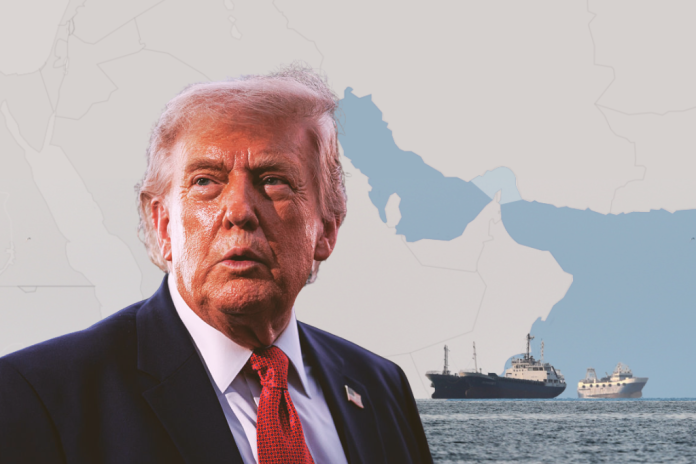
Trump threatens Hormuz takeover to collect tolls and 20% of oil if Iran deal fails
Center Right
President Donald Trump on Sunday said the United States will take control of the Strait of Hormuz, collecting tolls and 20% of the oil that flows through the waterway if negotiations between Washington and Tehran in Switzerland fall through. Vice President JD Vance is meeting with Iranian officials on Sunday to finalize the terms of […]
Economist Peter Schiff is warning that the federal government's yawning budget gap will be papered over with a flood of newly printed money, and that ordinary Americans will pay for it through prices that could eventually double.The chief economist and global strategist at Euro Pacific Asset Management laid out the math in a post on Saturday. In May, he wrote, the government spent $628 billion while collecting just $335 billion in taxes, a shortfall so large that balancing the budget would require tax revenue to nearly double. Schiff does not believe that will happen, and his prediction for what comes instead is blunt. "Since that won't happen," he wrote, "massive money printing will cover the shortfall, sending consumer prices doubling instead."In other words, Schiff is arguing that the administration faces a politically impossible choice and will take the path of least resistance. Rather than impose a tax increase steep enough to close the gap, which he later estimated at roughly 50 percent once seasonal revenue is accounted for, he expects the government to monetize the debt. The cost of that decision, in his telling, does not disappear. It simply shows up at the grocery store and the gas pump instead of on a tax bill.The thread drew agreement from others who share Schiff's hard-money outlook.Where Schiff went further than some observers was on the political fallout. When one user argued that doubling taxes was "virtually impossible" and would "absolutely cause massive unrest," recommending spending cuts instead, Schiff agreed the unrest is coming either way. "Yes, but they won't" cut spending, he replied, predicting that the government "will still get unrest, but they will blame it on inflation." The implication is that the administration will treat rising prices as an external force to be managed rather than the predictable result of its own fiscal choices.
After issuing a plethora of fresh threats Sunday morning, President Donald Trump was issued a warning of his own from Iranian Parliament Speaker Mohammad Bagher Ghalibaf, who hours later warned Trump to “be careful” with his words amid the delicate ceasefire between the United States and Iran.As relayed by Fox News’ Trey Yingst, Trump threatened to “take over” both Iran and the Strait of Hormuz, while also issuing a vague threat that appeared to suggest he may order the assassination of Iranian peace negotiators, Ghalibaf included. In a statement published on social media, Ghalibaf hit back at Trump and urged him to tread carefully.“Don't they think to themselves that if their threats had any effect, they wouldn't have reached the point of despair today? We don't count on the threats of the Americans,” Ghalibaf wrote in his statement, according to an English translation from Hebrew by Google Translate.“They better be careful with their statements, our armed forces are ready to respond in another way. Whatever they say, we are the ones who will act.”Trump’s threats Sunday morning have already had an impact on the negotiations being held in Switzerland. An Iranian news outlet reported that the Iranian delegation left the negotiation venue in protest of Trump’s threats, and MeidasTouch, a progressive media outlet, argued that Trump was “single-handedly destroying the entire peace process.”🚨🚨 BREAKING: Iran's negotiators have LEFT the venue in protest of Trump's threats, per Tasnim.Trump is single-handedly destroying the entire peace process.— MeidasTouch (@MeidasTouch) June 21, 2026
“Lots of Killing going on in Chicago…Why isn’t [Illinois] Governor [JB] Pritzker calling me for help?” President Trump wrote on Truth Social early Sunday.
Talks in Switzerland between the US and Iran were still ongoing despite Iranian media reports that negotiators had left the venue, according to people familiar with the matter.
President Donald Trump's account of a phone call he says he had with Iranian officials, in which he reportedly threatened to wipe out their country, take over the Strait of Hormuz, and more, has set off a wave of disbelief, ridicule, and alarm across the political spectrum.The threats were relayed by Fox News correspondent Trey Yingst, who said he spoke with Trump for more than 20 minutes and came away with what he called "new insight" into the president's posture as nuclear talks opened in Switzerland. According to Yingst, Trump described what he told the Iranians about the strait in blunt terms. "You close it and you won't have a country," Trump said he warned them. "You won't even make it back to your f------ country." Yingst added that Trump said, "We may take over the Strait, if we have to."The response from Trump's critics was immediate and caustic. Former White House communications director Anthony Scaramucci, who served briefly in Trump's first term before becoming a frequent antagonist, summed up his reaction in three dry words. "Normal Presidential behavior," he wrote, sharing a MeidasTouch post that reported Trump had told Iranian President Masoud Pezeshkian, after Pezeshkian said Iran would not give up enrichment, "He better watch his mouth ... or we will take over the rest of the country."Journalist Aaron Rupar, who posted Yingst's full segment, catalogued the threats without restraint. "We'll take over the rest of your country ... I'll blow the s--- out of them," Rupar quoted, describing the "bonkers phone call" as one that "apparently included threats to assassinate Iran's leadership, impose draconian US tolls in the Strait of Hormuz, and occupy Iran with the US military."Democratic Rep. Ted Lieu of California zeroed in on the practical and legal emptiness of the threats. "US troops would die during any ground invasion of Iran," Lieu wrote. "It would also be brazenly illegal without Congressional authorization." He warned that seizing the strait would trap American forces in a quagmire, adding that "Iran would try to kill them every day in a forever war." His conclusion was that Tehran is not impressed: "Iran knows these are empty threats by Trump."Some questioned whether the call even happened as described. Author and Iran expert Hooman Majd, who has written extensively about the country and served as an informal interpreter for past Iranian presidents, flatly disputed the premise. "President Trump did not speak with an Iranian official and say anything of the sort directly to him," Majd wrote. He then floated a mocking theory about how Trump might be staging these confrontations: "Is it possible the WH staff has arranged for a Persian-accented staffer to man a phone for Trump to call whenever he wants to yell at an 'Iranian official'?"Notably, the criticism was not confined to the left. David Pyne, a self-described America First analyst who posts as @AmericaFirstCon, called the president "completely unhinged" and accused him of "threatening to assassinate Iran's diplomatic representatives and invade, conquer and occupy all of Iran." Pyne, who opposes new wars, argued the bravado was hollow. "His threat to take over all of Iran is a bluff since he's reportedly afraid to invade Iran knowing that it would lead to thousands of US military servicemembers being killed in action," he wrote, adding that even committing the entire active-duty Army and reserves "likely wouldn't be enough to conquer all of Iran without a US nuclear first strike."The threats were also amplified, approvingly, by right-wing accounts. Commentator Nick Sortor, whose post was boosted by conservative legal activist Mike Davis, framed the same language as a triumph. "HOLY CRAP! President Trump issued a DIRECT THREAT to Iranian negotiators in Switzerland," Sortor wrote, presenting "You close [the Strait] and you won't have a country" as evidence of strength rather than instability.US troops would die during any ground invasion of Iran. It would also be brazenly illegal without Congressional authorization.And if US troops took over the Straight, Iran would try to kill them every day in a forever war.Iran knows these are empty threats by trump. https://t.co/x3ZDeY52Zt— Ted Lieu (@tedlieu) June 21, 2026
President Donald Trump appeared to threaten Iranian peace negotiators with assassination Sunday in a “bonkers” phone call with Fox News’ Trey Yingst, the details of which Yingst revealed on air just moments later.Last week, Trump officially agreed to a tentative peace deal with Iran, giving the two parties 60 days to finalize a more permanent agreement to end hostilities. Vice President JD Vance arrived in Switzerland Sunday to meet with an Iranian delegation of negotiators led by Speaker Mahammad Bagher Ghalibaf and Foreign Minister Abbas Araghci.However, after Iranian military officials announced on Saturday that they would, again, close the Strait of Hormuz due to violations of the tentative peace deal, Trump suggested, Yingst said, that the Iranian negotiators may not “make it back” to their home country.“President Trump tells Fox News he spoke with Iranian officials overnight and said ‘you close it and you won’t have a country,’” Yingst said, recalling his phone call with Trump held moments earlier. “He went on to tell these officials, ‘you won’t even make it back to your f---ing country.’”Whether Trump’s remarks suggested he may order the Iranian negotiators assassinated before their return home remains unclear, though multiple Iranian negotiators have been assassinated throughout the duration of the U.S. war against Iran, such as Ali Larijani, the former speaker of the Iranian Parliament who was killed in March in an Israeli airstrike."We'll take over the rest of your country ... I'll blow the shit out of them" -- here is Trey Yingst's entire segment about the bonkers phone call he says he had with Trump this morning that apparently included threats to assassinate Iran's leadership, impose draconian US tolls… pic.twitter.com/RLi9bos14Q— Aaron Rupar (@atrupar) June 21, 2026
JD Vance's path to the presidency may run through Tehran, and not in a way that helps him. That is the striking implication of a new analysis by Iran expert Karim Sadjadpour, who argues in The Atlantic that the vice president's political future now depends heavily on whether hardline Iranian officials decide to play along with Donald Trump's latest gamble.Sadjadpour, a senior fellow at the Carnegie Endowment for International Peace, lays out how Trump handed Vance responsibility for an enormous and unlikely task: not merely striking a new nuclear deal, but engineering a wholesale transformation of US-Iran relations after a war that Sadjadpour says ended in humiliation for the president. The memorandum that paused the fighting, he writes, is so lopsided that it reads as if Tehran drafted it, with 13 of its 14 provisions amounting to boilerplate or favoring Iran outright.That is the project Vance has been told to deliver, and Trump has been remarkably candid about who absorbs the blame if it fails. "If it works out, I'm going to take the credit," the president said, according to the piece. "If it doesn't work out, I'm blaming J.D."The expert's sharpest observation is about where that leaves the vice president. Vance's prospects, Sadjadpour writes, "may rest as much on Islamic Revolutionary Guard Corps officers as on Republican-primary voters." In other words, a man eyeing the 2028 nomination has tied his standing to the cooperation of the very military and clerical figures who built their careers on resistance to the United States.Vance is reportedly pinning hopes on Mohammad Baqer Qalibaf, a former IRGC general and current speaker of Iran's Parliament, with whom he spent more than 20 hours in Islamabad and supposedly developed a rapport. Sadjadpour is skeptical that private warmth means anything. He notes that Qalibaf's public appearances, where he mocks America, praises Hezbollah, threatens Israel, and celebrates partnership with China, are a far more reliable guide to Tehran's intentions than any backroom assurances.The broader picture Sadjadpour paints is of an Iranian regime that thrives on isolation and treats sabotaging American presidents as a point of pride. He traces that pattern back to the 1979 revolution and the hostage crisis that helped sink Jimmy Carter's reelection. This time, he suggests, Tehran stands to claim an unusually rich prize. The Islamic Republic, he writes, may get "a two-for-one": the presidency of Donald Trump, and the presidential ambitions of JD Vance.If Sadjadpour is right, Vance has accepted a mission whose success is largely outside his control, with a boss already rehearsing the line that will pin any failure on him. The clerics and generals in Tehran, not the voters in Iowa, may end up deciding how that story turns out.