The Atlantic
Iran Got a Great Deal That It Could Still Squander
For some forces in Iran, no agreement is a good agreement with the United States.
Center Left
In the December 1987 edition of this magazine there appeared an essay by Tom Wolfe titled “The Great Relearning.” Wolfe’s...
For some forces in Iran, no agreement is a good agreement with the United States.

After a week of the World Cup, visitors to the U.S. are marveling on social media about things like free drink refills. It's a respite as tensions between Washington and its allies run high.
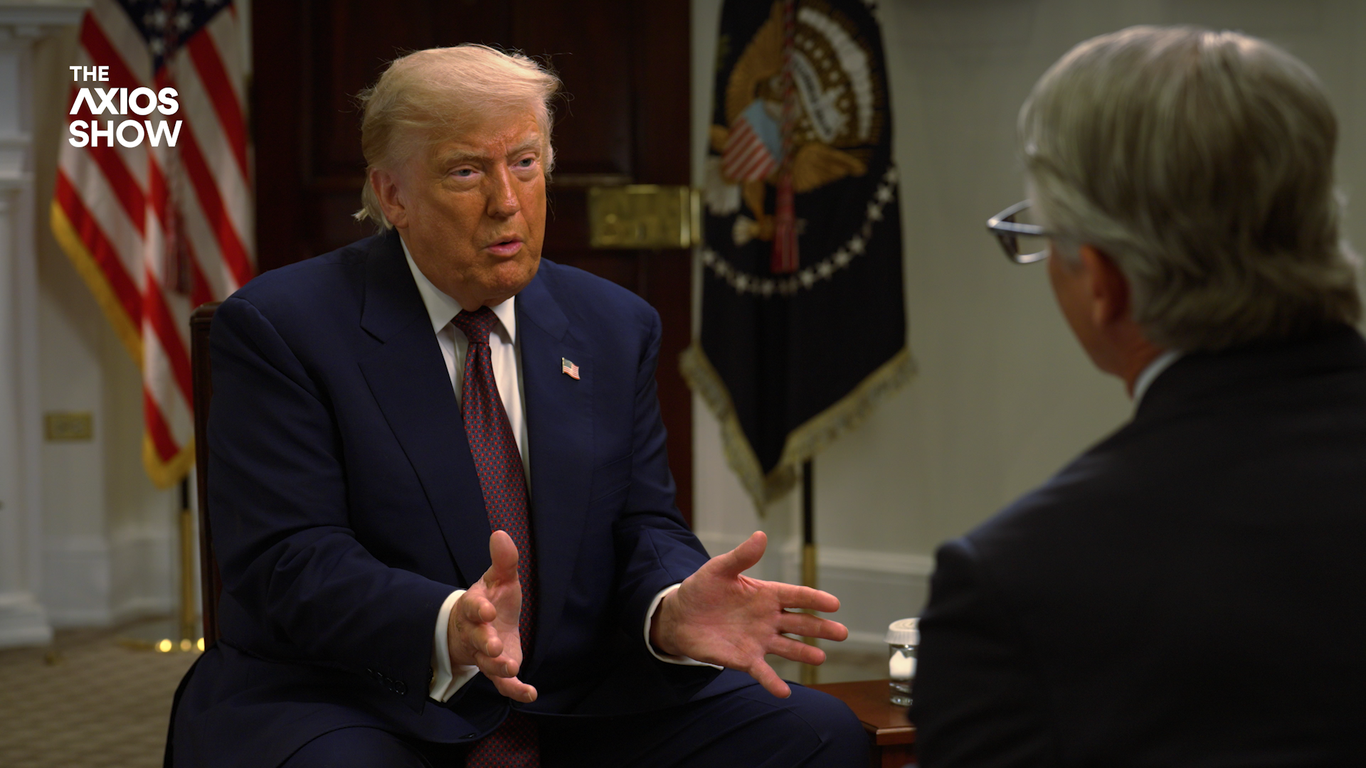
President Trump declared on "The Axios Show" on Thursday that he's discovered "no limits" to his power since going to war with Iran.A forthcoming book reveals he's been entertaining an even grander idea: that he may be the most powerful man in history.Why it matters: Trump is no longer merely testing the limits of the presidency. He's describing power in world-historical terms — placing himself in the lineage of conquerors, dictators and strongmen who bent nations to their will.In a wide-ranging, soon-to-be-released 45-minute interview with Axios' Marc Caputo, Trump repeatedly measured power by submission: G7 leaders believed him when he joked "I'm the boss," he said, while Israel has "a lot of respect for me" and will "do as I say."Zoom in: In "Regime Change," coming Tuesday from The New York Times' Maggie Haberman and Jonathan Swan, Trump proudly shows off a document arguing he's more powerful than Attila the Hun, Genghis Khan, Napoleon, Stalin, Mao and Hitler.Trump "began reading from it," the authors write, "reciting the names of some of history's most powerful figures" and explaining how each "fell short of his own power as U.S. president.""They didn't have airplanes, right? You couldn't travel around," Trump said of Alexander the Great, the Caesars and William the Conqueror. "Napoleon," he added "with relish," according to the authors.Haberman and Swan write that the revealing part was "the evident pleasure he took in the company of Mao, Hitler, and Stalin" — and "the untroubled ease with which he accepted a place among men who had reshaped the world through conquest and fear."Zoom out: Hints of that grandiose theory of power surfaced throughout Trump's interview with Axios, hours after returning from what he called a "very dominant" G7 summit in France.Trump named China's Xi Jinping and India's Narendra Modi as the world leaders he most admires, praising Xi as "all business" and Modi as "a very tough cookie." He declined to identify the leaders he considers the weakest — then pivoted to lamenting Vladimir Putin's absence from the G7, which was the G8 prior to Russia's expulsion after its 2014 annexation of Crimea.Trump lingered on French President Emmanuel Macron's decision to honor him with a dinner at Versailles, the kind of imperial stage Trump called "my weakness."Between the lines: Allies, in Trump's telling, are only relevant when they recognize who holds the real power."If it weren't for me, Israel would not exist today," Trump told Axios, adding that his relationship with Prime Minister Benjamin Netanyahu is "good, but we have to keep him a little bit sane." Trump struck a similar tone toward Republican hawks furious over his Iran deal: "Some guys that I used to respect, I don't respect anymore. They're hardliners," he said.Pressed on why the deal falls short of his original demands, a defiant Trump opted for his own reality — insisting the outcome does, in fact, amount to "unconditional surrender" by Iran as well as "regime change."Reality check: For all of Trump's claims of limitless power, he acknowledged one force still constrains him — the economy.He argued that extending the war to satisfy hawks could have triggered a "worldwide depression." He pointed to falling oil prices and a surging stock market as proof he made the right decision to back a deal that could end the Iran war."I have one primary wish as president ... I never want to be the late, great Herbert Hoover," Trump said, referring to the 31st president, who's forever associated with the Great Depression.The bottom line: Trump posted the "Great Men" document on Truth Social on Thursday, calling its author a "presidential historian." Haberman and Swan report that the author was actually the longtime caddy and personal confidant to golfer Gary Player.The document's conclusion: Trump's willingness to use his power on a global scale "makes him by far the most powerful person that has EVER walked this planet."Watch a clip from the interview.

Over 130 million people tuned in to watch the historic UFC Freedom 250 event on the South Lawn of the...

American dads have never been more devoted to their children. But increasing numbers of men are choosing never to enter family life at all, writes Brad Wilcox.

Op-ed views and opinions expressed are solely those of the author. What cruel irony that we learned last week that Social Security is going broke even sooner […]

As President Donald Trump's vanity projects collapse, the reality of his failures is reflected in his presidency, according to a columnist on Wednesday.Trump has attempted to remodel the White House and build a ballroom, slap his name on the Kennedy Center, and remodel the reflecting pool by spending millions to repaint it dark blue only for algae to return and turn it neon green — but that has all backfired, wrote James Ball, political editor at The New World, in a piece published by The i Paper."Trump, in other words, waded into a complex problem that successive administrations failed to address, declared he alone could fix it, didn’t learn anything about the actual underlying issues, and fell flat on his face," Ball wrote. "Some readers might be spotting parallels between the reflecting pool and the President’s Middle East policy, but even just sticking to his misadventures in the capital provides no shortage of disasters."His second term has been marked by missteps and "laws keep tripping him up," Ball explained."Trump sees himself as a strongman and wants the world to see him in the same way," Ball wrote. "He thinks Congress and the Supreme Court work for him. Laws are things he gets to write, not things he has to follow. He seems to believe that every other nation has to do what he wants."Yet Trump has continued running into problems."But it is a lot harder to project that image when you can’t even manage a home renovation or fix the pool at the bottom of your garden," Ball wrote."Trump is a man in a rush, particularly to leave a lasting impression on Washington DC. But by trying to build a legacy in the nation’s capital, he risks doing the opposite. He wants a legacy in marble, not one covered in algae," Ball added.

Great Britain’s new social media ban for kids under 16 is threatening to escalate longtime tensions with the Trump administration over internet and social media policy. Prime Minister Keir Starmer revealed this week his nation is moving forward with the ban, less than a week after the White House urged Downing Street against it, citing concerns over free speech…