Long-time readers may remember a series of posts I wrote circa 2020 about the conflicts between Chief Justice Roberts and…
The post The Chief Justice Behind The Curtains appeared first on Reason.com.
Long-time readers may remember a series of posts I wrote circa 2020 about the conflicts between Chief Justice Roberts and…
The post The Chief Justice Behind The Curtains appeared first on Reason.com.
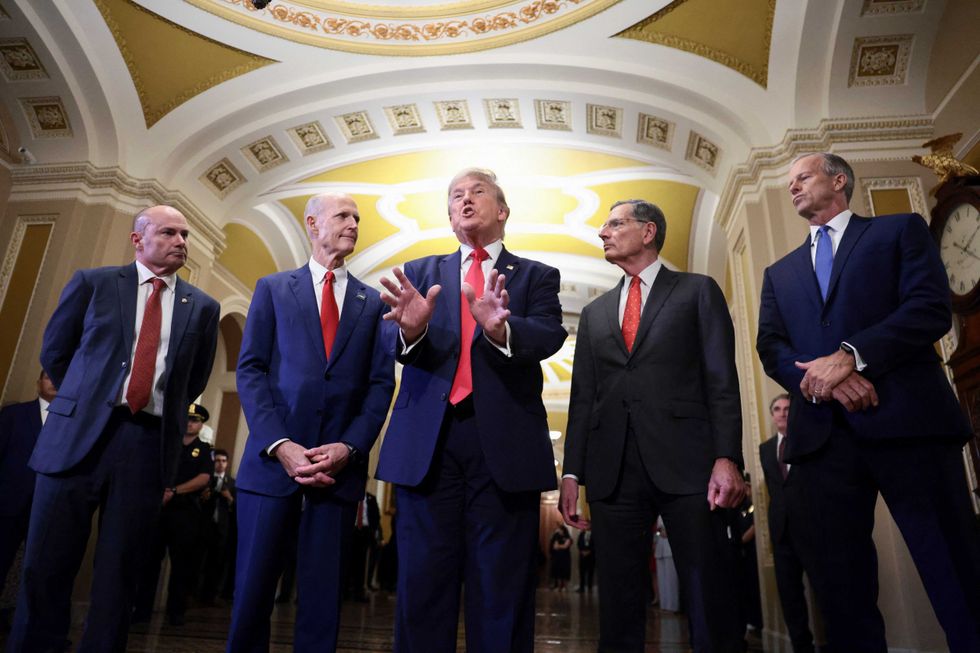
President Donald Trump's controversial new intelligence chief is clearing house, and career officers warn the man swinging the axe doesn't know what he's cutting.Bill Pulte, Trump's loyal acting director of national intelligence, began notifying dozens of intelligence officials of their terminations Thursday, part of a downsizing Trump ordered when he installed Pulte at the office two weeks ago, MS NOW reported Friday. An intelligence official, who spoke anonymously citing fear of reprisal, told the outlet that leadership is targeting workers it believes are "deep state" and accused them of failing to hand up a complete picture of available intelligence.But former officials aren't buying his rationale. Several told MS NOW they had never heard of intelligence officers withholding information from their superiors. "The premise is absurd," one said. Another questioned how Pulte, who ran the federal housing agency and has no intelligence background, could reach such a conclusion within days of arriving.“I have a real question of how he would know this. This isn’t a guy who is familiar with intelligence,” a former official told the outlet. “How is he going to get to the bottom of this and rely on any information with a matter of fidelity? It would be like me taking over a hospital and firing dozens of surgeons in a matter of days.”The cuts follow Pulte's earlier removal of six political appointees who served under his predecessor, Tulsi Gabbard. His arrival has drawn alarm across party lines: he took the post without ever holding a security clearance, and he can stay in the acting role past November's midterms under federal vacancy rules. Critics note his office doesn't collect intelligence of its own, relying instead on the CIA, the NSA and more than a dozen other agencies to supply it.Democrats and some Republicans fear the purge is less about efficiency than about clearing out analysts who might resist Trump's election claims. The ODNI says it is providing "elite, apolitical intelligence that keeps America safe."
Major American corporations that benefited from tax cuts enacted last year by President Donald Trump and congressional Republicans are donating to the campaigns of GOP lawmakers who made the windfall possible.A report published Friday by Unrig Our Economy spotlights seven House Republicans who voted for the sprawling and unpopular GOP budget package, which extended tax breaks for corporations and wealthy Americans while inflicting unprecedented cuts on Medicaid and federal nutrition assistance—with disastrous consequences for millions of low-income families across the country.Rep. Mariannette Miller-Meeks (R-Iowa), one of the lawmakers featured in the new report, has received campaign donations from corporate PACs representing 3M, Amazon, Walmart, AT&T, and other companies that collectively received billions of dollars in tax breaks from the Republican law, which restored a provision allowing businesses to immediately write off new investments.Amazon saw its US income taxes fall by more than half last year due to the GOP law, even as the company’s profits grew. Unrig Our Economy noted that Amazon, whose PAC donated thousands to the Republicans spotlighted in the new report, has an effective federal tax rate of 1.37% following enactment of the budget law.Miller-Meeks, who has received at least $57,000 in donations from the PACs of companies that benefited from the 2025 law, issued a statement Thursday bragging about supporting “the largest tax cuts in American history,” not mentioning that the benefits will disproportionately flow to profitable corporations and the richest people in the country.“Thanks to the Republican tax law, corporations are receiving tax breaks, House Republicans are getting campaign cash, and working families are getting stuck with the bill,” the report states.Another Republican lawmaker featured in the report, Rob Bresnahan of Pennsylvania, received $2,500 in campaign donations from the PAC of FirstEnergy, which reaped $500 million in depreciation deductions thanks to the GOP tax law.“Bresnahan voted to give FirstEnergy hundreds of millions in tax breaks even after the company raised utility prices for his constituents,” Unrig Our Economy’s report observes.The report also points out that Bresnahan “owned stock in every single one” of the companies who contributed PAC money to his campaign following passage of the Republican budget package last summer.“This comes after Bresnahan has already faced scrutiny for dumping stock in Medicaid providers and selling off bonds in Pennsylvania hospitals before voting to slash Medicaid and put rural hospitals at risk,” the report notes.Leor Tal, Unrig Our Economy’s campaign director, said in a statement that “one year ago, House Republicans ripped away healthcare and food assistance from millions of Americans, so that corporations could get massive tax breaks.”“Now, many of those companies are dishing out PAC money to the Republicans listed in this report,” said Tal. “Republicans in Congress sold out many of their own constituents to help corporations get even richer. It’s time that House Republicans step up, do the right thing, and start fighting for working Americans—not giant corporations.”
The Justice Department (DOJ) declined on Thursday to release additional unredacted records from its investigation into convicted sex offender Jeffrey Epstein, telling a federal judge that it has already adequately complied with the law. The DOJ’s response came in the final hours of a court-ordered deadline to remove redactions in at least a dozen documents…
The Trump administration concluded a recent mineral deal with Kazakhstan that, not surprisingly, enriches not only President Donald Trump’s own family but that of his secretary of commerce, Howard Lutnick. Trump’s two eldest sons, part owners of Dominari Securities, are set to profit from the Kazakh tungsten deal. So is Cantor Fitzgerald, the investment firm run by Lutnick’s two sons.As The New York Times pointed out in its investigation of the scheme, “Their sons were soon doing business with partners in a deal that their fathers were negotiating, continuing a pattern of self-enrichment in the second Trump administration that has few precedents in American history.”The phrases “self-enrichment” and “few precedents” are interesting ways of characterizing this latest instance of the administration’s corruption. Isn’t self-enrichment a good thing, in the sense of profiting from your own hard work? By contrast, the article doesn’t mention the word “corruption” at all. Perhaps the Times is worried about getting hit by yet another Trump legal challenge (in October last year, Trump refiled a $15 billion defamation suit against the paper for its coverage of his 2024 presidential campaign).There are indeed several precedents in American history for what Trump is doing. These previous corruption scandals—Credit Mobilier, Whiskey Ring, Teapot Dome—wrecked the reputations of presidents and cast long shadows over American politics. They also helped to produce the kind of safeguards that Trump is now destroying.Foreign policy is a tool by which the administration levies a toll on any entity that has the temerity to be a country other than the United States. As with much of Trump’s disrespect for norms, his corruption has been massive and largely in full view. The two outstanding questions are: Will Trump and company ever be held accountable for their graft and will this corruption have an enduring impact on political institutions in the United States?Tracking the DamageIf scandalous behavior unfolds in full view of everyone, is it still a scandal? “Scandal” suggests something hidden, something whispered about, something revealed. Trump’s actions are full frontal. They are both brazen and matter-of-fact.According to the Trump administration and its extended family, the money skimmed off the top of economic transactions is just smart politics. The administration has endeavored to negotiate every peace deal, trade agreement, investment arrangement, and mineral pact in such a way as to deliver Trump, his family, and their circle of close supporters a good chunk of change.This is Trump’s interpretation of the American dream: Folks would be downright foolish not to profit from their position. All the great tycoons made their money, from railroads to AI, by being in the right place at the right time with the right amount of ruthlessness. In Trump’s case, however, he is using taxpayer money to cover the risk. And most the time, given the terms of the arrangement, there is hardly any risk because Trump is using his presidential power to game the system. That’s what he really means by the “art of the deal.” Trump only deals from a marked deck of cards.The Center for American Progress runs Trump’s Take, which estimates that the president has received a little over $2.6 billion in cash and gifts since he took office in January 2025.The graft is not secret, though sometimes the actual amounts involved are obscured by layers of complex finance. Trump’s recent mandatory financial disclosure offers some details. But thanks to a number of websites, it’s become quite easy to track in real time the growing amount of Trump’s slice of the pie.The Center for American Progress runs Trump’s Take, which estimates that the president has received a little over $2.6 billion in cash and gifts since he took office in January 2025. Much of this money has come from various crypto schemes, including the Trump meme coin, but also such dubious ventures as the documentary about Melania Trump and a number of legal settlements (more colloquially known as shakedowns). Corruption Counter puts the value at $2.2 billion and includes such recent items as the $100 million savings for Trump from the recent effort to bar the Internal Revenue Service from auditing the president. (Courts blocked the overall $1.8 billion “settlement fund,” but the Justice Department is upholding the IRS amnesty.)If you want to keep track just of the crypto deals, the Democrats on the House Oversight Committee maintain the Trump Family Digital Grift Wealth Tracker. Senator Chris Murphy (D-Conn.) keeps his own list, which highlights the insider trading around the Iran War and a defense contract with Dell after the president invested in the company. David Kirkpatrick, at The New Yorker, has been keeping a running total of Trump’s ballooning assets. In January, he updated his total to $4 billion, which details, among other things, the Gulf money flowing into Trump pockets.
Everyone knows the song.It’s a warm summer night, the top of the seventh inning has just concluded, and the organ begins to ring throughout the stadium. It’s time to whip out the singing voice for one of America’s most iconic tunes — "Take Me Out to the Ball Game." At a time when baseball fandom was overwhelmingly male-dominated, the character of Katie stands out as an unusual creation for the era.Yet few baseball fans, let alone Americans at large, know the true history behind the 118-year-old symbol of our country’s pastime.To get to the beginning, we must travel back to the time of President Theodore Roosevelt. The year is 1908: The Ford Model T makes its debut in the automobile market; New York City drops the very first New Year’s Eve ball in Times Square; and the Grand Canyon is declared a national monument.The story goes that Jack Norworth was riding a New York subway train when he was inspired by a sign he saw that read, “Baseball Today — Polo Grounds.” Norworth quickly developed the lyrics to the song, with Albert Von Tilzer composing the music.The irony? According to reports, neither of these men had ever been to a baseball game. Norworth did not attend a game until 32 years later in 1940.Norworth and his then-wife Nora Bayes would go on to debut the tune during a vaudeville act at the Amphion Theater in Brooklyn. The song was quickly recorded by multiple different groups, with both the Edward Meeker and the Haydn Quartet versions finding mass success. Although only the chorus is sung at baseball games today, the original song contains multiple verses that tell the story of Katie Casey (later changed to Nelly Kelly by Norworth) — a “baseball mad” fanatic who would rather have her boyfriend take her to the ballgame than to the theater. At a time when women did not even have the right to vote, let alone the fact that baseball fandom was overwhelmingly male-dominated, the character of Katie stands out as an unusual creation for the era.The earliest documented instance of "Take Me Out to the Ball Game" being played at a baseball game was during a Los Angeles high school game in 1934. The song made its Major League debut later that year during Game 4 of the 1934 World Series.Stadium bands began regularly performing the tune during games in the mid-20th century. However, the way baseball fans engage with the song today — singing it during the seventh-inning stretch — was popularized by Chicago White Sox announcer Harry Caray in the 1970s. Caray later brought the tradition to the Chicago Cubs when he became their announcer in 1982. In 2001, "Take Me Out to the Ball Game" was ranked #8 on the "Songs of the Century" list, and later in 2010, Edward Meeker's recording was inducted into the Library of Congress' National Recording Registry.So next time you find yourself indulging in America's pastime, remember to buy some "peanuts and Cracker Jack" so that you can "root, root, root for the home team" — but never forget: "For it's one, two, three strikes, you're out, at the old ball game."Like Blaze News? Bypass the censors, sign up for our newsletters, and get stories like this direct to your inbox. Sign up here!
New York Mayor Zohran Mamdani delivered his July 4 address from behind George Washington's desk at City Hall. The mayor was joined by recently naturalized U.S. citizens as he highlighted the ideals the founders of the nation put forward 250 years ago.