Townhall
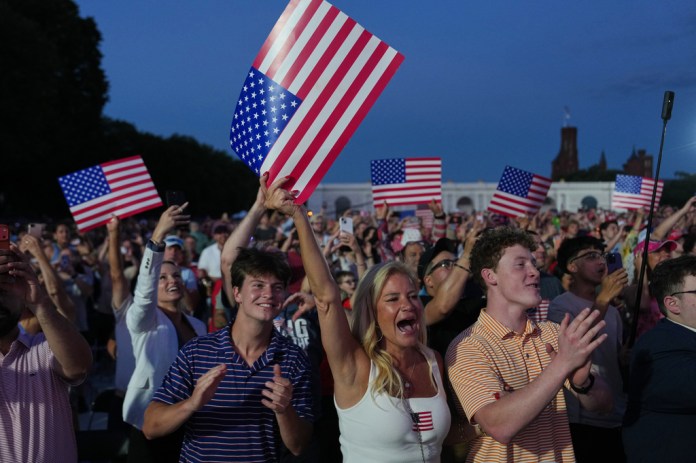
Less than one week before Americans are set to celebrate the 250th anniversary of the signing of the Declaration of Independence, new polling shows American pride has hit a new low nationwide. About one-third of the country identifies as “extremely proud” to be an American, with a 56-percentage-point pride gap between Republicans and Democrats, according […]

The justices will decide this week whether President Trump can end the guarantee of birthright citizenship and fire a leader of the independent Federal Reserve.
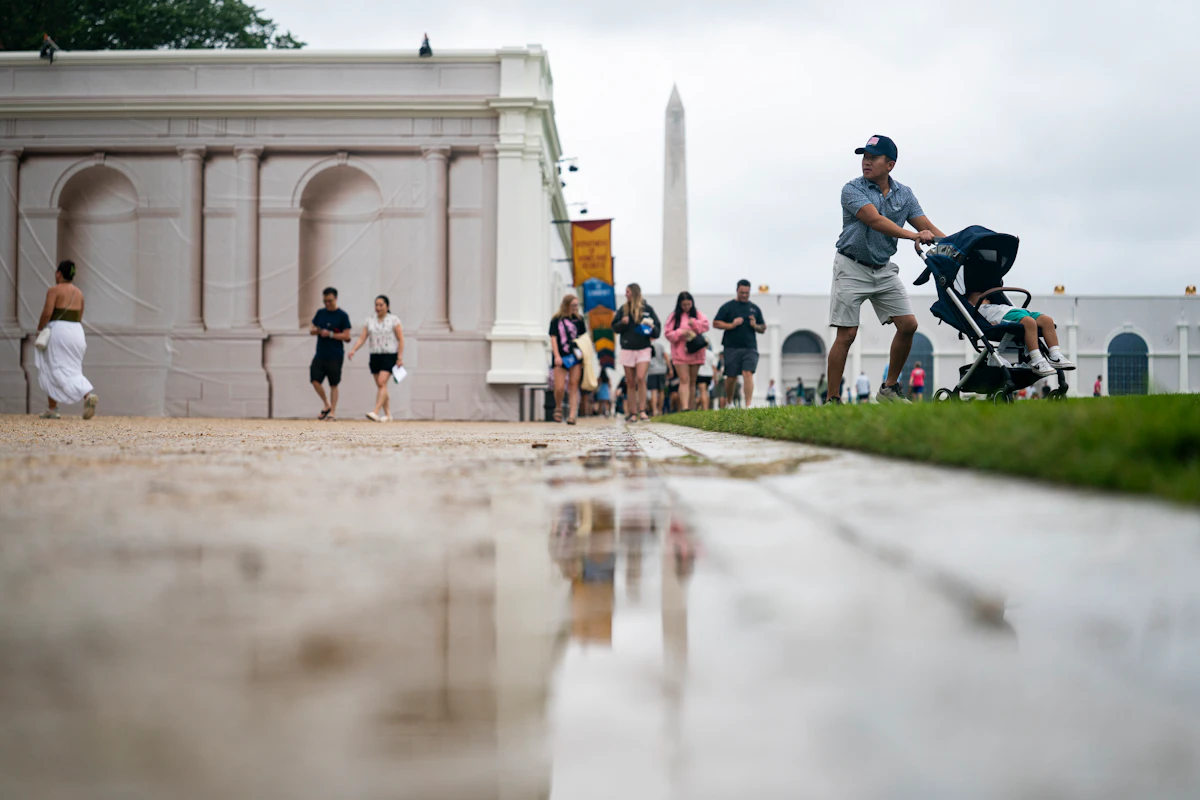
The opening weekend of the Great American State Fair in Washington, D.C., was, to put it simply, miserable. It was extremely muggy, with rain pouring down seemingly every hour. A child rolled around in the grass, crying and screaming, “I. WANT. TO. GO. HOME!!!” Creed’s “Higher” blared over the loudspeakers, and a sparse crowd milled about the various exhibitions. The bare-bones setup—flimsy, fake two-dimensional columns that looked like something Wile E. Coyote would run into while chasing the Road Runner—left much to be desired, as America’s 250th anniversary was celebrated with kitsch and ennui rather than grandeur and appreciation. More than anything, the event lacked energy—and people. There wasn’t any line or wait to get in. The vibe was more conference-like than celebratory, and the state exhibits varied wildly in effort and presentation. Utah and Guam had particularly involved setups, while others like South Carolina felt totally sterile. Connecticut and Maine shared a space that looked like the waiting room of a pediatrician’s office, while Hawaii and Alaska didn’t have anyone attending to visitors. There were $25 pretzels, an AI George Washington, an interactive “Loyalist or Patriot?” test, and a whiteboard wall full of messages from attendees, one of which read “a felon and predator resides at 1600 Pennsylvania Ave!!”“It feels more like a campaign event than a fair,” said M., a D.C resident who didn’t want to be named and was visiting with his wife and son. “There was potential here. I think that the state exhibits they had, some of them were very well done, others didn’t really have much effort put into them.… My four-year-old enjoyed the carousel, but I think that if this was done a little bit more thoughtfully it could’ve been really fun. I’ve been going to state fairs for most of my life, I’m from Minnesota. And so seeing what a really thought-out, well-done state fair looks like—it’s an incredible experience.” Bit of a flimsy set up at the Great American State Fair pic.twitter.com/4H1YauQgp4— Malcolm Ferguson (@malc_ferg) June 29, 2026“Kind of disappointing they don’t have anywhere to sit, especially if you get food—you’re just standing,” said Virginia resident Anita, as we were being ushered out of the “rain-or-shine” event Sunday afternoon due to the weather. “Right now, we’re being postponed because of lightning. Where are we all supposed to go? We drove two hours, we’re not just gonna go jump in the car. It’s kinda sad there’s not a backup plan.” “I think if [Trump] wanted to make a bigger splash, he should’ve gotten Disney, or somebody who knows how to do this,” said Haven, another D.C. resident attending the fair. While many states and artists opted out of the event, corporations did not. The presence of companies like Northrop Grumman, United Health Group, Chime, and others was very apparent.“I understand that people are advertising here, that there’s sponsors,” said a visitor named Ryan. “Coming in and seeing SpaceX, or like Micron was kind of like, ‘Oh, I wasn’t expecting that.’ But it’s America, so maybe I should’ve.” When asked about defining American moments of their lifetimes, attendees’ answers were about as bleak as the scene, as almost all the answers included 9/11, Covid-19, and pretty much every war the U.S has been in. “The Revolutionary War, World War II, the Vietnam War, the Iraq War,” said Haven. “It’s a shame you think of war first.” Of course, not everyone was underwhelmed by the fair.“I know how much [President Trump] loves the country, so I’m not the least bit surprised that they’re going all out,” said Nicki Hannigan, in her seventies, who came all the way from Grand Rapids, Michigan, with her husband, Jack.“There’s not a weed in this grass!” Jack said. “I don’t know if anybody’s noticed that, but that takes some doing. If the administration can do that well, they can do a lotta stuff well.” “Well” is relative, as the event has been shrouded in tumult as Trump took over. What was originally supposed to be a weeks-long blockbuster festival to celebrate the nation turned into a politically charged event, where even B- and C-list artists like Flo Rida, Milli Vanilli, Vanilla Ice, and the Commodores dropped out. Soon, nearly a dozen states did too, as it became more and more obvious that Trump was using this event for partisan purposes. As everyone bailed, Trump petulantly declared the fair would instead be kicked off with a rally that he would headline—but even that didn’t get much of a turnout. That timeline of chaos still felt prescient, as the haphazard, thrown-together nature of the event stood out more than anything.
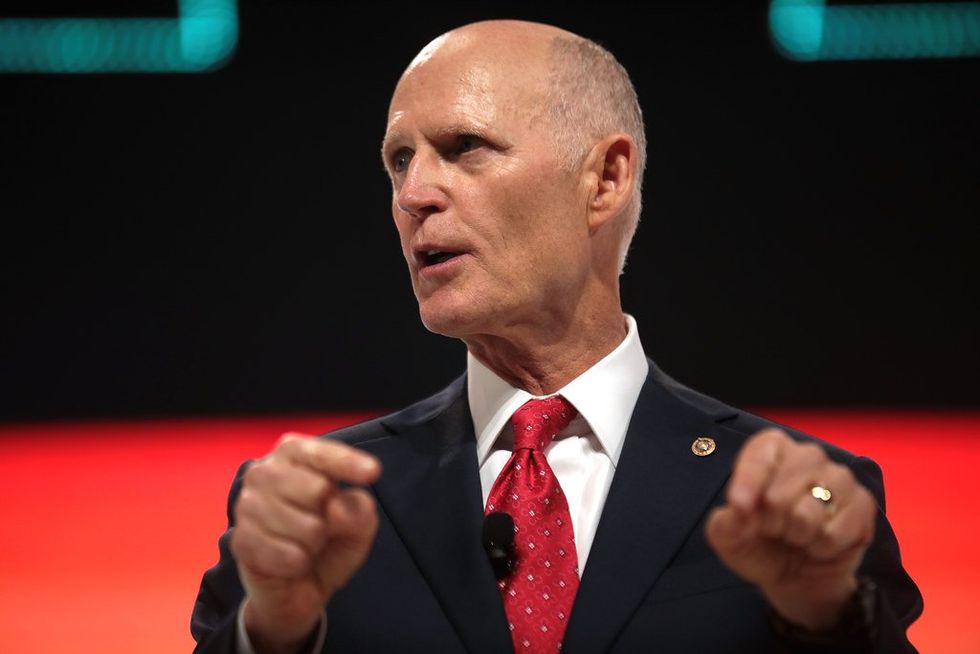
With tensions between President Donald Trump and Senate Majority Leader John Thune (R-South Dakota) growing — and the 2026 midterm elections a little over four months away — Sen. Rick Scott (R-Florida) invited Trump to address Senate Republicans at a lunch held on Wednesday, June 26. Scott is saying that he was trying to promote a healthy dialogue between Trump and Thune, but the Florida senator, according to Politico's Jordain Carney, proposed the lunch "without Majority Leader John Thune's express approval" — and Scott's actions are fueling speculation about his possible motivations."What has become eminently clear in recent weeks is that Scott — after a long career in business, two terms as governor and nearly eight years as senator — just isn't a back-bench kind of guy," Carney reports in Politico. "He has lots of thoughts on how the Senate should be run and a willingness to express them, even if it puts him at odds with Thune's vision. The leader, who trounced Scott in a 2024 conference election, has largely avoided holding doomed votes that would split Republicans and, like many GOP senators, would like nothing more than to get past the months-long intra-party fight over the SAVE America Act, the elections bill pushed by Trump."Scott, according to Carney, "insists that those who see this as a prelude to a leadership challenge" against Thune "have it all wrong."The Florida senator/ex-Florida governor told Politico, "Here's what I don't get. Other people get to put out their position. If I put out mine, then I want to be leader?"But Carney notes that Scott's latest actions are "only his latest attempt to stay in the thick of the action in a body where obscurity can be hard to avoid.""His stint running the GOP Senate campaign arm ahead of the 2022 midterms was controversial and ended with Democrats beating historical headwinds and slightly expanding their bare majority," Carney reports. "He annoyed colleagues with his policy of not intervening in contested Republican primaries and infuriated some of them by promulgating a policy agenda through his personal political operation that they hadn’t agreed to. That did not deter Scott from challenging then-Minority Leader Mitch McConnell after the election that year, garnering only 10 votes of 47. He tried again after McConnell stepped down as leader two years later. Scott won 13 votes in a three-way race, but Thune ultimately prevailed."Carney points out that Thune, unlike McConnell, Scott "doesn't have an openly antagonistic relationship with Scott." And the Senate majority leader avoided criticizing Scott during an interview with Politico.Thune told Politico, "He brings people in that help inform our conversations and discussions about some of the major policy issues. I'm very supportive of what he's doing."

We sent our guy Brandon London to Norway vs. Senegal using public transportation from midtown Manhattan to MetLife Stadium to test just how bad the commute is to get to the World Cup. Watch on Youtube: https://youtu.be/caw1bhrtgeg

A professor of political science weighed in Monday on the latest controversy surrounding President Donald Trump and his family, one that involves allegations of corruption so blatant, the professor said, that a graphic outlining the alleged corruption bore resemblance to “an inbred family tree.”According to an explosive report from The New York Times Sunday, the sons of both Trump and Commerce Secretary Howard Lutnick are expected to profit handsomely from a secretive deal signed off on by Trump last November. As revealed by the Times, the Trump administration approved “as much as $1.6 billion in federal financing” for a small American mining company in an arrangement to secure Kazakhstan’s tungsten reserves, a deal that both Trump and Lutnick’s sons are expected to financially benefit from.Adam Bonica, a professor of political science at Stanford, noted the unprecedented simplicity of the alleged corruption scandal, writing on social media that the graphic created by the Times to illustrate the key players in the arrangement was unlike any similar graphic he’d seen before.“Usually these political corruption maps have complicated plumbing,” he wrote in a social media post on Bluesky, a comment that was flagged by Zeteo on Monday. “You know it’s bad when it’s just a closed loop that looks like an inbred family tree.”Trump’s sons – Donald Trump Jr. and Eric Trump – took a 20% stake in an entity “related to the Kazakhstan project,” the Times reported, and Lutnick’s sons – Brandon and Kyle Lutnick – helped raise funds for the deal through their investment company Cantor Fitzgerald, something that “typically [nets] Cantor millions of dollars in fees.”Even Pini Althaus, the owner of the aforementioned mining company, Kaz Resources, admitted to the Times that the optics of the arrangement looked "disturbing."“I can see how the optics might be disturbing to some people,” Althaus told the Times.Usually these political corruption maps have complicated plumbing. You know it’s bad when it’s just a closed loop that looks like an inbred family tree.[image or embed]— Adam Bonica (@adambonica.bsky.social) June 28, 2026 at 11:54 AM

“I do not love America, and never have, especially now.” Those are the opening words of America, U.S.A.: How Race Shadows the Nation’s Anniversaries, a new book from Princeton historian Eddie Glaude. Released ahead of the 250th anniversary of the Declaration of Independence on July 4, the book is a critical look back at how the United States has celebrated previous milestone birthdays, including what narratives were left out of the official commemorations. This comes as President Donald Trump has made himself the center of many events and celebrations for the 250th anniversary, while promoting a “storybook version” of U.S. history that elides the injustice that was baked into the very founding of the country, Glaude tells Democracy Now! in a wide-ranging conversation about race, inequality and the legacy of slavery. “Donald Trump and his supporters, they want to be white without judgment,” says Glaude. “History is a battleground, because history, of course, holds them to account.”

The Trump administration’s commemorations of the 250th anniversary of the country’s founding have drawn criticism for their overt partisanship and conflicts of interest for the Trump family. Surveys show widespread ambivalence and lack of enthusiasm for the semiquincentennial. StoryCorps founder Dave Isay has set out to capture the national mood with Connect250, an oral history project matching strangers across the United States to interview each other about their lives, families and formative experiences. The series is produced in partnership with NPR’s Morning Edition, with the conversations to be preserved in the Library of Congress. “It’s actually a very hopeful project,” says Isay. “We have to hold on to hope.”