Nuclear energy revival fueled by growing embrace by the Left
Source: Washington Examiner · Bias: Center Right
Summary
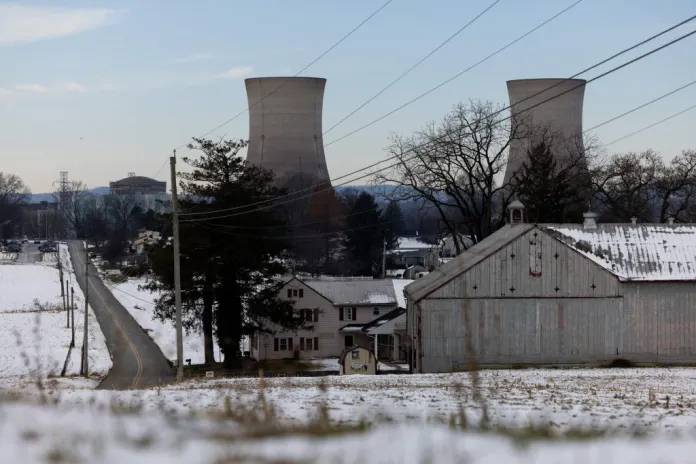
Nuclear energy is now championed by liberal Democrats and environmentalists, who led anti-nuclear protests and rallies across the United States 50 years ago. The carbon-free power source was long controversial, as critics said it posed massive environmental and public health threats. But as demand has soared, thanks to artificial intelligence, electrification, and increased manufacturing, many […]
Nuclear energy revival fueled by growing embrace by the Left
Center Right
Nuclear energy is now championed by liberal Democrats and environmentalists, who led anti-nuclear protests and rallies across the United States 50 years ago. The carbon-free power source was long controversial, as critics said it posed massive environmental and public health threats. But as demand has soared, thanks to artificial intelligence, electrification, and increased manufacturing, many […]
Resistance is mounting across the United States against the increasing use of surveillance tech company Flock Safety’s cameras, with a growing number of cities canceling contracts as the artificial intelligence-powered license plate readers are quietly being installed in thousands of locations nationwide.State and local police departments first used the Atlanta-based company’s automated license plate reader (ALPR) systems for standard law enforcement purposes, but they are now being employed for a much broader range of uses, including immigration-related searches and other actions supporting US Immigration and Customs Enforcement (ICE) during the Trump administration’s deadly anti-immigrant crackdown.“We have cameras that are used for everything from illegal dumping to drug houses to hotels that are just big problems,” Flock Safety engineer Kevin Cox told prospective customers during a demonstration of the company’s Condor Camera, according to a Thursday report in The Washington Times.“There are endless, endless uses for what we can do with these things,” Cox added.Those uses include spying on constitutionally protected protest activity and enforcing abortion bans by tracking pregnant people’s travel across states—even ones in which the medical procedure is legal.The ACLU—which recently launched a “Get the Flock Out” campaign to “fight creepy ALPR cameras”—says there are currently between 80,000 and 100,000 Flock devices installed nationwide that conduct more than 20 billion scans per month. More than 5,000 law enforcement agencies use the cameras, and some of them keep their locations a secret.“Flock’s ALPR cameras aren’t like your normal traffic cameras,” the ACLU explained. “This surveillance technology records and tracks every car that comes into view, and then an AI algorithm catalogs the make, model, color, license plate number, bumper stickers, and even scratches. This personal information is then uploaded into a nationwide database that any law enforcement agency with a Flock contract can search—with few regulations or oversight on how they use what they find.”The backlash against creeping state surveillance has even transcended the partisan divide.“I think our country is in a kind of uniquely anti-surveillance environment right now, which is to say that, in a time where it seems there is nothing that is not partisan, opposition to government surveillance is nonpartisan,” ACLU privacy and surveillance attorney Chad Marlow told The Washington Times on Thursday.There is growing action—both legal and otherwise—to end the use of ALPRs across the country.According to the public information project Ban Flock Cameras, 82 Flock contracts were terminated across 28 states between August 2021 and May 2026, with 39 of those cancellations occurring in the first five months of 2026 alone.Even Amazon-owned Ring announced earlier this year that it would stop doing business with Flock Safety.Susie O’Hara, a member of Santa Cruz, California’s nominally nonpartisan City Council, told WBUR earlier this year that she grew increasingly concerned about local use of eight Flock cameras last year after learning that police were sharing data gleaned from the cameras with the company’s national network without city officials’ knowledge, a violation of state laws banning the practice.O’Hara became increasingly convinced that Santa Cruz should cancel its Flock contract after an ICE agent fatally shot Renee Good, a US citizen, in Minneapolis in January.“I have goose bumps on my arms thinking about the absolute chaos that was happening in Minneapolis,” she said. “And just the absolute insanity of what we were seeing... It was totally clear to me that we should in no way consciously be in this system at all—just no way.”Less than a week after Good’s killing, the Santa Cruz City Council voted to terminate the city’s Flock contract, becoming the first municipality in California to do so.“For us, the threat to our civil liberties was greater than any benefit we could get from the flawed product,” Santa Cruz Mayor Fred Keeley told KQED at the time.Chad Kemp, who represents District 32 on the nonpartisan Dane County Board of Supervisors in Wisconsin—which in April voted to stop funding two dozen cameras leased from Flock—told The Washington Times that “there’s a public safety issue here, but there is also a privacy issue.”“There are serious concerns about individuals who can be monitored without their knowledge, or if it is even constitutional or ethical to track people without a warrant,” he added.At the national level, US Reps. Robert Garcia (D-Calif.) and Raja Krishnamoorthi (D-Ill.) last year launched an investigation into the use of Flock cameras to track pregnant people across state lines for abortion care and to conduct unauthorized immigration enforcement operations.Krishnamoorthi and Sen.
The fight that scrubbed the world's most powerful AI models from the internet featured personality clashes, industry confusion, and international backlash.Why it matters: Anthropic's models are back online, but the impact of its 20-day showdown with the Trump administration will be long lasting.Behind the scenes: It began when Amazon, Anthropic's partner and investor, sounded an alarm that was later disputed by cybersecurity experts.It warned about a "jailbreaking" issue it found with the AI lab's latest models, Mythos and Fable — meaning a technical flaw that could have caused a failure of their guardrails.Amazon flagged its concerns to the administration, triggering sweeping export controls. A U.S. official said the government conducted its own tests once it became apparent that the issue needed to be addressed.Cybersecurity experts, however, later wrote in an open letter to the administration that other leading AI models have the same issue Amazon warned about with Anthropic.On June 12, Commerce Secretary Howard Lutnick, at the direction of President Trump, called Anthropic CEO Dario Amodei. Lutnick made clear to Amodei the issue needed to be resolved fast and alerted the CEO that the company would be receiving a letter imposing sweeping export controls, the U.S. official said.Amodei called Lutnick back that night after receiving the letter, realizing it effectively meant the models would have to be taken offline — to which Lutnick responded that was indeed the goal.That decision led to a three-week, multi-agency crash course in AI safety.Anthropic deployed engineers to Washington D.C. According to a U.S. official, the company wanted to prove everything was already resolved and further changes were being fine tuned.But the federal Center for AI Standards and Innovation and the National Security Agency said those changes weren't good enough, prompting further fixes, according to the U.S. official.Gradually, various agency heads approved of the changes, and on July 1 the models were released, the official said.Out of all of the administration officials Amazon's Andy Jassy could have called, it was Treasury Secretary Scott Bessent who first heard about the jailbreaking issue found in the company report, according to a separate source familiar.Bessent was early to sound the alarm on Mythos, work with White House Chief of Staff Susie Wiles to re-engage the embattled company, and help get a cybersecurity executive order across the finish line.While technical discussions to address the jailbreaking issue took place in D.C., it was Bessent who stood next to President Trump during the G7 where allies called for global cooperation on safety standards.At the center of the showdown was Commerce Secretary Howard Lutnick, who also flanked Trump at the G7 meeting while his department's teams led technical discussions.National cyber director Sean Cairncross, the White House Office of Science and Technology Policy, Treasury Department chief information officer Sam Corcos, and the NSA also all participated in technical discussions, according to various sources.Washington mobilized faster to hold scores of meetings and pulled in far more agencies than one would expect for a single technical issue, one source said.The tension spiraled amid personality clashes and poor communication.Anthropic eventually understood that in order to be successful they needed to be on the same side as the government, the U.S. official said.As discussions turned more technical, Anthropic policy chief Sarah Heck and Anthropic co-founder Tom Brown got more involved. Brown also had multiple conversations with Lutnick and Cairncross the weekend of June 12.There was never a moment where Dario stepped offstage and someone else replaced him, one source said, adding that Brown's technical expertise allowed him to sit in a room with government specialists and go line‑by‑line through how models behave under stress.Between the lines: It remains uncertain when and how Anthropic's models will be released to ally countries around the world — which proponents say is key to beating China — or how other labs from OpenAI to Google will release their latest models.OpenAI, whose latest model GPT-5.6 is on hold, did not have visibility into discussions between Anthropic and the White House and is engaged in daily technical discussions on the release of its own model, a source said.The bottom line: There's a lot of work left to be done on a framework for approving future models with a clear inclusive process that has transparency standards and timelines, sources familiar said.
In just the past two weeks, four insurgent left-wing candidates - including three socialists - have won Democratic congressional primaries. The latest victor, 29-year-old Melat Kiros, defeated 15-term incumbent Diana DeGette Tuesday night.
The White House is facing the prospect of a summer slowdown in the job market, with economic issues top of mind for voters heading into November’s midterms. NBC News correspondents Kelly O’Donnell, Brian Cheung and Keir Simmons report on renewed economic concerns. Oil industry expert John Kilduff discusses what consumers can expect to pay at the gas pump heading into the fall.
WHAT’S HAPPENING TODAY: Good afternoon and happy Thursday, readers! Daily on Energy will be suspended tomorrow for the long-Independence Day weekend. Our regularly scheduled programming will pick back up on Monday! 🦅🇺🇲 If you’re in Washington D.C. for the festivities, this year’s fireworks are expected to start around 10:30 p.m. or 11 p.m. It will […]