The Trump administration’s hesitancy in signing a major drone deal with Ukraine is slowing the U.S. military down in an area where it’s already trying to play catch-up. Even as Ukrainian President Volodymyr Zelensky has urged Washington to make a deal, with talks between the two nations stretching back to at least September, the U.S.…
President Trump’s boasts of securing a commitment from Iranian leaders not to develop a nuclear weapon have puzzled nuclear experts who note that Tehran has made that pledge for more than 50 years.
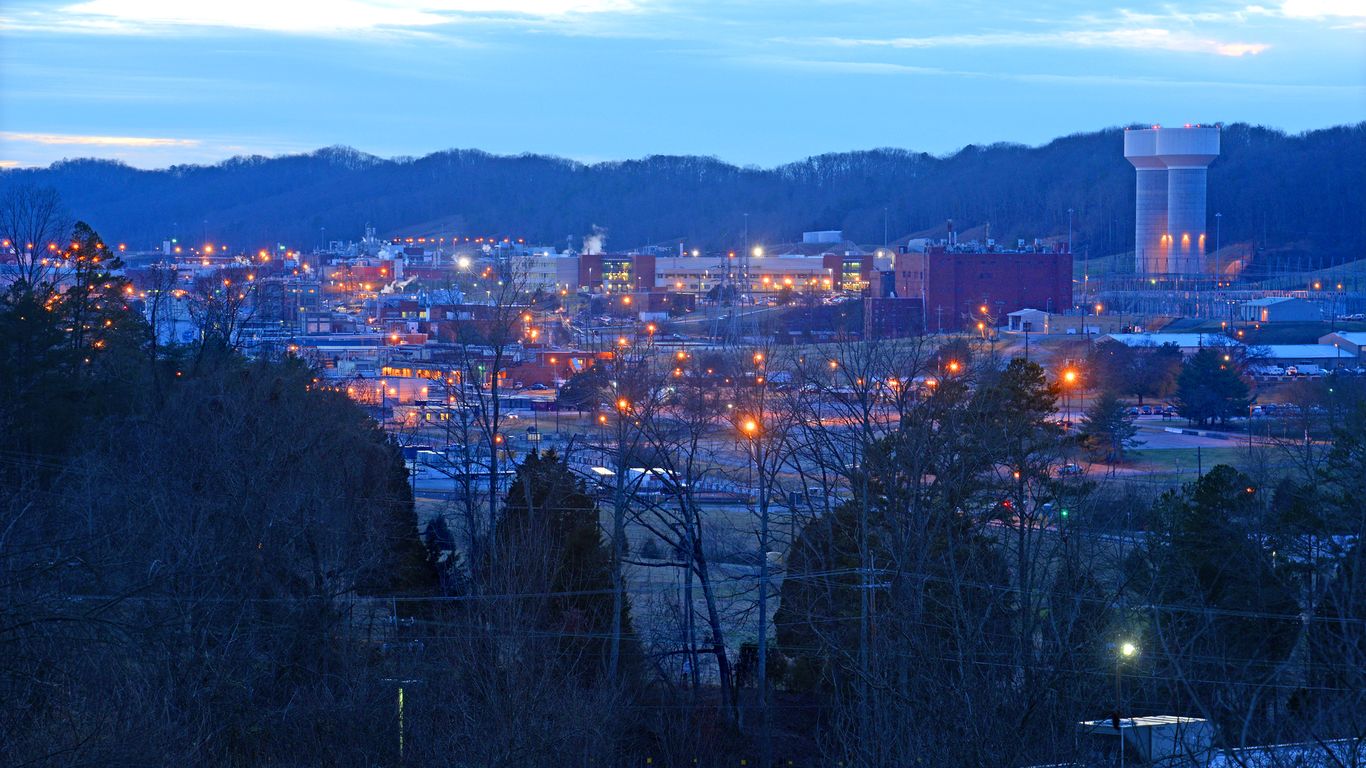
President Trump's envoys Steve Witkoff and Jared Kushner traveled to the national lab in Oak Ridge, Tennessee on Thursday for consultations with a team of technical experts that could play a role in nuclear negotiations with Iran, Axios has learned. Why it matters: The White House is trying to reach a memorandum of understanding (MOU) with Iran to end the war and begin in-depth nuclear negotiations, and wants to have experts at the ready should those talks be launched.The U.S. and Iran are still at odds on several details of the MOU, according to U.S. officials and regional sources involved in the mediation. The sources characterized the negotiations as in their final stretch, but it remains unclear whether agreement will ultimately be reached."This meeting in Oak Ridge doesn't mean that a deal is going to happen, but it is a sign that the negotiations are in a very serious phase and that there is a good chance to get it done and we want to be prepared," a U.S. official said.The intrigue: Axios was alerted on Thursday to the fact that Witkoff had made an unannounced trip to eastern Tennessee. Two U.S. officials later confirmed he and Kushner were visiting Energy Department facilities at Oak Ridge.Some of the country's foremost experts in uranium processing and centrifuge technology are based at Oak Ridge National Laboratory and Y-12 National Security Complex. In the past, nuclear materials and equipment — including from Kazakhstan and Libya — were routed through Tennessee.The White House declined to comment. The National Nuclear Security Administration did not provide comment.The two U.S. officials said a team of roughly 100 experts was recently established to take part in the nuclear negotiations should a preliminary deal be reached. The Iran envoys made the trip to meet with members of that team and discuss preparations for the potential implementation of a nuclear deal.Driving the news: Witkoff and Kushner agreed terms with their Iranian counterparts last week on a 60-day MOU to extend the ceasefire, reopen the Strait of Hormuz, allow Iran to sell oil and launch talks on Iran's enriched uranium stockpile and limitations on future enrichment.Trump asked for two amendments to the text last Friday, and the Iranians said they would ask for tweaks of their own. The U.S. is waiting for the official Iranian response, but the sources said the gaps are relatively narrow.For example, Trump asked Tehran to agree that any final deal would include a 60-day deadline to conclude the down-blending of Iran's enriched uranium, but the Iranians want that deadline to be 90 days, according to two sources briefed on the talks.There is also disagreement over how much of Iran's frozen billions would be released, and when. The U.S. has said it would release funds after a final deal was reached and concrete steps were taken toward implementing it, a U.S. official said. The Iranians want some of the funds released immediately.An adviser to Iran's supreme leader told CNN that the talks were deadlocked over the frozen funds and "the ball is in Trump's court."Zoom in: If the negotiations advance to the second phase, the team of experts that met with Witkoff and Kushner would have to develop a plan for the disposal of Iran's nuclear material, how to limit the enrichment program further, and how to verify compliance.The U.S. officials said some of the same experts with whom Witkoff and Kushner met on Thursday participated in the process of recovering enriched uranium from Venezuela several weeks ago. That material, from a research reactor, arrived last month in South Carolina for processing.Some of the nuclear experts who participated in the meeting also joined Kushner and Witkoff in Oman for nuclear negotiations with Iran before the war."These are the top nuclear experts in the U.S. who know how to do the technical things that a deal with Iran will entail," a U.S. official said. What to watch: U.S. officials claim the White House has been getting positive indications from the Iran negotiators, but think there are internal divisions in Tehran over how to proceed.
The release of heavily redacted FBI records showing that a sheriff's deputy exchanged emails with would-be Trump assassin Thomas Crooks before the July 13, 2024 shooting — as Raw Story reported — sent MAGA world into overdrive this weekend, with commentators across the political spectrum demanding answers about what those emails said and why the documents remain concealed.MeidasTouch, the liberal political media outlet, reached nearly 500,000 views with a post summarizing the Judicial Watch release, noting that "the records remain heavily redacted, concealing the nature of the communications."Kaelan Deese, a political reporter, called it "a bombshell in their Thomas Crooks FOIA fight," and flagged the recovery of the gray remote device with an antenna from Crooks' pocket as a detail warranting further scrutiny.Sara Gonzales, a conservative commentator at The Blaze, kept her focus on the emails: "The public deserves to know why and when Crooks contacted law enforcement."Not everyone agreed the word "exchange" was warranted. Heather Champion, a conservative social media personality, urged precision: "I don't know if 'exchange' is correct but they did receive emails from Thomas Crooks before the July 13 Trump rally."Left-wing podcaster Jimmy Dore, who has previously raised questions about the official account of the shooting, used the records to revisit a string of unresolved details. "So you're telling me there's some nefarious stuff surrounding the supposed assassination attempt of Trump?" he wrote. "You mean the one where the cops admitted to seeing him THREE TIMES in a restricted area with a scope and a backpack and yet never did anything? The one where a bunch of people in the crowd saw the shooter on the roof but no cops or secret service officers or sheriff's deputies or State troopers saw him?"Shane Cashman, a journalist, offered the most pointed response, cataloging the same unanswered questions in a sardonic thread while warning against the leap to conspiracy. "There's literally nothing weird about Thomas Matthew Crooks emailing a deputy from Butler, PA before the assassination attempt," he wrote, before listing item after item: that Crooks practiced at the same range Homeland Security used, that local police and Secret Service spotted him with a rangefinder and texted about him for over an hour before he climbed the roof, that no Secret Service drones were flying that day while Crooks allegedly had one, that his house had no trash or silverware and his body was cremated ten days later before Congress could view it. "This is like when people say the CIA was shadowing Oswald before he, and he alone, shot JFK."What nobody knows, still, is what those two emails said.
FBI records obtained through a Freedom of Information Act lawsuit reveal that a Butler County Sheriff's deputy exchanged two emails with Thomas Matthew Crooks — the gunman who shot and wounded President Donald Trump at his Butler, Pennsylvania rally on July 13, 2024 — prior to the attack. The content of those emails remains unknown. The records are heavily redacted.Judicial Watch announced it had forced the release of 48 pages of FBI records through a federal lawsuit. An FBI interview summary from July 17, 2024 shows a deputy telling investigators she had checked her records and found two email communications from Crooks — both "in regard to [redacted]." She told investigators she did not personally interact with Crooks and did not recognize him when news of the shooting broke, only learning of the connection when a New York Times reporter emailed her Sunday night asking questions.The records also reveal that a Beaver County Emergency Services Unit medic who responded to the AGR building roof — where Crooks had positioned himself — told the FBI she observed a Washington County SWAT officer remove "a gray remote device with numerical push buttons and an antenna and a cell phone" from Crooks' right pocket after he was killed. Explosive ordnance disposal personnel subsequently arrived on the roof to examine the device. A police canine also "hit" on the building beneath the roof while the medic was present, prompting an evacuation — though Crooks' body remained on the roof.The medic pronounced Crooks dead at 6:25 p.m. She later handed a body bag to someone from either the FBI or Secret Service but could not recall which agency, the report states."Our federal lawsuit continues to force the release of new information from the assassination attempt at the Butler rally," said Judicial Watch President Tom Fitton. "The American people deserve full transparency about Thomas Crooks, his contacts, and why key details about this case remain hidden nearly two years later."
Friends,Today is the 82nd anniversary of D-Day — the Allied invasion of Normandy on June 6, 1944. It’s referred to as “D-Day” after the military term for a day when a secret combat attack or operation is planned.It was the largest seaborne invasion in history. It began the Western Allied effort to liberate western Europe from Nazi Germany.Over 2,500 American soldiers, sailors, and airmen were killed during the initial amphibious assaults and airborne operations. All told, there were 4,414 confirmed Allied deaths on the first day of the invasion, which also included troops from the United Kingdom and Canada.At the time of the invasion, my father was 30 years old, in a tank battalion readying to go to Europe. My mother was 25, working in a factory producing gas masks for the war. Some of their friends participated in the invasion. A few were paratroopers. Others were pilots. Others were soldiers.As a small boy, I remember trying to talk with my father and my mother about D-Day. I wanted stories. The little I’d heard about it made it seem romantic and exciting. But they were reluctant to talk about it. They answered my questions in short sentences. Their voices were hurried. It was as if I was trying to open a door they’d rather keep closed. They had lost friends, relatives. D-Day, and the war it helped end, had left deep scars.Eventually they and their generation were called America’s “greatest generation” for their valor and sacrifice. They had fought fascism and won.Now, 82 years later, we have home-grown fascism. An entire political party seems to have given up on democracy. They’re supporting an ego-maniacal “strong man” who cares only about enlarging his own (and his family’s) wealth and power.His regime is marked by a degree of corruption, cruelty, and criminality never before witnessed in America’s national government.Trump’s and his “war” secretary, Pete Hegseth’s firing of so many top brass can be seen as a way to guarantee the loyalty of other officers to Trump rather than to America. Trump’s proposal to increase the U.S. military budget by nearly 50 percent can be understood as a bribe to officers. He wants them to side with him, if and when he tries to stay in power indefinitely.He has already tried to turn much of America into a police state.Public support for him is waning, and the federal courts have fought back. But it is startling and saddening how far Trump and his regime have gotten.What happened to the bravery and dedication of the greatest generation? What became of the sacrifices my parents and their peers made so that this nation could be free?How and why did so many Americans succumb to neofascism?I think it has to do with the anger so many Americans have felt that they and their children haven’t been able to get ahead, no matter how hard they work. Trump and other neofascists have channeled that anger toward immigrants, gays, transgendered people, Muslims, and Black people.Democrats and progressives should be channeling that anger toward the real culprits — a wealthy elite that’s used their money to gain political power and rig the economy to their benefit and against everyone else.Another reason so many have succumbed to Trumpian neofascism is the passage of time. Eighty-two years is long enough for a nation to forget, especially a nation whose collective memory is short to begin with. Very few living Americans remember the terror and heroism of our fight against Nazi fascism. The greatest generation has mostly died off.But we must not forget. Fascism is being born again, in America and in Europe. This time it’s masquerading as white Christian nationalism, but it’s as dangerous as ever.The best way to remember and honor the men and women who risked everything for us is to fight neofascism — fight for a stronger democracy, fight for the rule of law and social justice, fight against bigotry.Robert Reich is an emeritus professor of public policy at Berkeley and former secretary of labor. His writings can be found at https://robertreich.substack.com/. His new memoir, Coming Up Short, can be found wherever you buy books. You can also support local bookstores nationally by ordering the book at bookshop.org