Market expectations for rate hike haunt Warsh and GOP
Center Right
Investor expectations that rising inflation will force the Federal Reserve to raise interest rates this year are creating a political quandary for Republicans ahead of the midterm elections, as well as new chairman Kevin Warsh. Bond markets show that traders see it as a fifty-fifty proposition that the central bank will raise its interest rate […]
Senate Majority Leader John Thune (R-S.D.) and other Senate Republicans are under new pressure to deliver on President Trump’s agenda after Sen. John Cornyn (R-Texas) suffered a blowout loss in the Texas GOP primary. Republican strategists say Cornyn’s lopsided loss is a major blow to Senate GOP leaders who poured tens of millions of dollars…
A super political action committee with a progressive-sounding name but with Republican financial backers that has been meddling in Democratic primaries was further exposed Wednesday by independent journalist Judd Legum as a clear example of a “dirty tricks operation.”Legum’s new reporting on the funding behind a mysterious super PAC called Lead Left, which recently spent hundreds of thousands of dollars to benefit Maureen Galindo, a failed Democratic candidate for US Congress in Texas who has been broadly condemned for antisemitic rants.According to Legum, Lead Left is linked to Republican operative Caleb Crosby, treasurer of the House GOP-aligned Congressional Leadership Fund (CLF) super PAC.“Several pieces of evidence point to Crosby’s involvement,” explained Legum. “First, of the roughly 48,500 distinct political committees that have filed with the FEC since 2016, only two others share an address with Lead Left — the Staples at 2241 North Monroe Street in Tallahassee. Both of those committees are connected to the Crosby Ottenhoff Group, the political compliance firm founded by Crosby.Legum also documented what he said were “substantial similarities” in messages run against Democratic candidates by both CLF and Lead Left.“In Nebraska, the American Action Network, the affiliated non-profit of the CLF, sent mail and ran digital ads seeking to damage House Democratic candidate and John Cavanaugh by linking him to Trump,” explained Legum. “Before the Democratic primary, Lead Left then ran television advertisements with a nearly identical message.”In addition to spending money to boost Galindo, who lost to Democratic rival Johnny Garcia on Tuesday by more than 20 points, Lead Left this month also spent over $1 million in an attempt to derail the candidacy of retired firefighter Bob Brooks, who last week won the Democratic congressional primary in Pennsylvania’s 7th congressional district and will now face off against incumbent Rep. Ryan MacKenzie (R-Pa.).Elected Democrats, including House Minority Leader Hakeem Jeffries, have accused GOP-backed interests of funding Lead Left, which they say is misleadingly posing as a progressive organization to boost the prospects of fringe candidates and hurt the party’s chance of retaking the House in 2026.
Senate Majority Leader John Thune (R-S.D.) is throwing his support behind Texas Attorney General Ken Paxton after Paxton’s primary defeat of incumbent Sen. John Cornyn (R) on Tuesday. In a radio interview with Hugh Hewitt on Wednesday, Thune said maintaining the Republican Senate majority is paramount, and that Paxton’s general election opponent, Democrat James Talarico, is a…
Americans already grappling with elevated gas prices face another inflation squeeze as severe weather, trade policy and geopolitical conflict could send consumer costs surging just before November's midterm elections.Grocery prices rose in April by the most in nearly four years, and experts warn the pressures will only worsen through 2027, when the U.S. Department of Agriculture projects a 3.2 percent increase in grocery prices and other experts warn that could rise even higher, reported Bloomberg.“It’s going to be a challenging year,” said Ricky Volpe, an agribusiness professor at California Polytechnic State University who expects grocery costs to soar by 4 percent to 4.5 percent. “Food is going to become less affordable, and consumers should be prepared for it.”The U.S. experienced its warmest start to any year on record, with temperatures running about 6 degrees Fahrenheit above average through April. The early heat prompted crops to begin blossoming prematurely instead of remaining dormant through winter, leaving them vulnerable to subsequent frosts. Meanwhile, drought has devastated agricultural regions nationwide — 70 percent of U.S. winter wheat production sits in drought areas as of mid-May, along with 25 percent of corn production.Beef prices hit record highs in April due to the smallest cattle herd in 75 years, squeezed by drought and elevated production costs. Tomato prices surged 33 percent over two months following winter storms that damaged Florida's growing season combined with declining shipments from Mexico due to Trump administration tariffs on Mexican imports.California, which supplies nearly half of U.S. vegetables and three-quarters of fruit and nut receipts, faces severe irrigation challenges after Sierra Nevada snowpack fell to just 23 percent of typical levels.The Iran war has disrupted global fertilizer markets, with North American fertilizer prices up 20 percent since fighting began, and El Niño is forecast to emerge by August with potential for unusual strength persisting into 2027, threatening additional drought in major international growing regions for rice, coffee and cocoa.The impact is already visible in household budgets, according to the report. James Giese, a 62-year-old from Madison, Wisconsin, reports cutting back on prepared foods and meat while growing potatoes in his backyard to stretch his budget. "I'm probably considered middle-income, but it's starting to pinch," he said.Consumers face additional headwinds, with household debt rising and savings rates are falling, and real average hourly earnings declined for the first time in three years through April.Food insecurity measures showed meaningful increases between October 2025 and February 2026, according to Federal Reserve data."As I've been saying: Inflation is just getting started. I think this is going to be a major theme of the next few years," commented Wall Street Journal columnist Christopher Mims. "It is not going to be pleasant, even for people with money. For people without, it's going to be (and is already) devastating."
Win It Back PAC, a conservative super PAC, released an ad torching James Talarico, saying the Texas Democratic Senate nominee “fights for 6 genders and all species.” The ad is a compiled video of Talarico’s past posts and bits from his campaign speeches with comments calling him a “Texas trailblazer” and referring to him as […]
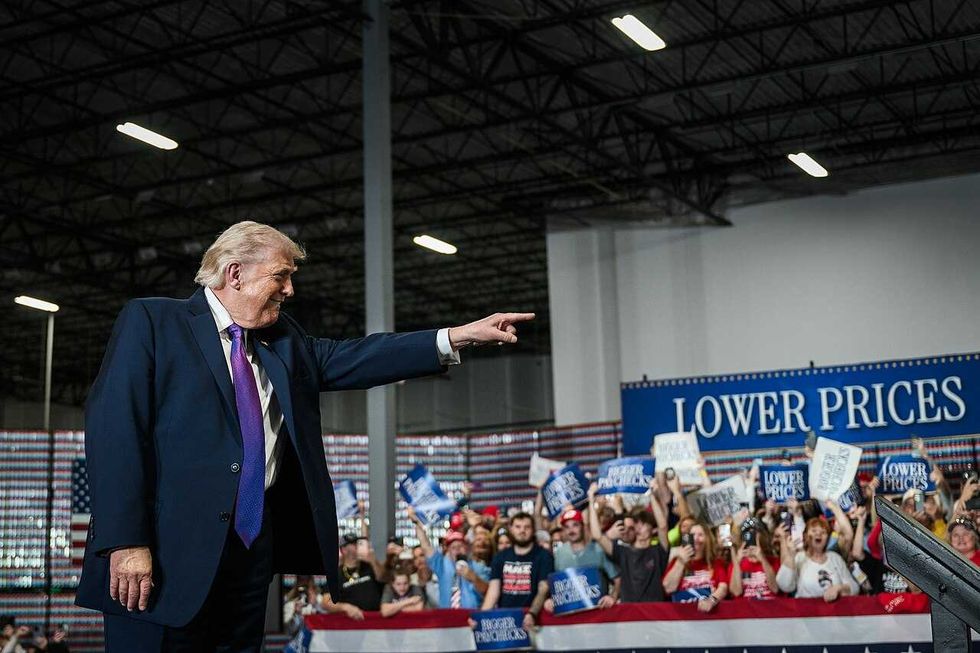
Despite suffering from weak approval ratings in countless polls, President Donald Trump is having no problem affecting the outcome of GOP primaries: Sen. John Cornyn (R-Texas), Rep. Thomas Massie (R-Kentucky), Sen. Bill Cassidy (R-Louisiana) and at least five Indiana state lawmakers are among the Republican incumbents who lost recent GOP primaries to challengers backed by Trump. Journalist Colby Hall is arguing that Trump's weakness in polls and far-right Texas Attorney General Ken Paxton's Tuesday victory over Cornyn are "the same story," showing that "Trump's coalition is getting smaller and louder at the same time.""The contradiction at the center of Donald Trump's politics has never been more visible than it was this week," Hall, the founder of Mediaite, writes in a column for his ColbyHall.com website. "He is one of the least popular presidents in modern polling history, and simultaneously, the most dominant force in the Republican Party. Neither fact is canceling out the other. His approval numbers are collapsing again. Depending on the poll, they are now approaching the lows he hit after January 6. He is underwater on inflation, cost of living, immigration, and now Iran. The broader electorate is plainly exhausted by him, the still very high price of a gallon of gas, and the bread and eggs he promised to make cheaper on Day 1 of his second term."Hall continues, "At the exact same moment, Trump casually ended Sen. John Cornyn's political career with a single endorsement of the far more MAGA-coded Attorney General Ken Paxton in Texas. Ironically, Trump helping Paxton win the primary delivers his MAGA faithful a short-term win while putting the seat itself in real jeopardy. Democratic nominee James Talarico is a much more plausible threat to Paxton than he would have been to Cornyn, and a Republican Senate majority that looked safe a week ago no longer does."According to Hall, the "true nature of Trump's current power" is that he "looks weak nationally" yet continues to be "all-powerful inside the Republican Party.""The two observations fit together pretty neatly," Hall argues. "Trump still owns the Republican primary electorate. The problem for Republicans is that the Republican primary electorate is no longer the country. His coalition is shrinking and becoming more emotionally concentrated at the same time. That creates the illusion of growing strength because intensity is very often mistaken for scale." Hall compares Trump's influence on the GOP's hardcore MAGA base to professional wrestling, noting that "the diehards in the front rows scream louder as the cheap seats empty out.""Trump's endorsement (of Paxton) remains incredibly powerful inside a shrinking but highly motivated audience that still sees him as the central figure in American politics," Hall explains. "Outside of it, the reaction looks very different. Republicans may still hold the seat, but they just replaced a broadly electable incumbent with a candidate carrying impeachment baggage, corruption allegations, and obvious general-election vulnerabilities. Democrats suddenly have a plausible opening in Texas that barely existed before."