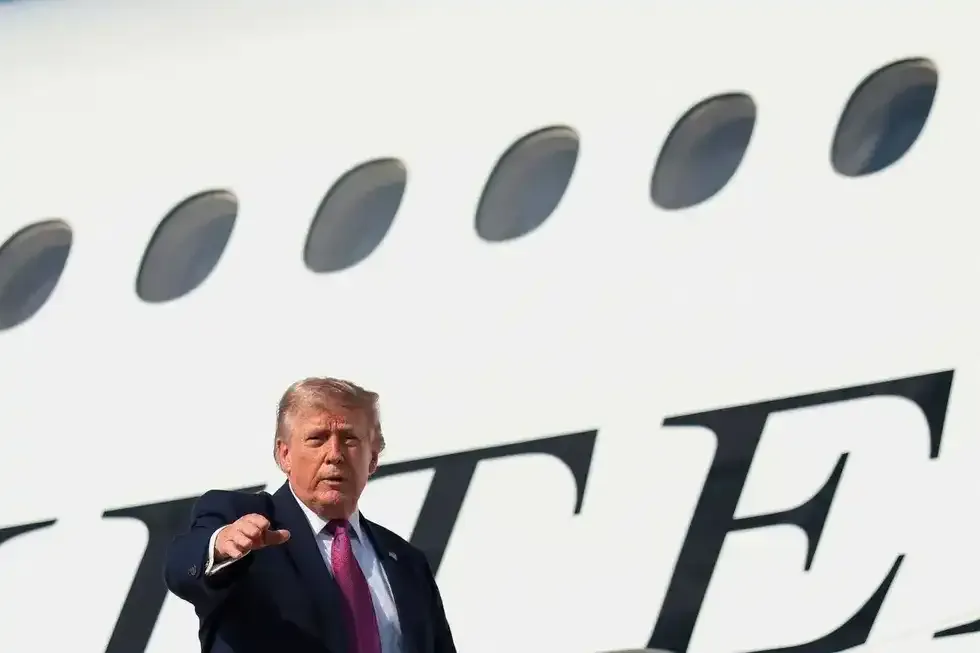
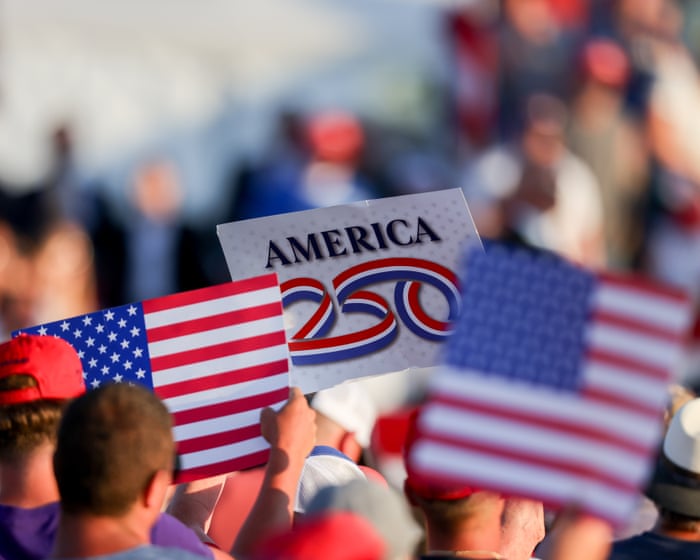
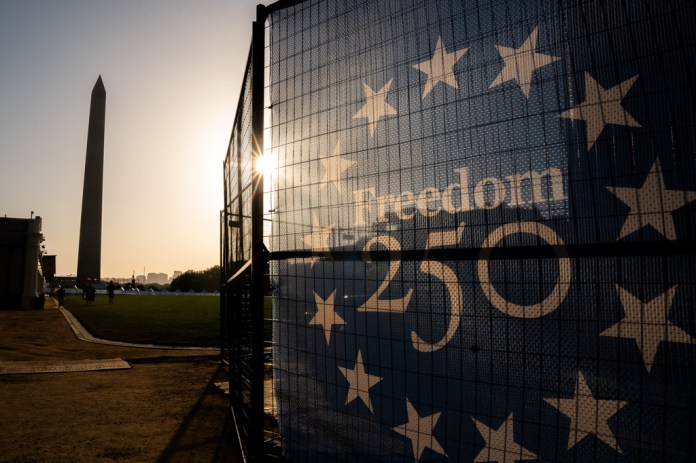
Severe weather threatened to put a damper on Friday on President Donald Trump's plans to speak near Mount Rushmore in South Dakota, prompting amusement from internet critics who said it seemingly indicated "god is angry."Trump was flying to South Dakota as part of a broader July 4 and America-250 trip, planning to visit the iconic American landmark for an Independence Day fireworks celebration. But Mother Nature, it seems, had other plans. A severe thunderstorm warning was in effect until 7:30 p.m. Eastern Time for the area, with quarter size hail that could damage vehicles reported by the National Weather Service. "Seek shelter inside a well-built structure and stay away from windows. This storm is capable of producing large hail," an alert on the weather service read.The weather alert forced Fox News to scramble, with host Bret Baier telling viewers they had breaking news."They just said there is severe weather on the way. In fact, they said hail could be coming, and they are urging everybody to get inside," said Baier, adding: "We're going to get to shelter."The setback prompted mockery from onlookers, with Ron Filipkowski, editor-in-chief of the progressive MeidasTouch news outlet, quipping on X, "God is angry."Dan Koh, a Massachusetts Democrat running for Congress, chimed in on X, "Considering Trump wants to cut the National Park Service budget by 40% and Mount Rushmore has a $57m repair backlog, you better run."The progressive influencer account known as Polly Sigh added: "Calamitous weather seems to follow Trump around these days. Mother Nature is so over him."Writer Joe Flood joked, "damn antifa!"Trump has had mixed luck with weather in recent weeks, with scorching temperatures and rain derailing his Great American State Fair.Fox at Mount Rushmore: They just said there is severe weather on the way. In fact, they said hail could be coming and they are urging everybody to get inside. We're going to get to shelter. pic.twitter.com/hyfc0nPghU— Acyn (@Acyn) July 3, 2026
Against a backdrop of sweeping rollbacks of civil rights and deteriorating relations with allies, many are feeling cynicalAs the United States prepares to mark its 250th anniversary on 4 July, the country faces a turbulent moment under the Donald Trump administration.The anniversary coincides with sweeping rollbacks of civil rights, deteriorating relations with traditional allies and growing domestic opposition to the administration’s handling of immigration and free speech. Against this backdrop, many Americans say they feel increasingly cynical about the country’s future. Continue reading...
Washington, D.C.’s annual A Capitol Fourth concert will go on as planned Friday evening despite oppressive temperatures expected to climb into the triple digits, though officials are adjusting event logistics and urging attendees to take precautions as a dangerous heat wave settles over the nation’s capital. The U.S. Capitol Police announced Friday morning that the […]
Katie Wilson, the Democratic Socialist (communist) mayor of Seattle, wants transgender 'refugees' to come to her city, where taxpayers will be forced to fund their surgeries.
The post Seattle’s Socialist Mayor Urges Transgender ‘Refugees’ to Come to Her City for Taxpayer Funded Surgeries appeared first on The Gateway Pundit.
An angry woman confronted Democrat Brockton Mayor Moises Rodrigues after he enacted a 'safety curfew' and canceled the America 250 July 4 fireworks.
The post Angry Woman Confronts Massachusetts Mayor For Canceling America 250 Fireworks (VIDEO) appeared first on The Gateway Pundit.
Today, Marta Norton, chief investment strategist at Empower, discusses the underwhelming June jobs report and that means for the Fed's next move. Then, Stuart Paul, Bloomberg Economics US and Canada economist, talks oil prices and what a permanent toll on the Strait of Hormuz would mean for oil prices. Plus, Robin Wenzel, head of the Wells Fargo Agri-Food Institute, breaks down the cost of fourth of July barbeque and where americans are feeling pinched at the grocery store. Finally, 'Bloomberg Business of Sports' co-hosts Vanessa Perdomo-Maglione and Randall Williams, discuss the United States' World Cup win over Bosnia-Herzegovina in the round of 32 and how a controversial red card may cost the US its leading scorer in the next game. (Source: Bloomberg)
A Somalian flag that was raised outside of Buffalo's City Hall to commemorate Somali Independence Day was stolen in an overnight heist, the city's leftist mayor decried.
President Trump is redefining what it means to be a U.S. ally in the AI era.Why it matters: For the White House, it's now about how partners can help the U.S. win the AI race.For decades, shared values and security interests have underpinned alliances with Europe and other partners around the world. Under Trump, that's no longer enough.As AI becomes central to economic and military power, frontier AI models, chips and infrastructure are turning into new instruments of American influence.Driving the news: The Trump administration is blocking allies from accessing the world's most powerful models, playing it close to the vest and criticizing Europe for not having its own robust AI industry.With export controls on Fable and Mythos lifted on Tuesday, Anthropic and the Trump administration are continuing Project Glasswing efforts, which the company previously said would give access to Mythos to 150 more organizations across more than 15 countries.Fable is also back.Commerce retains the power to pull back access when it deems appropriate. "The problem we have is that we are leading everybody by a lot," Trump said in a recent interview with "The Axios Show." "Europe has to be very careful. They're losing their way entrepreneurially."Trump pointed to the U.K. not tapping into energy sources in the North Sea because of environmental concerns: "It's crazy." Between the lines: The Trump administration's AI restrictions are part of a broader transactional approach to alliances.Catch up quick: Vice President JD Vance's speech last year at the Paris AI Summit set the stage for a confrontational relationship with the European Union.The U.S. was quick to rebuke the EU's focus on safety over innovation with Trump entering his second term laser-focused on deregulation. But the president now finds himself behind an ad hoc licensing regime that's creating its own regulatory uncertainty, both domestically and abroad.OpenAI's GPT-5.6 was forced into a staggered rollout last month due to government concerns.What they're saying: European Commission spokesperson Thomas Regnier on Wednesday said the bloc is looking forward to "intensifying" discussions with Anthropic to gain access to Mythos through Project Glasswing and that, in the meantime, it has access to GPT-5.5-Cyber.The EU has a delegation in the U.S. to determine the scope of a future tech dialogue, the frequency of meetings and the level at which they'll be held.The dialogue is expected to include frontier AI models, chip supply chains and cybersecurity."But we have one clear line," Regnier said, "which is that our sovereign legislation is not up for negotiation."Omran Sharaf, the United Arab Emirates' assistant foreign minister for advanced science and technology, told Axios "it's very important that trusted partners and strategic partners are included in the process."That way it is "synchronized and we're applying similar standards in controlling such technologies, rather than having something that gets imposed."The big picture: AI is changing what the White House wants in its alliances.Just last week, the EU and several European governments signed onto Pax Silica, the U.S.-led effort to secure AI supply chains and critical minerals, even as the White House restricts their access to frontier AI models.For the U.S., Europe is all of the above: a restraint, an indispensable partner and a competitor.The administration is simultaneously rejecting Europe's AI rules, inking deals with the region to secure supply chains and blocking access to cutting-edge technology.The bottom line: With the most advanced AI, allies will have to adjust to being considered trusted U.S. partners only in some cases."The conclusion that governments are coming to is: We'll be part of Pax Silica, yes. We'll work with the U.S. ecosystem where we can. We'll build around what we can't," A.J. Bhadelia, Cohere's head of global government affairs and external affairs, told Axios.