Airport security strains and TSA lines grow as Congress shows little urgency to end DHS shutdown
Source: Washington Examiner · Bias: Center Right
Summary
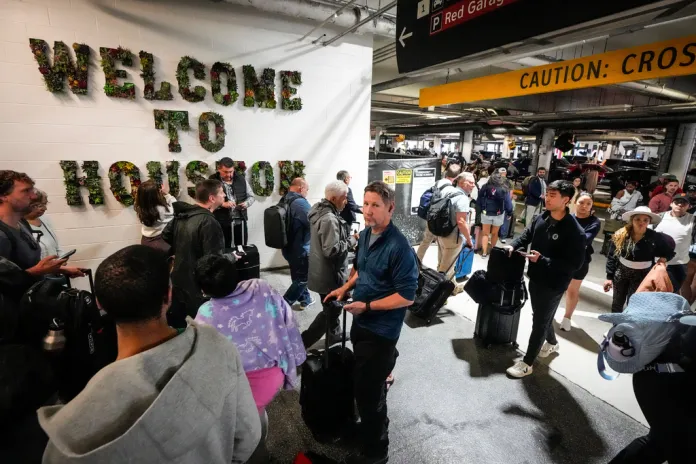
Airport security is beginning to buckle under the strain of the nearly monthlong shutdown of the Department of Homeland Security — but neither Republicans nor Democrats appear under much pressure to end it. Senators again failed Thursday to advance legislation to fully fund the DHS, marking the fourth time in recent weeks the chamber has […]
Airport security strains and TSA lines grow as Congress shows little urgency to end DHS shutdown
Center Right
Airport security is beginning to buckle under the strain of the nearly monthlong shutdown of the Department of Homeland Security — but neither Republicans nor Democrats appear under much pressure to end it. Senators again failed Thursday to advance legislation to fully fund the DHS, marking the fourth time in recent weeks the chamber has […]
Newly released body-camera footage shows the moment a Florida deputy arrived at the location where a woman had been mauled by an alligator. The woman, 31-year-old Orlando […]
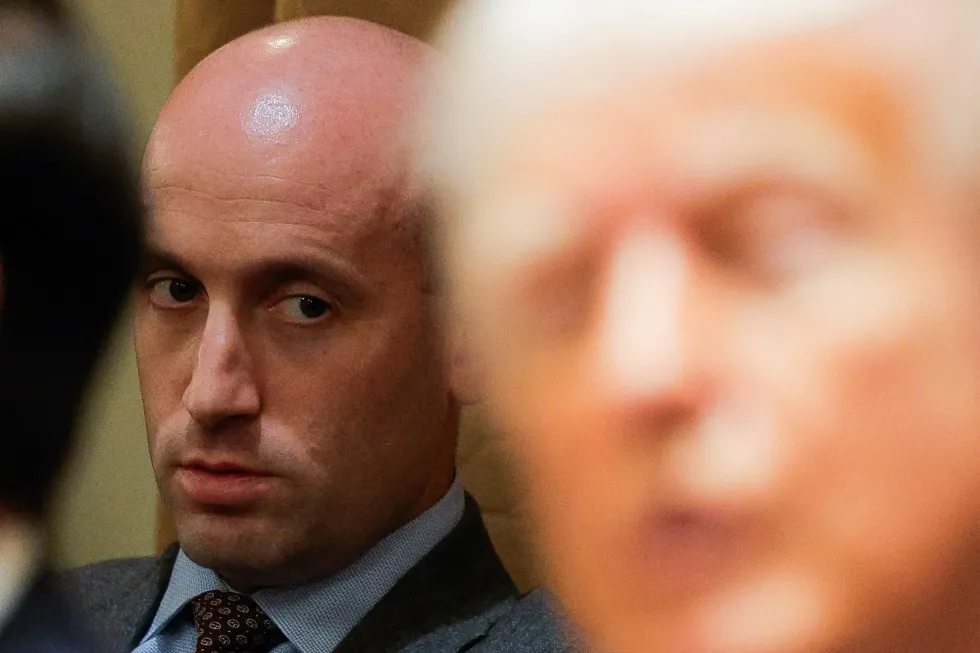
White House deputy chief of staff Stephen Miller kept up his attacks on birthright citizenship with a far-fetched hypothetical on Friday, and critics lined up to ridicule it.Days after the Supreme Court upheld birthright citizenship in a 6-3 ruling that struck down President Donald Trump's executive order, Miller posted on X that if you believe a foreign government could sail a hospital ship to the edge of US waters, "deliver a hundred babies to foreign moms, then promptly sail back," and that each child "is American for life, you don't believe in nationhood at all." The rant echoed the birth-tourism case he made on Fox News, where he floated a "hard look" at barring pregnant women from the country.Miller's post predictably led to quick backlash. Former Rep. Adam Kinzinger asked sarcastically, "What about our hospital ship that we sent to Greenland? It happened right?" Bulwark journalist Sam Stein quipped, "Well. When you put it that way." Internet personality Damin Toell pointed out that under the 1898 Wong Kim Ark precedent, and still after this week's ruling, babies born aboard foreign government ships in US waters are already exempt from birthright citizenship.Others flipped Miller's logic back on him.National security journalist Marcy Wheeler called his "perverted little fantasy" no more real "than it was for the century and a half since birthright citizenship was codified." Academic Alonso Gurmendi argued that "any citizenship rule can be made to sound absurd like this." And journalist Zaid Jilani went furthest, sarcastically asking: "What if a mom catapults over the US Mexico border and from 500 feet in the air pops a baby out, ties a parachute to it and lets it fall gently to the ground. Does that baby deserve citizenship, lib?"The administration has vowed to keep fighting, though some analysts say the ruling nearly went the other way. Independent estimates put actual birth tourism at a tiny fraction of U.S. births.
First lady Melania Trump gave Congress a private deadline to pass her signature foster care bill, and she is pursuing it largely outside the usual White House channels, according to a new report in Politico. At a bipartisan roundtable with the House Ways and Means Committee in April, the first lady publicly called foster care legislation a "moral imperative." Then, behind closed doors, she set a target, Rep. Jason Smith (R-MO) told the outlet: "I want this on Donald's desk by the August recess." The Fostering the Future Act, which expands housing, education and workforce help for young people aging out of foster care, passed the House unanimously.The Senate has not moved it out of committee, and lawmakers are set to leave Washington around Aug. 10. At a White House picnic the day the House passed the bill, both Trumps urged the Senate to hurry. "Hopefully, it will quickly pass in the Senate," the president said. He has not publicly pressed senators since.The deadline reflects a first lady who increasingly operates on her own track. Her office, not the State Department, has led her effort to reunite children displaced by the Russia-Ukraine war, negotiating directly with Moscow and Kyiv, the White House said. She has also shown a willingness to diverge from the administration's message. She broke with the White House on Epstein, calling for survivors to testify as the president's team tried to move past the scandal, and last week put her own spin on a Supreme Court ruling her husband celebrated, voicing support for the LGBTQIA+ community.A recent book recounted how she resisted Trump's overhaul of the White House grounds and lost.
Gov. Wes Moore (D-Md.) joins Meet the Press NOW to preview his upcoming address on America’s 250th birthday as President Trump prepares to deliver his own remarks.
For America’s 250th birthday, the Washington Examiner is taking you to Virginia’s Historic Triangle, where the story of our nation began. From the Jamestown settlement, the first permanent English colony in America; to the Yorktown Battlefield, where the fight for independence was won; to Williamsburg, where America’s founding principles were debated and shaped. Step back […]
Resistance is mounting across the United States against the increasing use of surveillance tech company Flock Safety’s cameras, with a growing number of cities canceling contracts as the artificial intelligence-powered license plate readers are quietly being installed in thousands of locations nationwide.State and local police departments first used the Atlanta-based company’s automated license plate reader (ALPR) systems for standard law enforcement purposes, but they are now being employed for a much broader range of uses, including immigration-related searches and other actions supporting US Immigration and Customs Enforcement (ICE) during the Trump administration’s deadly anti-immigrant crackdown.“We have cameras that are used for everything from illegal dumping to drug houses to hotels that are just big problems,” Flock Safety engineer Kevin Cox told prospective customers during a demonstration of the company’s Condor Camera, according to a Thursday report in The Washington Times.“There are endless, endless uses for what we can do with these things,” Cox added.Those uses include spying on constitutionally protected protest activity and enforcing abortion bans by tracking pregnant people’s travel across states—even ones in which the medical procedure is legal.The ACLU—which recently launched a “Get the Flock Out” campaign to “fight creepy ALPR cameras”—says there are currently between 80,000 and 100,000 Flock devices installed nationwide that conduct more than 20 billion scans per month. More than 5,000 law enforcement agencies use the cameras, and some of them keep their locations a secret.“Flock’s ALPR cameras aren’t like your normal traffic cameras,” the ACLU explained. “This surveillance technology records and tracks every car that comes into view, and then an AI algorithm catalogs the make, model, color, license plate number, bumper stickers, and even scratches. This personal information is then uploaded into a nationwide database that any law enforcement agency with a Flock contract can search—with few regulations or oversight on how they use what they find.”The backlash against creeping state surveillance has even transcended the partisan divide.“I think our country is in a kind of uniquely anti-surveillance environment right now, which is to say that, in a time where it seems there is nothing that is not partisan, opposition to government surveillance is nonpartisan,” ACLU privacy and surveillance attorney Chad Marlow told The Washington Times on Thursday.There is growing action—both legal and otherwise—to end the use of ALPRs across the country.According to the public information project Ban Flock Cameras, 82 Flock contracts were terminated across 28 states between August 2021 and May 2026, with 39 of those cancellations occurring in the first five months of 2026 alone.Even Amazon-owned Ring announced earlier this year that it would stop doing business with Flock Safety.Susie O’Hara, a member of Santa Cruz, California’s nominally nonpartisan City Council, told WBUR earlier this year that she grew increasingly concerned about local use of eight Flock cameras last year after learning that police were sharing data gleaned from the cameras with the company’s national network without city officials’ knowledge, a violation of state laws banning the practice.O’Hara became increasingly convinced that Santa Cruz should cancel its Flock contract after an ICE agent fatally shot Renee Good, a US citizen, in Minneapolis in January.“I have goose bumps on my arms thinking about the absolute chaos that was happening in Minneapolis,” she said. “And just the absolute insanity of what we were seeing... It was totally clear to me that we should in no way consciously be in this system at all—just no way.”Less than a week after Good’s killing, the Santa Cruz City Council voted to terminate the city’s Flock contract, becoming the first municipality in California to do so.“For us, the threat to our civil liberties was greater than any benefit we could get from the flawed product,” Santa Cruz Mayor Fred Keeley told KQED at the time.Chad Kemp, who represents District 32 on the nonpartisan Dane County Board of Supervisors in Wisconsin—which in April voted to stop funding two dozen cameras leased from Flock—told The Washington Times that “there’s a public safety issue here, but there is also a privacy issue.”“There are serious concerns about individuals who can be monitored without their knowledge, or if it is even constitutional or ethical to track people without a warrant,” he added.At the national level, US Reps. Robert Garcia (D-Calif.) and Raja Krishnamoorthi (D-Ill.) last year launched an investigation into the use of Flock cameras to track pregnant people across state lines for abortion care and to conduct unauthorized immigration enforcement operations.Krishnamoorthi and Sen.