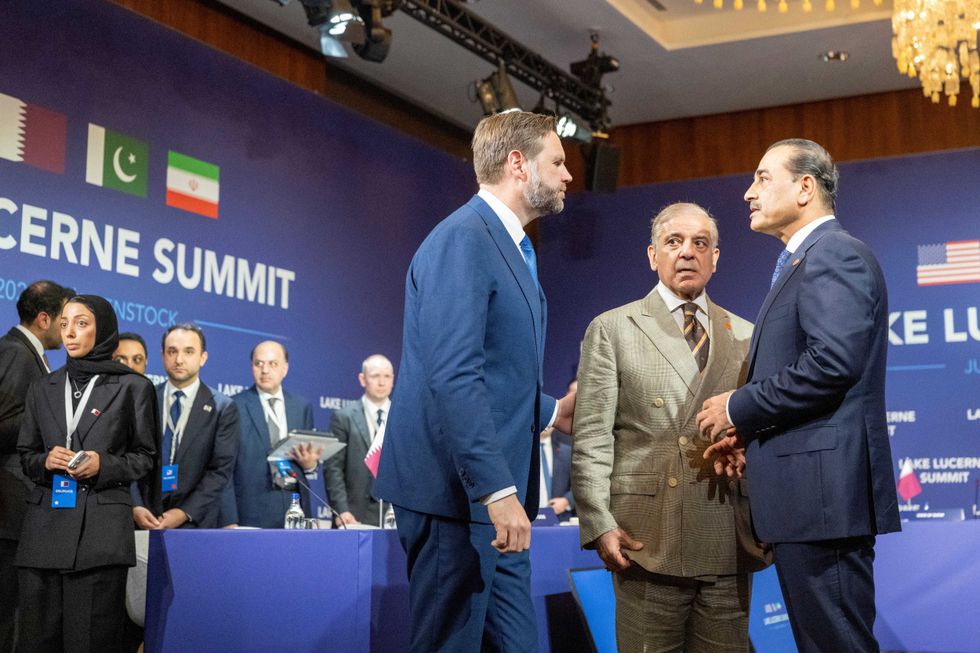
Footage showed Araqchi walking into the room where Vance, the US delegation, and mediators were, in front of the cameras, and then leaving after embracing Pakistani Prime Minister Shehbaz Sharif.
A foreign-relations expert offered blunt advice to President Donald Trump as negotiations between his administration and the Iranian regime deteriorate. Joseph Cirincione, a member of the Council on Foreign Relations, told MS NOW's Alex Witt on "Alex Witt Reports" that Trump appears to have a way to make a stronger deal with the Iranian regime, but the president is blind to it because of how much he is blustering about the state of the war. His comments come at a time when Trump's deal with Iran has become the "joke in Washington," according to Cirincione, and the Iranian regime seems to be backing away from an agreement struck between the two sides over continued fighting between Israel and Hezbollah in Lebanon. On Sunday, Iranian Foreign Minister Abbas Araghchi refused to shake hands with Vice President JD Vance when the two met for peace negotiations, which some observers described as a "humiliation" for Vance. While the two sides appear far apart on the war, Cirincione pointed out that Trump could still accomplish one of his major goals by preventing the Iranian regime from developing a nuclear weapon. "The Obama approach to negotiation worked. If Trump hadn't torn that up, we would have a fundamentally different relationship with Iran now, and Iran would still be many, many years away from the ability to build a bomb," Cirincione said. "So the only hope is to go back to negotiations and to hope that because Iran has emerged stronger from this war ... it doesn't really need a nuclear weapon as much as they thought they did." "They thought they needed it for defense," he continued. "Well, they have stronger deterrence right now." Cirincione said there is one catch that could make or break the talks. "I think they are willing to compromise on the program if Trump can just shut up and let the negotiators get to work and force the Israelis to stop their war in Lebanon; you could get a deal," he said. "You could still salvage this. But Trump has to act, not bluster."
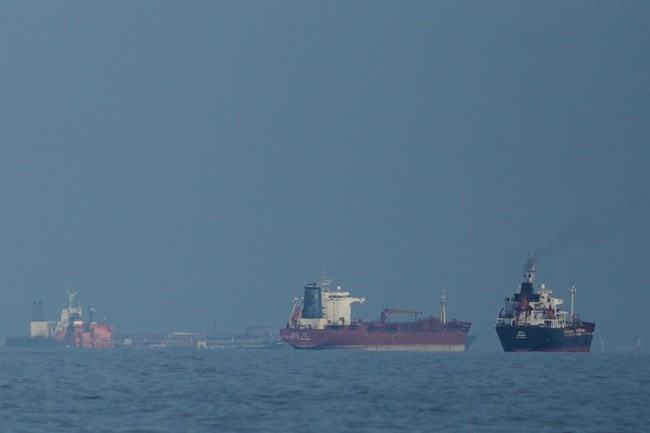
The deal President Donald Trump's administration struck with the Iranian regime has become a joke in Washington, D.C., and it's left the president embarrassed and flailing for an answer, according to one analyst. Last week, the Trump administration and the Iranian regime agreed to a deal that would immediately reopen the Strait of Hormuz, a critical waterway that accounts for roughly 20% of the world's energy trade, and postpone more substantive talks until later in the week in Switzerland. Those talks were scheduled to take place on Friday, but were delayed until Saturday due to ongoing fighting between Israel and Hezbollah in Lebanon. The Iranian regime also announced on Saturday that it was going to shut the Strait of Hormuz again.Joe Cirincione, a member of the Council on Foreign Relations, told MS NOW's Alex Witt on "Alex Witt Reports" that the negotiations have soured to the point where Trump has resorted to his "Tony Soprano" negotiation tactics by threatening the Iranians with violence. That has only seemed to further deteriorate the talks, even though Trump is telling "This is what happens when he doesn't have any cards to play," Cirincione said. "He's in a weak position, and now he's embarrassed by this deal. His base is revolting against it. If he were to force this deal to be presented to the United States Congress, I don't think it would pass, and that's not something I would have said just a week ago.""So, he's frustrated. He's lashing out. He's acting irrationally, as he often does, and basically lying about what's going on," Cirincione added. "The joke in Washington, D.C., is that Trump told us this war was going to end with unconditional surrender. He didn't tell us it was going to be our unconditional surrender," he continued.
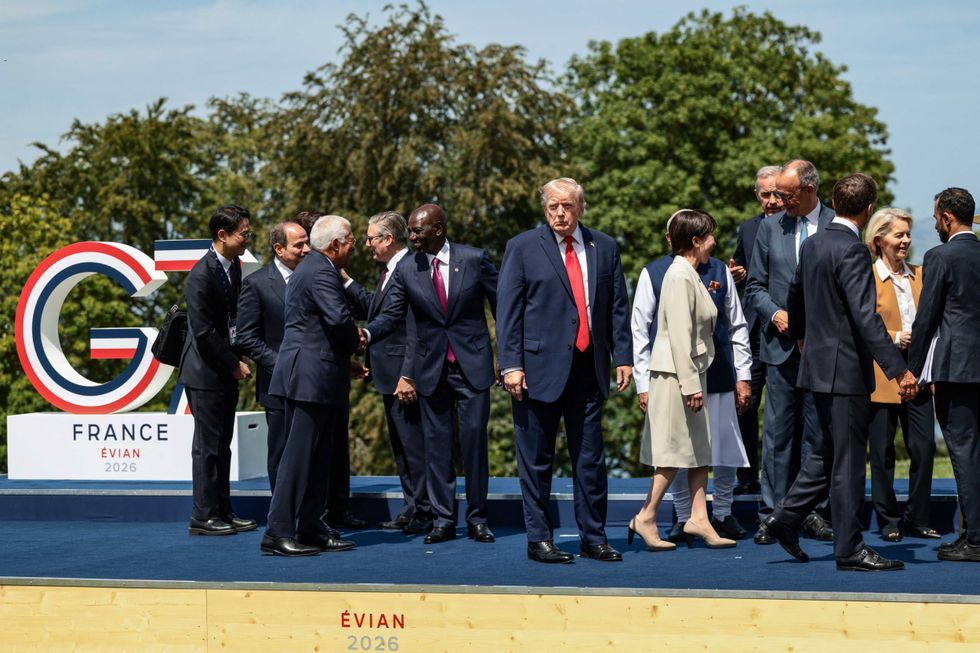
Sen. Chris Murphy says a single image from this week's G7 summit captures one of his deepest fears about the growing power of the tech industry: the chief executives of major artificial intelligence companies seated at the table alongside presidents and prime ministers, as if they were heads of state themselves."At the G7, the CEOs of the big AI companies sat at the table like heads of state, alongside presidents and prime ministers," the Connecticut Democrat wrote, sharing a photo of the summit's main session. His reaction was blunt: "This is the nightmare scene."For Murphy, the optics were not a harmless photo op but a visual representation of how far corporate influence has crept into the highest levels of government. The concern is that companies building the most powerful AI systems are no longer simply lobbying governments from the outside, but are being granted a seat among the elected leaders who are supposed to regulate them.Murphy paired the warning with a call for governments to push back against what he described as the "state-like power" of these firms. He floated several possible responses, suggesting officials consider "taking ownership shares, breaking them up into smaller entities, or imposing a regulatory structure that controls their power over citizens." The range of options, from partial public ownership to outright breakup, signals how seriously he believes the threat should be taken.The senator has emerged as one of the more vocal critics in Congress of concentrated corporate and technological power, and his framing fits a broader unease on the left about the cozy relationship between the tech sector and the current administration. The sight of AI executives integrated into a gathering traditionally reserved for the world's most powerful elected officials, in his telling, is evidence that the balance has already tipped too far toward private industry.His underlying argument is that state-like power demands a state-like response. If a handful of companies can shape economies, information, and security on a scale once reserved for governments, Murphy contends, then leaving their authority unchecked is itself the danger. The photo, to him, is less a snapshot of cooperation than a warning about who is really sitting at the table when the world's decisions get made.At the G7, the CEOs of the big AI companies sat at the table like heads of state, alongside presidents and prime ministers.This is the nightmare scene.Governments need to have a response to the state-like power of these companies, whether it’s by taking ownership shares,… pic.twitter.com/aPdK7FFRaE— Chris Murphy 🟧 (@ChrisMurphyCT) June 21, 2026
GOP Sen. Lindsey Graham said on Sunday that he thinks the US peace talks with Iran are going to fail -- and that President Trump is going to seize the Strait of Hormuz "by force."
The ongoing peace talks in Switzerland between American and Iranian officials got off Sunday to a rocky start, according to one Emirati political analyst who went on to describe the spectacle as nothing short of “humiliation” for Vice President JD Vance, who’s leading the U.S. delegation.“This was humiliation. No one in modern history has made America wait and beg for negotiations. This was the moment JD Vance should have returned to Washington. The Islamic regime did this on purpose,” argued Emirati political analyst and author Amjad Taha in an analysis published on social media.Taha flagged several key details from the meeting between the two delegations that made it, he argued, “easy for the world to draw its own conclusions” on “who looked confident and who looked desperate.” Chief among them was the U.S. delegation entering the venue “well before the Iranians,” according to Taha.“In diplomacy, the side with leverage doesn't wait in the room,” Taha wrote. “You claim to be leading and winning, yet you arrived first. First mistake.”Taha also flagged a telling moment from Iranian Foreign Minister Abbas Araghci, who Taha claimed “entered last and refused to shake hands,” a claim supported by reporting from the Iranian news outlet Tasnim News Agency.Ron Filipkowski, the editor-in-chief of the progressive media organization MeidasTouch, reacted to Taha’s analysis with a bleak assessment of the United States’ global standing.“The US has never looked smaller or weaker on the world stage,” Filipkowski wrote in a social media post on X to his more than 1 million followers.The US has never looked smaller or weaker on the world stage. https://t.co/HPfRhyBbJa— Ron Filipkowski (@RonFilipkowski) June 21, 2026