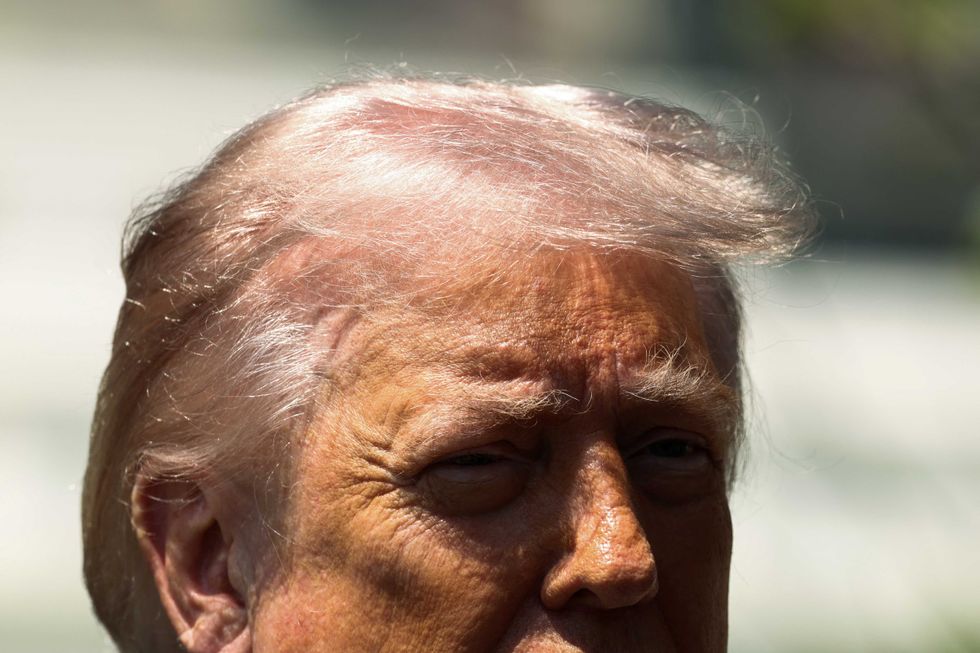
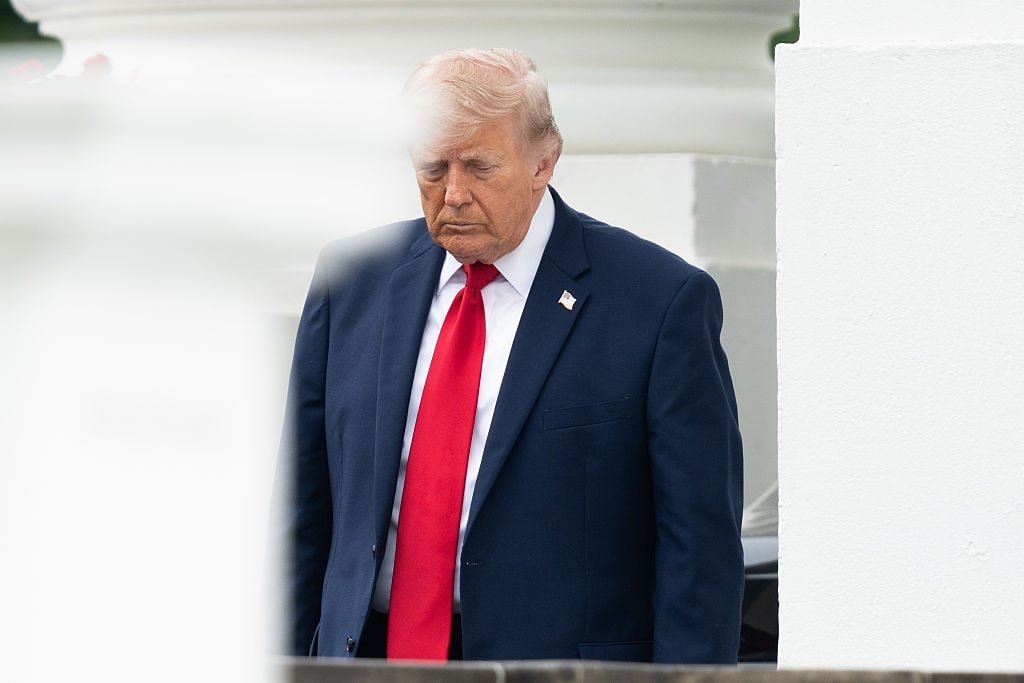
After President Donald Trump announced Saturday that an Iran peace deal was within reach, “hawkish Republicans” targeted the president with a campaign designed to convince him he would "look foolish and weak" for pursuing it – a pressure campaign that appears to have worked following fresh U.S. strikes on Iran Monday, Zeteo reported Tuesday.“Two sources with knowledge of the situation told [Zeteo] that hawkish Republicans flagged for the White House media coverage, social media posts, and other material arguing that reported peace terms would hand the Iranians victory and make Trump look foolish and weak,” Zeteo’s Martin Pengelly wrote in the outlet’s report. “And then came the apparently inevitable news: reports of renewed violence. And so, Trump’s Iran fiasco continues.”Trump’s announcement on Saturday was met with a wave of criticism from right-wing figures, with the president lashing out at said critics on Sunday as “losers” who knew “nothing” about the ongoing negotiations. Whether motivated by the “extreme internal pressure” he’s reportedly under or other factors, Trump did ultimately authorize strikes on targets in southern Iran on Monday, sinking two boats and attacking a missile launch site.Bloomberg has previously reported that the president has also been under extreme “outside” pressure to resume the Iran war as well, notably from Israeli Prime Minister Benjamin Netanyahu and billionaire media mogul Rupert Murdoch.
When Joe Biden defeated Donald Trump in Georgia in the United States' 2020 presidential election, there were two very different reactions among Republicans in the Peach State. Gov. Brian Kemp and Georgia Secretary of State Brad Raffensperger, much to Trump's chagrin, acknowledged Biden as the legitimate winner — while then- State Sen. Burt Jones (now lieutenant governor) promoted Trump's repeatedly debunked claim that Georgia was stolen from him. And according to New York Times reporters Danny Hakim and Richard Fausset, Georgia will have a major election denier in the governor's office if Jones replaces Kemp in January 2027.With Kemp term-limited, Georgia Republicans are having a gubernatorial primary race that finds Jones competing with Rick Jackson (described by Hakim and Fausset as a "brash, pro-Trump billionaire") for the nomination. A runoff primary election is scheduled for June 16."Burt Jones, the Republican frontrunner in the Georgia governor's race, presents his considerable efforts to overturn Donald J. Trump's election loss in 2020 as a badge of honor," Hakim and Fausset report in the Times. "On the stump, he even boasts about it…. Last week, Mr. Jones, with the help of an endorsement from President Trump, was the top vote-getter in the first round of Georgia's Republican primary for governor. "Jones, according to Hakim and Fausset, "still carries the baggage — or as some would have it, bragging rights" — from the 2020 election and played a major role in "efforts to keep Mr. Trump in power" even though he lost Georgia to Biden."Mr. Jones tried to organize a special state legislative session to overturn Mr. Trump's electoral loss," the New York Times reporters recall. "He helped arrange public hearings in the State Senate, where Rudolph W. Giuliani demonized Atlanta election workers and advanced false claims that the election had been stolen. He joined a fake Electoral College contingent from Georgia that sent its false votes to Washington as part of a multi-state effort to try to derail the certification of Joseph R. Biden Jr.'s victory."Hakim and Fausset continue, "He backed Texas litigation challenging his own state's election results…. If elected governor, Mr. Jones would join several Republican governors who are 2020 election deniers just as the Trump Administration is using the Justice Department to seize 2020 ballots and revive old conspiracies."When Trump "amped up his unsubstantiated claim of a stolen election" in 2020, there was "vigorous pushback from some state Republicans, including Gov. Brian Kemp, Lt. Gov. Geoff Duncan and Mr. Raffensperger." But Jones "attacked the state's Republican leaders, including Mr. Duncan, for asserting — accurately — that there was no credible evidence of widespread voter fraud."
Over the last few weeks, the United States right loudly claimed victory in a battle that few people on earth knew was happening. The National Review’s Editorial Board gloated, “Science Has Spoken Against Climate Alarmism.” Several papers owned by Rupert Murdoch ran similarly hyperventilating headlines that scientists had reversed “doomsday predictions” and “quietly scrapped the apocalyptic forecasts that have terrified policymakers and the public.” Donald Trump wrote on social media that the United Nations’ “TOP Climate change committee,” the Intergovernmental Panel on Climate Change, or IPCC, “admitted that its own projections (RCP8.5) were WRONG WRONG WRONG!”That isn’t what happened. And it’s hard to overstate the gulf between the scale of the right’s triumphalism and the size of the thing they are ostensibly talking about. The alleged victory in question is in reality an academic paper published last month by a team of Earth system modeling experts convened by the Coupled Model Intercomparison Project, or CMIP, an initiative of the UN’s World Climate Research Program. The paper describes several new forward-looking climate scenarios created to help researchers understand how and why the earth warms, and what might happen as it does. Such scenarios have been a mainstay of climate science since the 1980s, and are updated frequently to account for new research and observations. “These scenarios are not prediction machines,” said Detlef van Vuuren of the University of Utrecht, a veteran of emissions scenario development and the lead author on the CMIP paper. “They are simply ways to explore possible futures.” As the present changes, so too do researchers’ models of possible futures.So what exactly was Trump celebrating? The CMIP paper—which was published in April—notes that its researchers now consider one older scenario “implausible.” First created in the early 2010s, RCP8.5 outlines a world that is between 4.2 and 5.4 degrees Celsius warmer by 2100, thanks to extremely high levels of coal burning. Somewhat confusingly, the “8.5” in RCP8.5 doesn’t refer to temperature degrees but to specific levels of radiative forcing—a measure of change in the earth’s energy balance caused by human-caused greenhouse gas emissions. It was also developed at a time of rapidly rising fossil fuel use and relatively expensive renewables. “RCP” itself stands for “representative concentration pathway,” meaning that it was chosen to represent a range of similarly dire preexisting scenarios. Importantly, RCP8.5 was always intended as a “low-probability, high-risk” scenario among several others that show much lower radiative forcing, emissions, and warming. RCPs 2.6, 4.5, and 6.0 appeared prominently alongside RCP8.5 in the fifth assessment report of the UN Intergovernmental Panel on Climate Change, released in 2013. In 2017, modelers replaced RCPs with something called “shared socioeconomic pathways,” and used RCP8.5 to inform the high-end SSP that appeared in the IPCC’s sixth assessment report in 2023. (The IPCC does not create its own scenarios or conduct original research, but relies on largely volunteer experts to synthesize the latest-available climate science across a range of topics every few years.)Some 15 additional years of observable data about climate change, real-world climate policy, and the relatively recent, rapid proliferation of cheap renewables have now made the coal-heavy world of RCP8.5 look much less likely than it did in 2013. “We’re now in a very different position than RCP8.5 would have taken us, which is good,” van Vuuren said. “That doesn’t mean that RCP8.5 was wrong.” Continually updating scenarios to account for new data and understandings, he says, “is just the regular way we do our climate research.”The reasons why RCP8.5 seems to have struck such a nerve on the right stems back to a series of wonky debates among academics that started nearly a decade ago. Two researchers at the University of British Columbia—Justin Ritchie and Hadi Dowlatabadi—published a pair of papers back in 2017 arguing that the modelers relied too heavily on coal, and that extremely high coal usage in RCP8.5 entailed burning through more coal than exists in the world’s recoverable reserves of that resource. Subsequent entries into this debate cautioned against treating RCP8.5 as a “business as usual” outcome when the world looked increasingly on track to warm by roughly 3 rather than 4 or 5 degrees Celsius by 2100.Right-wing think tanks and climate skeptics glommed onto this debate to make a handful of bad-faith arguments that have relatively little to do with the generally good-faith academic discussions about the merits of RCP8.5.
CEASEFIRE INTERRUPTED: The U.S. military said the ceasefire with Iran remains in effect, even though it has been in a running battle with Iranian forces, after spotting what it assessed as an Iranian small boat laying mines near the Strait of Hormuz. The two Islamic Revolutionary Guard Corps boats were “eliminated,” and surface-to-air missile sites […]
Trump said he would be “mandatorily requesting” several Muslim nations sign the Abraham Accords and recognize Israel as part of any peace deal with Iran.
Last week’s primary election didn’t feature any races with both a Democrat and a Republican on the ballot, but Georgia Democrats still feel like they won.If you are one of the more than 2 million Georgians who cast a ballot, you will likely recall the poll worker asking you to choose a Democratic, Republican or nonpartisan ballot.In all, Democrats pulled more than 1 million ballots to Republicans’ nearly 940,000, or about 52.6% to 45.4%.Democratic Party of Georgia Chairman Charlie Bailey said that margin is the biggest for Democrats since 1998 and shows that voters are ready to line up in November behind candidates like U.S. Sen. Jon Ossoff and former Atlanta Mayor Keisha Lance Bottoms, the Democratic nominees for U.S. Senate and Georgia governor.“It’s just another piece of evidence of growing Democratic momentum, the work of the party, the strength of Jon Ossoff, the strength of Keisha Lance Bottoms coming into this governor’s race,” he said. “People are fed up with (Republicans), and what those numbers in the primary tell you is that that momentum is building towards November, when they’re going to vote these Republicans out.”In 2018, a midterm year with President Donald Trump in the White House and an open race for Georgia governor at the top of the ticket, Republicans pulled more ballots than Democrats by about 52% to 48%.Comparing the number of ballots drawn is not a perfect measure. Some people choose the other party’s ballot because they live in an area dominated by that party and they want to have a say in local races, or because they want to promote a weaker opponent for their candidate in the general election.Still, the discrepancy spells good news for Democrats looking ahead to the Nov. 3 election, says Emory University political science professor Andra Gillespie.“What it connotes or implies is that Democratic candidates are capturing the imagination of voters in ways that, if this energy can be sustained, could be helpful for them in terms of flipping seats nationally, and in Republican states like Georgia, narrowing those margins between Democrats and Republicans, even in contests where Republicans are the odds-on favorite,” she said.The difference in ballots is even more notable because Republicans had more high-profile races, said University of Georgia political science professor Trey Hood. No Democrat challenged incumbent U.S. Sen. Jon Ossoff, while Republicans had competitive races for U.S. Senate and Georgia governor at the top of the ticket.Hood said it’s also notable that Republicans who voted on Election Day did not outnumber Democrats by a large margin. Republicans only had about 4,000 more voters on Election Day than Democrats, about 508,000 to 504,000. Hood said that might signal a shift in GOP voter behavior, with more conservatives preferring to cast a ballot during Georgia’s three weeks of early voting.“I don’t know that we can expect to necessarily see a huge surge in Republican turnout on Election Day anymore,” he said.Voter demographics strong for DemocratsResults also show demographics that tend to favor Democratic candidates in Georgia had a strong showing.Statistically, Black voters in Georgia largely favor Democrats, and they made up nearly 32% of the vote.“If Black turnout was 31% in a general election, yeah, that would be probably a good Democratic year,” Hood said. “I mean, before now, the highest it’s ever been is about 29%. And the more Black turnout as a percentage of the total electorate, the less of the white share of the vote you have to draw off as a Democrat. So if that pattern held and Black turnout was 31% in the general, it would be big.”Data from the secretary of state’s office also shows that the electorate was nearly 57% female and 43% male. That number is likely boosted by high turnout among Black women, who are registered to vote at a higher rate than Black men.Reality check?Still, the high Democratic turnout was not enough to land a pair of Democratic-aligned candidates on the state Supreme Court, and not everyone thinks the numbers show the wind is at Democrats’ back.Georgia Republican Party Chairman Josh McKoon said turnout in primary elections does not correlate with general election turnout.McKoon said he chalks up the ballot discrepancy to the typical midterm backlash to the party in the White House and Democrats having a competitive field for governor for what he said was the first time in more than two decades.“It was Mark Taylor and then it was Jason Carter, then it was Stacey Abrams twice,” he said. “Now, this time they actually had a wide open primary, and a lot of people ran. And so, yes, it’s not surprising that they had more than their usual turnout because usually they don’t have anything to turn out for.
Scandal-plagued Ken Paxton has won Trump’s backing – can he defeat John Cornyn in a high-stakes primary runoff? Ken Paxton, the state attorney general, takes on four-term incumbent John Cornyn on Tuesday in the ugliest primary election of the year. The winner of the Republican Senate runoff in Texas will contest November’s general election against Democrat James Talarico.Paxton and Cornyn have spent months coveting the most valuable endorsement in Republican politics: Donald Trump. Last week, scandal-plagued Paxton got it, with the US president describing him as “a true Maga warrior”. Continue reading...