Trump: Cornyn didn’t object to ‘anti-weaponization’ fund before challenger endorsement
Source: The Hill News · Bias: Center
Summary
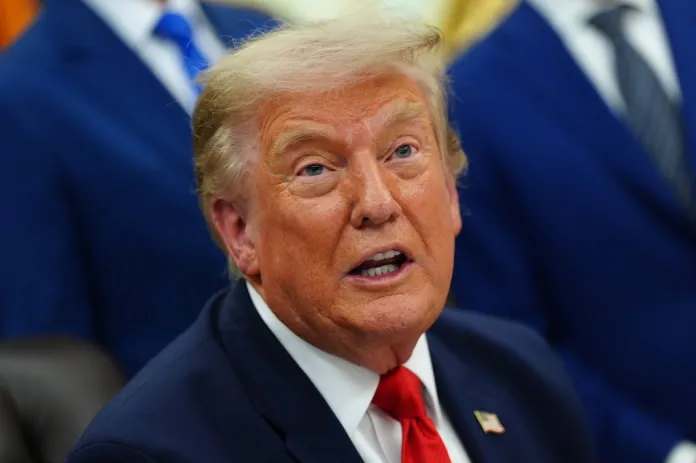
President Trump lashed out early Friday over Sen. John Cornyn’s (R-Texas) move to withhold his support for acting Attorney General Todd Blanche’s nomination due to Trump’s proposed “anti-weaponization” fund, writing that the senator did not object to it prior to the president’s endorsement of Cornyn’s primary opponent. “John Cornyn never had a problem with the…
Trump: Cornyn didn’t object to ‘anti-weaponization’ fund before challenger endorsement
Center
President Trump lashed out early Friday over Sen. John Cornyn’s (R-Texas) move to withhold his support for acting Attorney General Todd Blanche’s nomination due to Trump’s proposed “anti-weaponization” fund, writing that the senator did not object to it prior to the president’s endorsement of Cornyn’s primary opponent. “John Cornyn never had a problem with the…
President Donald Trump on Friday argued in favor of the anti-weaponization fund that his administration previously said was dead, as Sen. John Cornyn (R-TX) continues to hold up acting Attorney General Todd Blanche’s nomination over concerns about the fund. “Perhaps there has never been a group of people treated so badly in our Nation’s history,” […]
WASHINGTON (AP) — President Donald Trump is taking Friday's Cabinet meeting on the road — to the Camp David presidential retreat in Maryland, a rustic backdrop for sessions that have come to be known for being overly long and consumed by administration officials' endless praise for their boss. White House press secretary Karoline Leavitt said [...]
Republicans on the Senate Finance Committee voted Thursday to block a Democratic amendment that would have prohibited the Internal Revenue Service from giving sweeping tax audit immunity to President Donald Trump, his family, and their businesses.If passed, the amendment would have nullified a central element of the deal that the US Justice Department cut with the IRS in May to settle Trump’s $10 billion lawsuit against the tax agency. Experts have argued that such broad audit immunity is unlawful, and Democrats have warned the agreement could leave the IRS with no recourse if Trump decided to dodge taxes on the billions of dollars he has pocketed during his second stint in the White House.Democrats on the Finance Committee sought to attach their amendment to bipartisan legislation aimed at streamlining tax administration. The amendment failed in a 13-14 vote along party lines, and the bipartisan bill passed out of committee 26-1—with Sen. Elizabeth Warren (D-Mass.) the lone opponent. Warren told Politico that she “cannot support a bill that rubber stamps Donald Trump’s corruption.”“Senate Republicans blocked Democrats’ proposal to end Donald Trump’s IRS sweetheart deal,” Warren wrote on social media following Thursday’s vote. “This deal gives him FULL IMMUNITY from audits on tax returns he’s filed. It’s corruption on steroids.”The vote on the Democratic amendment came as Trump’s attorney general nominee, Todd Blanche, remained stalled in the Senate, in large part due to the Justice Department’s failure to commit to sufficient limitations on the IRS audit immunity deal, which Blanche signed.Blanche, who is currently the acting attorney general, testified during a Senate confirmation hearing earlier this month that the IRS audit immunity deal is “not forward-looking,” but a key Republican said this week that the Justice Department has not yet provided sufficient written commitments to limit the immunity agreement.Blanche reportedly met with the two Senate GOP holdouts—John Cornyn of Texas and Thom Tillis of North Carolina—on Thursday in an effort to hash out a deal to advance his nomination. Trump, who has aggressively avoided taxes throughout his career and broke with political tradition by refusing to voluntarily release his federal income tax returns, threatened on Thursday to pull Blanche’s nomination until Cornyn and Tillis leave the Senate next year, having lost reelection.The New York Times summarized the IRS immunity deal, should it survive legal and political scrutiny:First, the IRS has to drop any inquiries, whether civil audits or criminal investigations, it was pursuing into Mr. Trump, his family members, their companies, or ‘affiliated individuals.’ Second, the IRS can’t start any new investigations into tax returns that this potentially large pool of people and companies has already filed.That means that any tax maneuver the Trumps have already used, whether the IRS was already auditing it or not, is now off limits. The agency typically has three years after someone files a tax return to assess more in taxes. So there are potential audits of Mr. Trump and his family that the IRS could have initiated—claims that ‘could have been asserted,’ in the language of Mr. Blanche’s order—that it is now not supposed to. But the next tax return that Mr. Trump files could, theoretically, still be eligible for an audit.“Trump’s sweetheart audit immunity deal is perhaps the most brazenly corrupt action taken by a president in American history, and Congress must permanently put a stop to the unchecked greed on display,” Sen. Ron Wyden (D-Ore.), the ranking member of the Senate Finance Committee, said earlier this week. “Elected officials cannot look taxpayers in the eye and ask them to play by a set of rules that the president of the United States is exempt from.”
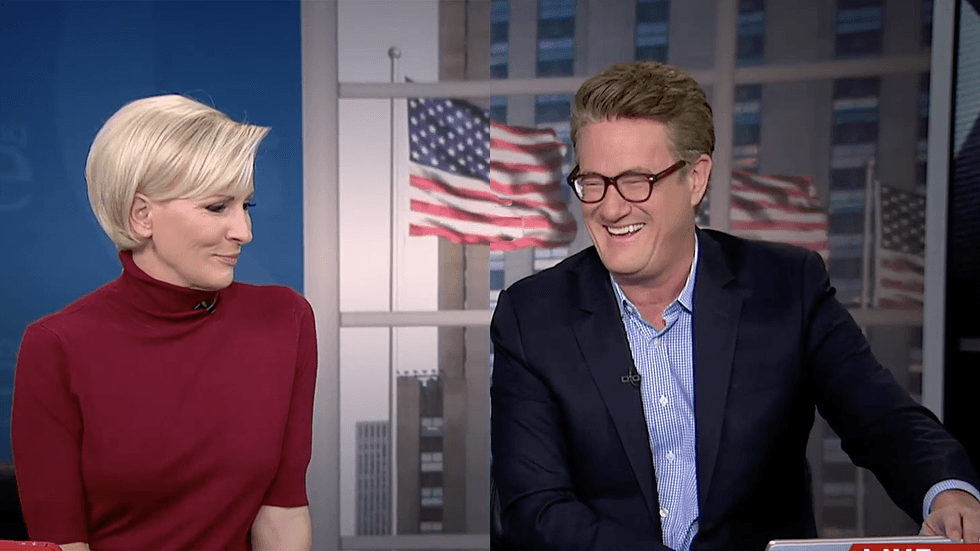
The hosts of "Morning Joe" cracked up on Friday, laughing at President Donald Trump's willingness to throw his attorney general nominee "overboard" once two Republicans said they refused to sign off. Formerly Trump's personal lawyer, Todd Blanche has been serving as the acting attorney general since Pam Bondi left the office. There was a willingness to approve Blanche among Republicans on the Senate Judiciary Committee, but one sticking point remained: a nearly $1.8 billion "anti-weaponization" fund dreamed up by the president.On Thursday, two U.S. Senators on the Senate Judiciary Committee said that someone at the White House is stopping Blanche from agreeing to putting the cancellation of the fund in writing.The terms Sen. John Cornyn (R-Texas) wants guarantee that the fund will not be started. A federal judge requested a signed agreement in court, and Blanche refused twice to sign such a pledge. Sen. Thom Tillis (R-N.C.) is also bothered by the idea that Trump and his family would be above the law, due to a provision in the contract saying that neither he nor his children could ever be audited by the IRS "forever.""Morning Joe" co-host Mika Brzezinski read the news about the IRS ban on audits as Joe Scarborough cracked up laughing. "Donald Trump is saying, 'I will throw my attorney general nominee overboard if my family and I can't get immunity from the IRS,' the likes of which nobody else in America has," said Scarborough. "So, what he's saying is we want to live — the Trump family wants to live by separate rules regarding the IRS than any other family in America, any other family on the planet. And he's willing to not have an attorney general, to do that. I mean, this is something." He added that the matter isn't only unpopular with Democrats, but with Republicans too. Reporter Jonathan Lemire said it's the issue that lawmakers are angrier about than the fund. Trump, he said, "made clear what his priorities are. He prioritizes the fund and the IRS protections over installing Todd Blanche as permanent attorney general."Blanche could remain in his acting role indefinitely, as he was already approved by the U.S. Senate as the deputy attorney general. As Trump discovered in his first term, having "actings" in the top spots gives him more freedom to hire and fire as he sees fit. There have not been serious consequences to Trump's use of "acting" secretaries in the first or second terms. Lemire noted that Trump's solution to the matter was to simply say he'd reappoint Blanche after Cornyn and Tillis are gone. "But problem with that plan, of course, is we have no idea what the Senate's going to look like come January," he explained. "The Republicans may have a smaller margin or perhaps be in the minority."Cornyn also made it clear on X Thursday that he and Tillis are not the only two who have issues with Blanche over the contract between Trump and the government. Calling it "self-dealing" and "corruption," Scarborough said he's "never seen anything like it in my life. This is one politician saying, "My family and I are going to get protected status, are going to get immunity from IRS audits now and in the future."Axios reporter Marc Caputo said that both the Senate and White House realize they have "a broken relationship." Trump grows increasingly angry because the Senate won't do what he demands over the SAVE America Act, the filibuster and other matters.
White House economic adviser Kevin Hassett scrambled Friday after being confronted by Fox Business’ Maria Bartiromo about the “way lower than expected” economic growth that fell far short of his previous predictions.In early May, Hassett told Bartiromo that he “personally would make a bet” with his “friends” that U.S. economic growth would be 4% for the “rest of the year.” He doubled down on that prediction in early July. And yet, on Thursday, the Commerce Department reported “weaker than expected” GDP growth – a broad measure of economic activity – of just 1.5% for the second quarter of 2026, per the Bureau of Economic Analysis.“Yesterday, the GDP was slower than expected; last time we spoke, you told me you were expecting 4% growth in the second half of the year,” Bartiromo said. “We got a growth number yesterday, but it was way lower than people expected – how would you assess the macro story today?”Rather than admit his prediction was widely off, Hassett attempted to reframe his past remarks as referencing a narrower interpretation of economic growth.“Well I think that what we were looking at when you and I talked last was... uh... the really surging domestic demand, and so final sales within the U.S. were about 4% actually, almost exactly the number we talked about, 3.9%,” Hassett said. “The reason why the topline number was 1.5% was that we imported so many capital goods because we're building factories so fast that the number was different than we expected by a little bit.”Despite Hassett’s claim that the United States was “building factories so fast,” federal data paints a different picture. Factory construction spending was actually down 22% when compared with the same time last year, having declined every month this year. Manufacturing employment is also trending downward, with the sector losing 38,000 jobs over the past 12 months while adding 18,000 in the past six months.“The bottom line though is that if you look at that – the huge surge in capital spending – it means that the economy is really running on all cylinders,” Hassett claimed.
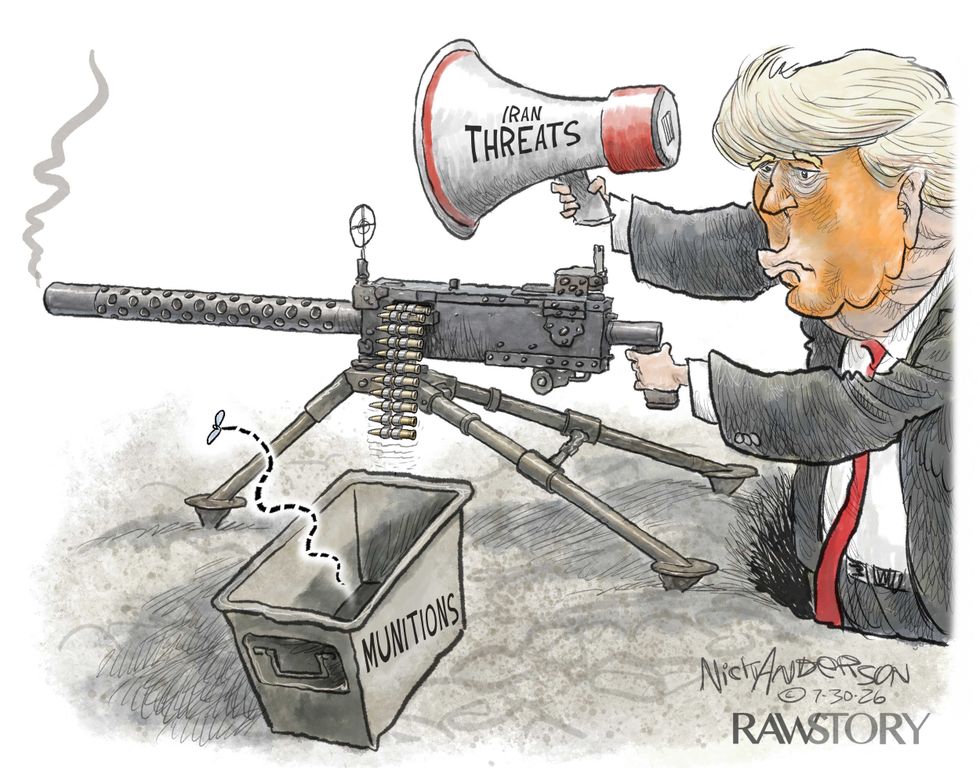
Trump's turns to empty threats as he runs out of real ammo in his five-month war on Iran.The latest from Raw Story's Nick Anderson, a Pulitzer Prize-winning editorial cartoonist.
The Trump administration has adopted a new and unusual tactic in its ongoing push to investigate voter fraud – obtaining the IP addresses of people who registered to vote online.The FBI recently requested and received the IP address tied to an online voter registration in South Carolina with assistance from state and local officials, according to documents first shared with Axios."It's unclear how often the FBI plans to take the extraordinary step of seeking IP addresses," Axios reported, "but its push in South Carolina has broad implications nationwide: 43 states allow some form of online voter registration."Alan Helms, a veteran election official in York County, South Carolina, said it was the first time in his tenure that law enforcement had approached his office this way. A former senior Justice Department official was more blunt, describing the request as an inappropriate "fishing expedition" into private voter data.While an IP address doesn't reveal a person's identity, it can indicate general location and internet service provider — including whether a registrant was located outside the state or the country.This South Carolina case is part of a broader, multi-agency federal effort tied to President Donald Trump's persistent, unsubstantiated claims of fraud in the 2020 election. ICE has separately requested voter data in Texas and North Carolina, while the Justice Department is suing 30 states and Washington, D.C., seeking access to voter rolls from jurisdictions that have declined to share registration information voluntarily.Critics argue the campaign is rooted in unproven allegations rather than evidence of systemic fraud. Robert Weiner, a former senior DOJ civil rights counsel, said the administration has pursued "every possible avenue to undermine the confidence in the integrity of the federal election process."The administration has pointed to New Jersey as an example of election vulnerabilities, after a software error led to roughly 6,600 noncitizens registering to vote.New Jersey has since removed about 4,500 people from its rolls but is resisting federal demands for full access to its voter data. State officials note that some individuals initially flagged as ineligible may in fact be eligible voters.