Takeaways from Iowa's primaries. And, DOJ nixes Trump's 'anti-weaponization' fund
Center
Polls have now closed in six states that held primary elections yesterday. Here are the key takeaways. And, the Justice Department has scrapped plans for Trump's "anti-weaponization" fund.
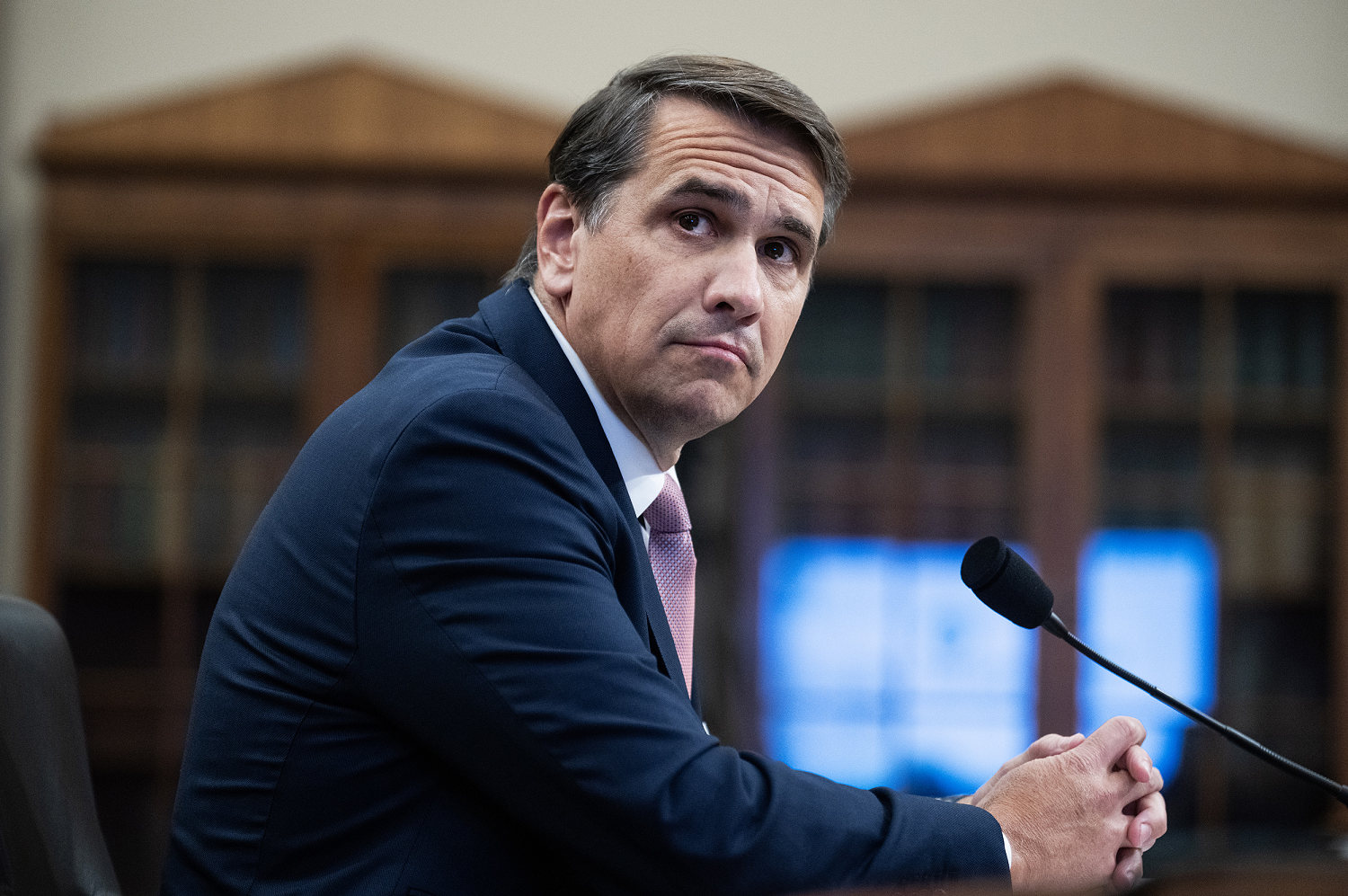
Department of Homeland Security (DHS) Secretary Markwayne Mullin will testify before the House Homeland Security Committee Wednesday morning on President Trump’s fiscal 2027 budget request for DHS. The White House is asking for $63 billion in budget authority for the department in 2027, a $2.2 billion decrease from 2026 enacted levels — just over a…
The Justice Department's No. 3 official briefly admitted on X that the agency was moving to revive a controversial fund to compensate Jan. 6 defendants — then deleted the post on Wednesday.Associate Attorney General Stanley E. Woodward, Jr. responded to a post from Sen. Lindsey Graham (R-SC) with a terse three-word reply — "We're on it." — before quietly scrubbing it. Politico's Josh Gerstein flagged the deletion.The admission came just hours after Acting Attorney General Todd Blanche told the House Appropriations Subcommittee on Commerce, Justice, Science, and Related Agencies that the DOJ's $1.776 billion "Anti-Weaponization Fund" was finished — permanently. "Look, we're not moving forward with the fund. Period," Blanche told the panel. Asked by Rep. Grace Meng (D-NY) if that meant never, Blanche said: "Correct."Graham had proposed threading the needle on the dead fund. While acknowledging Blanche's announcement, he argued that "there are many victims of the weaponized Biden Justice Department" and proposed routing claims through the existing Federal Tort Claims Act process instead of creating a new system.Critics in both parties had hammered the fund as a "slush fund" — a nearly $1.8 billion pot of taxpayer money with no judicial review, no congressional oversight, and commissioners the president could fire at will. A federal judge in the Eastern District of Virginia had already temporarily blocked it.Rep. Jamie Raskin (D-MD), the ranking member on the House Judiciary Committee, called it a "racket" designed to funnel taxpayer dollars to "insurrectionists, rioters, and white supremacists." Even roughly half of Senate Republicans were unhappy with the fund, according to Sen. Ted Cruz (R-TX).Woodward's deleted post raises fresh questions about whether the administration intends to pursue Graham's workaround — and whether Blanche's "period" means what he said it did.
Republicans and Democrats all compete together in the unusual primary to set the one-on-one race in November. Two Democrats and one Republican were in close contention.
Sanders' plan would impose a one-time tax of 50 percent of AI companies' stock and give the government voting shares and the power to block corporate decisions.
U.S. President Donald Trump, in a recent series of GOP primaries, unseated one prominent Republican after another — including Sen. John Cornyn (R-Texas), Rep. Thomas Massie (R-Kentucky) and Sen. Bill Cassidy (R-Louisiana), none of whom will be competing with Democratic candidates in the 2026 midterms' general election. But on Tuesday, June 2 in Iowa's GOP gubernatorial primary, Trump suffered what the New York Times' Reid J. Epstein describes as a "shock defeat."Trump, four days before the election, endorsed Rep. Randy Feenstra (R-Iowa) for governor of Iowa. But Feenstra narrowly lost that primary to businessman/farmer Zach Lahn."The primary loss for Rep. Randy Feenstra, whom the president endorsed on Friday afternoon, came at a time of mixed signals of Mr. Trump's power over the Republican Party," Epstein explains in the New York Times. "He has won a series of dominant primary victories over Republican opponents, but has faced rising pushback from his party in Congress."In the past, GOP and Democratic strategists considered Iowa a swing state. Former President Barack Obama won Iowa in both 2008 and 2012. Yet the midwestern state has trended Republican in recent years. Trump carried Iowa in three presidential elections in a row, defeating Democratic nominee Kamala Harris by roughly 13 percent in the state in 2024.But Trump's endorsement wasn't enough to get Feenstra past the finish line in Iowa's 2026 GOP gubernatorial primary. And Epstein describes that outcome as a "rare high-profile primary loss" for the president."In modern Republican primary politics," the New York Times reporter notes, "Mr. Trump's endorsement is the gold standard. In the last month, it has ousted sitting senators, a congressman and state legislators whom the president deemed insufficiently loyal. So when Mr. Feenstra won Mr. Trump's endorsement for governor last week, it felt like the push he needed to get past four candidates in the primary."Epstein continues, "Yet Mr. Feenstra was toppled on Tuesday by Zach Lahn, a conservative political operative and farmer who ran an insurgent campaign. Mr. Feenstra was seen as having run a lackluster campaign, and also faced the wrath of former Rep. Steve King, who lost to Mr. Feenstra in a 2020 primary and backed Mr. Lahn. Mr. Feenstra's defeat makes him the highest-profile candidate endorsed by Mr. Trump to lose a Republican primary race in years — perhaps since Luther Strange, an appointed senator in Alabama, fell to Roy Moore in a 2017 special election primary. Mr. Moore went on to lose the general election to Doug Jones, a Democrat."The presumptive nominee in Iowa's gubernatorial race is State Auditor Rob Sand. Gov. Kim Reynolds, a Republican, decided not to seek reelection.Iowa's last Democratic governor was Chet Culver, who left office in January 2011.
President Donald Trump admitted in an interview published Wednesday that he lobbed expletives at Israeli Prime Minister Benjamin Netanyahu in an explosive phone call on Monday, citing his growing frustration with Israel’s refusal to halt its invasion and bombardment of Lebanon as the cause for his outburst.Details of the supposed call were first reported on by Axios, which claimed Trump had called Netanyahu “f------ crazy,” and said that “everybody hates you” and “hates Israel.” Trump also reportedly told the prime minister that he’d “be in prison if it weren’t for me,” with Netanyahu having been indicted on corruption charges by the Israeli government, and for war crimes by the International Criminal Court.Trump was asked about the authenticity of the call in an interview with The New York Post’s Miranda Devine, host of the outlet’s podcast Pod Force One.“You were angry with him, you said ‘are you f-ing crazy, what are you f-ing doing, I helped you stay out of jail’ – is that true?” Devine asked in a video interview published on Wednesday. “Did you speak to him in those terms?”“I did,” Trump admitted, before pressing back on the call being characterized as “angry.” “I wouldn’t say angry, I was a little bit… perturbed at his constantly fighting with Lebanon, you know? At some point, I said, ‘Bibi, we got to stop this, we got to stop this.’”Since its latest invasion of Lebanon in early March, Israel has killed more than 3,400 Lebanese and injured over 10,200, per the Lebanon Health Ministry. Israel’s bombardment of Lebanon is a key sticking point in the Trump administration’s peace negotiations with Tehran. Iran has demanded that Israel halt its bombardment of Lebanon as a condition in its negotiations with the Trump administration on ending the war, a demand that Israel has largely ignored, despite Trump himself demanding as much in April.Trump on Axios report that he told Netanyahu "you're f*cking crazy":I did. I always get angry. I was a little bit perturbed at him, constantly fighting with Lebanon....You know, at some point I said we're going to stop this. pic.twitter.com/4c6Tpo1GkZ— Clash Report (@clashreport) June 3, 2026
Mixed picture emerges from races across the US, as Trump’s pick fails in Iowa. Plus: Jill Biden speaks about her husband’s decision to drop out of the 2024 electionDon’t already get First Thing in your inbox? Sign up hereGood morning. It has been a night of drama as crucial election results have unfolded – or not – across the US.In California, the crucial race for governor remains too close to call. With mountains of ballots left to count, the Republican Steve Hilton was leading the field with the Democrats Xavier Becerra and Tom Steyer following. A quirk of the state’s political system means the top two candidates face off in the general election regardless of which party they belong to.Where else were primary elections held? In many other states. Many eyes were on Iowa, where Josh Turek, backed by millions in outside spending, clinched the state’s Democratic primary, defeating the state senator Zach Wahls, who had pitched himself as an anti-establishment outsider. On the Republican side, Randy Feenstra’s second-place finish in the gubernatorial race ended Donald Trump’s perfect endorsement streak, which had held strong since March.When will we know the full results? Voting experts say it could take weeks to finalize the tightest races.What was Pelley said to have done? In an email, the newly appointed executive editor, Nick Bilton, claimed Pelley had “hijacked my first meeting … to disparage me, my qualifications, and my intentions with remarkable incivility and contempt”. In a message to staff he said that after repeated, failed attempts to find common ground over the weekend, “we have parted ways with Scott Pelley”. Continue reading...