House Dem lashes out at GOP efforts to probe foreign donations with stunning claim on motive
Rep. Terri Sewell claims the GOP probe into ActBlue and CEO Regina Wallace-Jones is part of a pattern of Trump DOJ harassment of Black women in power.

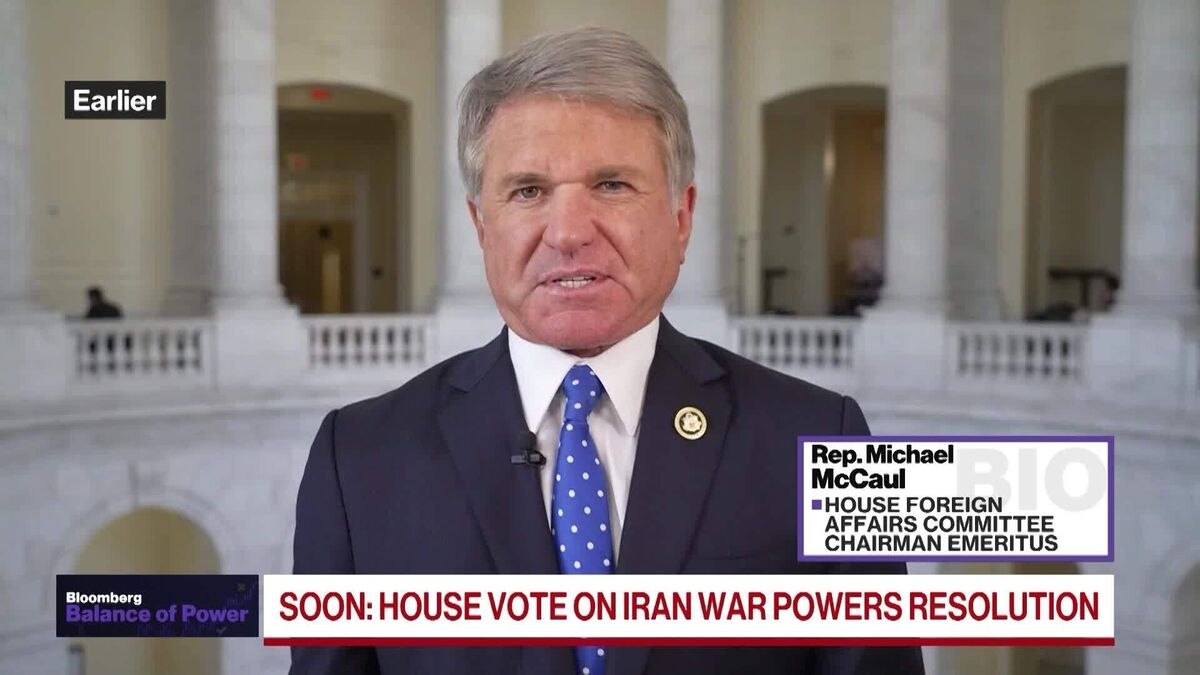
Republican Representative Michael McCaul of Texas, a member of the House Foreign Affairs Committee, spoke about Congress' War Powers vote and warns that it could 'undermine' and 'take away leverage' from President Donald Trump during ongoing negotiations with Iran. He speaks with Joe Mathieu and Kailey Leinz on Bloomberg's Balance of Power. (Source: Bloomberg)
Rep. Terri Sewell claims the GOP probe into ActBlue and CEO Regina Wallace-Jones is part of a pattern of Trump DOJ harassment of Black women in power.
The U.S. military said it launched new attacks on Iran on Wednesday, with President Trump saying it's time for the regime to "pay the price." Ed O'Keefe reports.
Doctors are demanding that the American Medical Association step up and take a true offensive posture against Health and Human Services Secretary Robert F. Kennedy Jr.According to Politico, "members of the group’s House of Delegates are sending a clear message to their leaders: Call out Kennedy, even if it costs us in the pocketbook," and spoke up intensely at the AMA annual meeting.Since Trump took office, the AMA has offered some criticism of Kennedy as he dismantles vaccine approval bodies and fails to act in the face of deadly disease outbreaks around the world — but the group has balanced this with praise of his stated mission to encourage Americans to live healthier lifestyles, as laid out in the controversial Make America Healthy Again movement.However, said the report, this is likely to change due to "the election of Sandra Fryhofer, an internist from Atlanta and uncompromising Kennedy critic, as AMA president-elect. She beat Michael Suk, who as AMA board chair in 2024 and 2025 prioritized doctors’ Medicare fees and promised continued pragmatism in dealing with Kennedy."Fryhofer has pledged to take a more aggressive posture, vowing to hold the administration accountable for “measles running rampant, public health destroyed, a trillion dollars ripped from Medicaid, inadequate physician payment, [and] stupid immigration rules.”Speaking to Politico in interviews, "AMA doctors described an advocacy organization at its wit’s end with Kennedy ... Long a Republican-leaning constituency, doctors began shifting left during the battles over managed care three decades ago." For several holdouts, the report continued, "President Donald Trump’s alliance with Kennedy, a longtime skeptic of vaccine safety and critic of the medical establishment, was the last straw."This also comes as Kennedy and his allies have come under increasing criticism for obstructing new potentially lifesaving research under the guise of requiring stricter safety standards in clinical trials.
Senate Republican Majority Leader John Thune was noticeably absent from Wednesday’s Oval Office bill signing ceremony — but top House and Senate leaders — including Speaker Mike Johnson — were present, cheering on the president. Thune did take time to talk with reporters, where he tied Wednesday’s surging inflation numbers to Trump’s Iran war.The Washington Examiner’s David Sivak asked Thune directly why he wasn’t present at the president’s signing of the $70 billion reconciliation bill to fund ICE and the Border Patrol, or to talk about FISA legislation with Trump. Thune noted that Speaker Johnson is “down there anyway” and that he and Johnson “talk regularly,” Sivak reported. Thune appeared to suggest that there might not have been an invitation, adding, “I don’t know that we got asked, but I’ve got stuff going on here, as you know.”Thune spelled out the inflation connection to reporters, as Punchbowl News’ Andrew Desiderio reported. “The sooner we get the situation in Iran stabilized, the Strait [of Hormuz] opened up, those [inflation] numbers will trend in a better direction,” he said. “But obviously right now there are important national security objectives we’re trying to achieve.”“The American people realize that if we’re heading in the right direction and the trendlines are good and the confidence is good long-term — which I [think] it will be because of all the other things we’ve done on the economy — then obviously people will start to see improvement,” he also said. “It may not happen overnight, but it will. But at least for now, we’ve got to do everything we can to keep the pressure on [in] getting the situation in the Middle East resolved.”Getting the situation in Iran resolved was not how President Trump appeared to approach Iran on Wednesday. “Iran’s Military is a complete and total mess,” he wrote on Truth Social. “Much of it, like their Navy and Air Force, doesn’t even exist anymore – They have been completely defeated. Iran is all talk and no action. The Bully of the Middle East is dead!!! They’ve taken too long to negotiate a deal that would have been great for them, now they will have to pay the price!!!”In that Oval Office meeting, Trump also slammed Iran, saying that the U.S. would hit Iran hard again on Wednesday, and insisted the Iranian government is “playing us for suckers.”Thune has distanced himself from the president over time, refusing his repeated demands to pass the controversial SAVE America Act — legislation some call voter suppression — to kill the filibuster, and to fire the Senate parliamentarian. He has also opposed Trump’s intelligence nominee. Thune tried to persuade Trump to back Senator John Cornyn (R-TX), but the president endorsed Ken Paxton instead — and Paxton went on to defeat Cornyn in the May primary runoff.
Speaker Mike Johnson (R-La.) announced that the House will vote Thursday morning on extending the nation’s foreign spy powers through July 2, a move that comes amid a partisan clash over President Trump naming Bill Pulte to be the acting director of national intelligence (DNI). The expected vote comes after Democrats in the Senate largely…
A Democratic lawmaker didn't mince words on Wednesday and dropped a stunning rebuke to President Donald Trump.Rep. Jim McGovern (D-MA) criticized Trump and his $1.8 billion slush fund in an interview with Scott MacFarlane, chief Washington correspondent and anchor at MeidasTouch."What do you think your constituents think about this slush fund?" MacFarlane asked."They're disgusted," McGovern said. "They think Trump is a corrupt son of a b---- who doesn’t give a s--- about them.""He's not doing anything to do with the issues of affordability, gas prices are going up, inflation is up, healthcare costs are up, housing costs are up, everything is up," McGovern said. "He's doing nothing about it and this Congress is doing nothing about it."He said that Republicans are "scared s------" of Trump and afraid of retribution."I tried three times to get them to make an amendment in order, so we could eliminate this taxpayer-funded slush fund and all three times, every single Republican in this committee voted no to not allow an amendment to go to the floor, to even debate it, they voted no," McGovern added. "What's happening in this Congress is the speaker of the House, the Republican leadership, have turned this place into an embarrassment."MacFarlane: What do you think your constituents think about this slush fund?McGovern: They think Trump is a corrupt son of a bitch who doesn’t give a shit about them.[image or embed]— Acyn (@acyn.bsky.social) June 10, 2026 at 10:19 AMMacFarlane: What do you think your constituents think about this slush fund?McGovern: Republicans are scared shitless of Trump. They won’t even say they are mildly concerned because they are afraid of retribution. He is the most corrupt president in history. pic.twitter.com/eMNYlty4EX— Acyn (@Acyn) June 10, 2026
Lawyer Alan Dershowitz on Wednesday said he wants “complete transparency” if he testifies before the House Oversight and Government Reform Committee as part of its probe into convicted sex offender Jeffrey Epstein. The committee’s chair, Rep. James Comer (R-Ky.), said earlier in the day that he would like to have Dershowitz and Acting Attorney General…
In 2018, David Tyson Jr., an African American, sued Richardson Independent School District in Texas for violating Section 2 of the Voting Rights Act. In the district’s 164-year history, Tyson was the only person of color ever to serve on the school board. Yet, at the time of the lawsuit, white students made up less than 30 percent of the district while Black and Hispanic students made up nearly 60 percent.When Congress enacted the Voting Rights Act at the height of the Civil Rights Movement, it gave communities the tools to combat these kinds of racial harms. Section 2 of the act outlaws state and local governments from enacting voting rules that result in racial discrimination. One of the undersung aspects of the Supreme Court’s recent decision in Louisiana v. Callais—for which there has been much hue and cry over the way it’s paved the path for right-wing state governments to draw majority-minority federal districts out of existence—is that it cuts away at this protection for local governments, as well, rendering it “all but a dead letter,” as Justice Kagan laments in her dissent.While the media has focused on Callais’s impact on Congress in the 2026 midterms, its darkest mark will be on local governments. Section 2 of the Voting Rights Act has been most frequently applied to address and remedy local electoral practices, not state ones. Its use heralded diverse school boards and city councils where national minorities, by virtue of being local majorities, can govern.Through this phenomenon, diversity develops twice over. First, through representational diversity and second, through institutional diversity. Minorities can see themselves represented on school boards, county commissions, and city councils. And they can harness that representation to institute local governments that do not look like state or national government. These more representative governments are more likely to become local laboratories willing to conduct policy experiments or try alternative governance approaches that the broader polity dismisses or ignores. This is why diversity at the level of individuals and institutions cultivates a rich democracy. Callais endangers these sites of local democracy by hollowing out Section 2 protections.But back in 2018 when Tyson filed his lawsuit, Section 2 of the Voting Rights Act was still intact. We can look back in time to see its salutary effects. Tyson told a “tale of two districts,” where—unsurprisingly—a ceaselessly homogeneous school board had harmful consequences for the Richardson school district. Elementary schools where at least 70 percent of the students met grade level in two or more subjects were two-thirds white—and the vast majority were not economically disadvantaged. By contrast, the lowest-performing elementary schools were predominantly made up of Black, Latino, and economically disadvantaged students. Atop the startling peak of disparity was the 60-point achievement gap between the district’s highest-performing school, which was predominantly white, and its lowest-performing school, which was predominantly Latino.These racial inequities did not go unnoticed by the Black and Latino voters of Richardson. And yet, Richardson’s school board remained persistently white for one reason: the district’s voting practices. While white students constituted a minority in the district’s schools, white voters still comprised a majority of the district’s population. These demographics, combined with an at-large, district-wide voting scheme where every voter in the district voted in every school board election, meant that minority voters would never succeed in electing a candidate of their choice. The minority vote would always be diluted against the white vote. The school board—whether under the threat of ongoing litigation or by a genuine change of heart—agreed to end this pernicious status quo. In 2019, Richardson Independent School District settled. As part of the settlement, the district moved toward a single-member district voting model. Specifically, it instituted an electoral scheme that allows voters within a predefined border to elect a board member to represent them—similar to congressional districting. Two of the five single-member districts in Richardson were drawn to ensure that Black and Latino voters were the majority. Voters from these districts later elected Regina Harris, the first Black woman, and Debbie Rentería, the first Hispanic person, to serve on the school board.Richardson was not alone in making this kind of change. In response to immigration and changing racial demographics, the late 2010s saw a spate of lawsuits across school boards in North Texas alleging violations of Section 2 of the Voting Rights Act. Many of these districts settled and moved to electoral systems that gave voters of color greater voice in their representation.