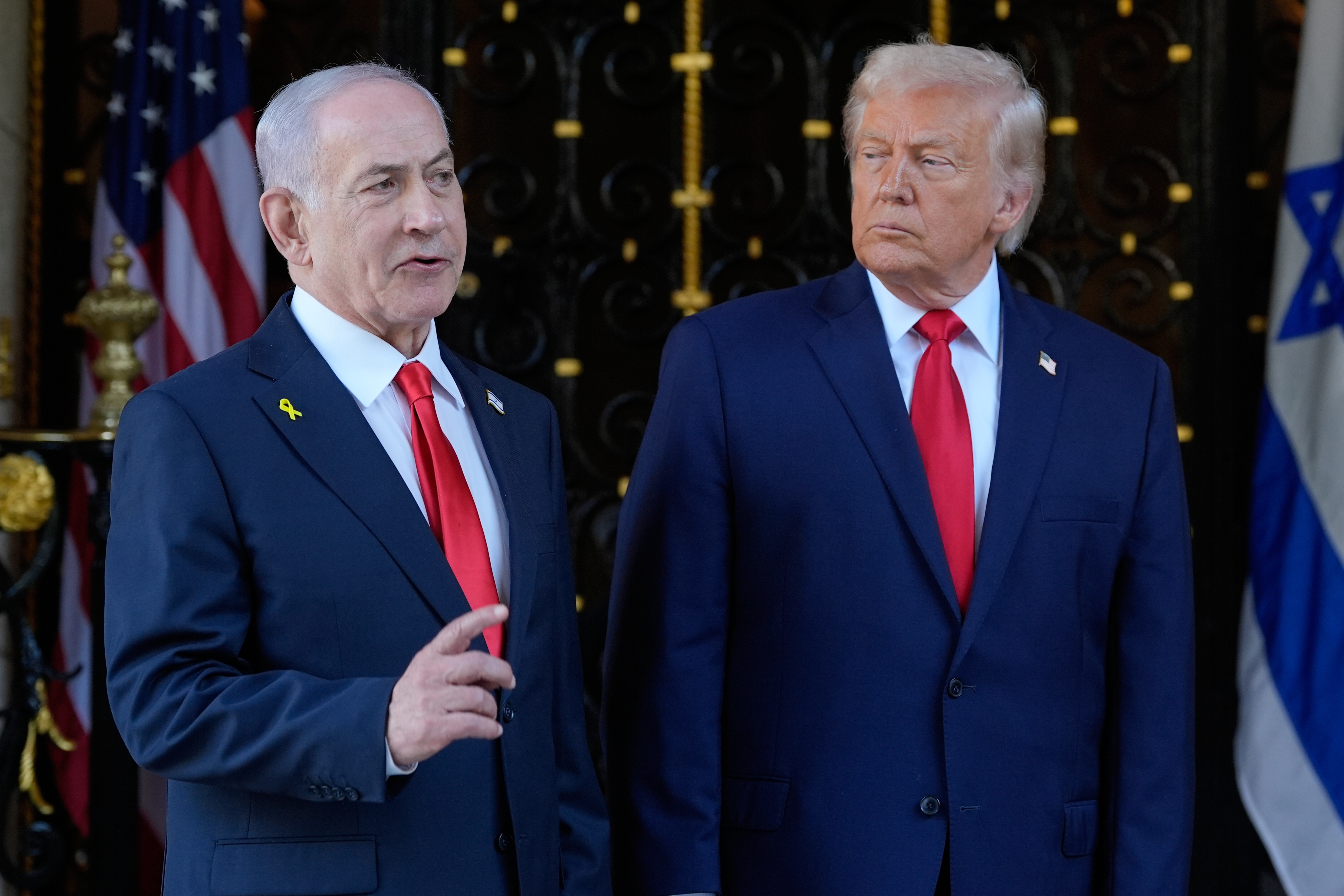
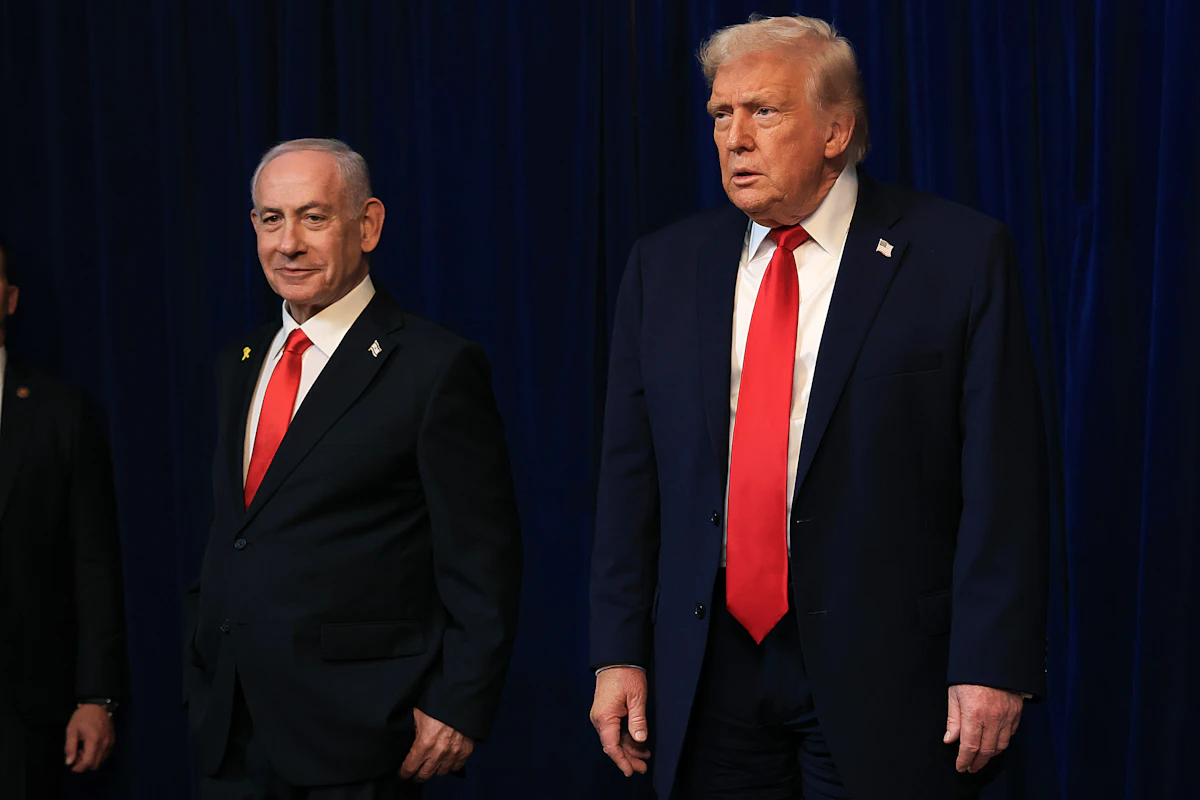
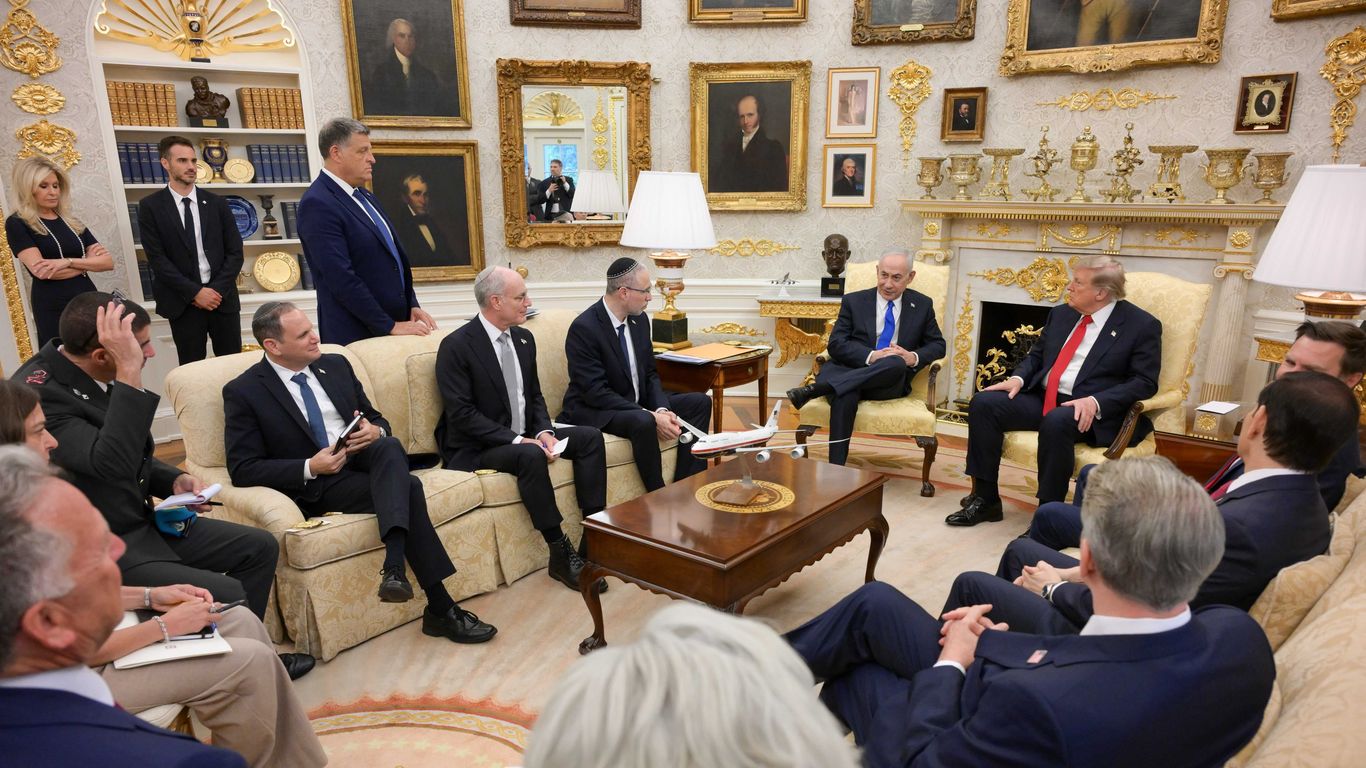
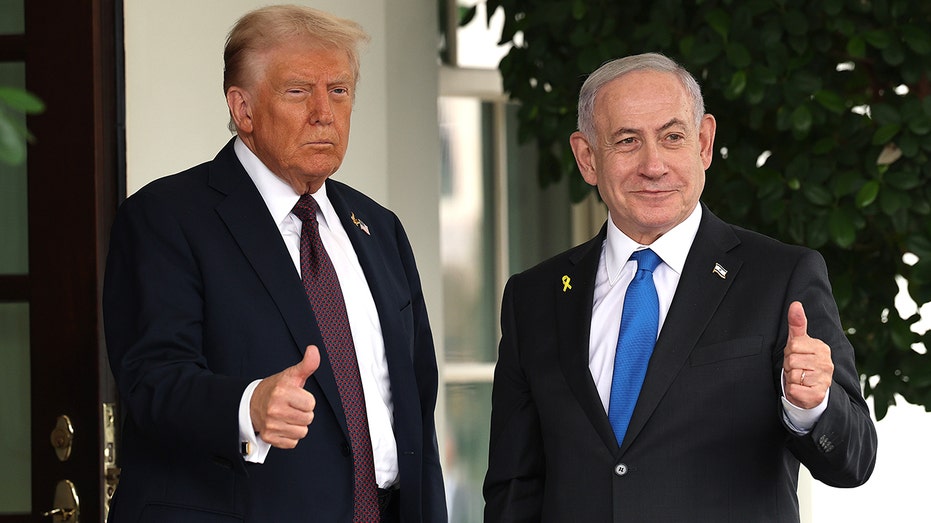
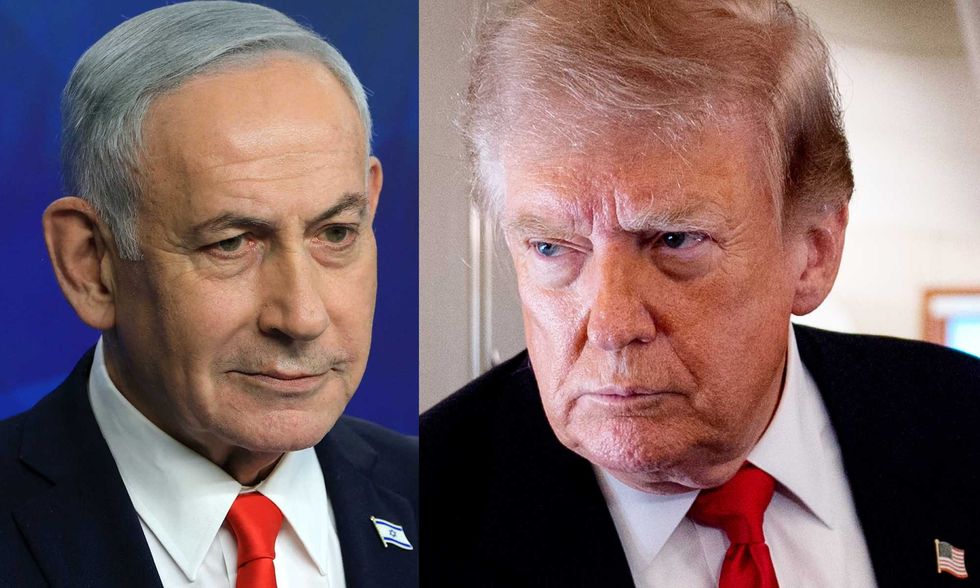
Netanyahu to meet Trump in a first encounter since the Iran war began
Source: NPR Topics: News · Bias: Center
Summary
The meeting comes as both face pressures at home. Netanyahu is up for reelection, embattled in part due to his deteriorating relationship with Trump. Trump is under pressure to end an unpopular war.
Netanyahu to meet Trump in a first encounter since the Iran war began
Center
The meeting comes as both face pressures at home. Netanyahu is up for reelection, embattled in part due to his deteriorating relationship with Trump. Trump is under pressure to end an unpopular war.
President Donald Trump pardoned a Republican megadonor linked to a massive fraud scandal after he contributed to a high-stakes swing state campaign, according to a new report.Adam Kidan — who pleaded guilty in the lobbyist Jack Abramoff conspiracy case —received a pardon from Trump just days after making a $2,600 to Rep. Ryan MacKenzie's (R-PA) leadership PAC on June 30, NOTUS reported Wednesday."Trump traveled to Mackenzie’s eastern Pennsylvania district on June 23 to campaign with him," the report stated. "The president pardoned Kidan on July 3."Mackenzie’s office denied communication with Trump regarding the pardon but did not respond to question about whether the campaign would keep the cash, NOTUS reported. Neither the White House nor Kidan replied to requests for comment.But his Democratic challenger Bob Brooks's campaign told NOTUS they are livid as it fights to win a “toss-up” race, according to the report.“Three days after a convicted fraudster cut Ryan Mackenzie a massive campaign check, that same fraudster walked away with a presidential pardon," Brooks campaign manager Jenna Kaufman told NOTUS. "That is corruption in plain sight.”Kidan donated about $270,000 to Trump-affiliated committees during the 2024 election cycle and hosted fundraisers at Mar-a-Lago, according to the report.He pleaded guilty to federal charges of conspiracy and mail fraud in 2005."As part of his sentencing, Kidan and Abramoff were ordered to pay a total of $217 million in restitution," the report stated. "It’s unclear whether Kidan paid the full amount, and Trump’s pardon is likely to erase any remaining financial obligations."
As the shooting war with Iran enters its sixth month, the United States continues to smash Iran’s military — and lose the information war in Iran, at home, and around the world.American forces can strike targets across Iran and hit Tehran’s regional allies, especially the Houthis in Yemen. By every conventional military measure, Iran is taking severe losses. Yet a growing domestic and international audience believes Tehran is fighting the United States to a standstill.The Iranian officials would earn an A in my information-warfare seminar. Too many American officials would earn an FIt is not. But Iran is winning the argument over what the war means.Too many senior American officials still treat television — whether broadcast or streamed — as a record of an event rather than a battlefield in its own right. The War Department approaches global visual media as if it were still 1991 and Desert Storm. That must change.U.S. military planners still tend to think in Clausewitzian terms: War is politics conducted through the controlled application of violence. That formulation reflected the technology of the early 19th century. It does not account for an information age in which images cross the globe in milliseconds and political effects can precede, outweigh, or even replace battlefield effects.I call this form of conflict SOFTWAR: the hostile use of global visual media to shape another society’s will by changing its view of reality. Three colleagues and I have taught this form of warfare to generations of students at U.S. war, staff, and intelligence colleges since the early 1990s. Too few American institutions adapted.Iran did. Its military and intelligence apparatus has embraced the concept since at least 2003 and even adopted the American-coined term in its own publications and influence operations.That helps explain why the United States has spent billions of dollars over five months while Iranian drone and missile attacks — and Tehran’s televised defiance — continue. Washington is using Cold War systems and industrial-age doctrine against an asymmetric enemy organized for the infosphere.Iran’s theocratic dictatorship is fighting a four-dimensional guerrilla war across land, sea, air, and information. Its military losses have limited its ability to retaliate directly against U.S. forces. Its remaining attacks are therefore chosen less for battlefield effect than for global media impact.Oil tankers and cargo ships in the Strait of Hormuz, a desalination plant and power station in Kuwait, Saudi Arabia’s state-owned oil hub, a liquefied natural gas facility in Qatar, a U.S. communications center in Jordan, and American naval facilities in Bahrain all produce frightening images and headlines.RELATED: The only Iran plan that doesn’t end with a 20-year hangover Marcin Golba/NurPhoto/Getty ImagesIran times its scattered counterattacks for its own early-morning hours so the images arrive during the American prime-time news cycle. The objective is not merely to damage a target. It is to shape the story told about the war here, there, and everywhere.The United States helps Tehran by concentrating almost exclusively on visible military targets while leaving the regime’s domestic television system intact. Islamic Republic of Iran Broadcasting continues to push the mullahs’ account across dozens of television channels and through its official news operation.Washington destroys weapons and commanders but fails to contest the information environment that gives those losses political meaning. It has not destroyed the transmitters and replaced the regime’s message with one aimed directly at the Iranian people.Those people are the regime’s real engine: a population that has endured repression and the reported killing of tens of thousands of anti-government demonstrators. Outside the relatively small number of Iranians with access to Starlink, the United States has no coherent way to speak to them at scale.America does not lack the technology. The military weakened its own capacity. In 2024, it retired the EC-130J aircraft of the 193rd Special Operations Wing, the only U.S. airborne radio and television broadcast platform. The aircraft were judged too vulnerable for modern combat, but no announced drone replacement has taken over the mission.The result is overwhelming kinetic power without a direct means of reaching the Iranian public. It is the doctrine of a mechanic who responds to an engine-warning light by cutting the wire to the bulb. The warning disappears. The engine keeps failing.Meanwhile, Iranian propagandists study the American audience, especially younger people hostile to the Trump administration, and target them with AI-generated Lego-character videos.
Senate Judiciary Committee members will deliberate and vote on Thursday on acting Attorney General Todd Blanche, President Donald Trump’s nominee for the permanent position. Because the nominee lacks critical qualifications to serve as the nation’s chief law enforcement official, members should reject his nomination. Since March 2025, during Blanche’s tenure as deputy attorney general under […]
Minnesota lawmakers enacted a statewide ban on prediction market in May. The first-of-its-kind law had been scheduled to go into effect on August 1. Now, that ban is on hold after the top two prediction markets, as well as the federal agency tasking with regulating them, persuaded a federal judge to temporarily block the law on Monday.Judge Katherine Menendez granted the preliminary injunction after concluding that Minnesota’s ban was likely pre-empted by the CFTC’s exclusive regulatory authority, a position that the agency had forcefully advanced in the lawsuit alongside the two best-known brands in the nascent industry, Kalshi and Polymarket. While Menendez noted that at least some of the contracts offered by the companies fall outside the CFTC’s jurisdiction, she opted for a broad injunction for now and emphasized that the final judgment may be different.Monday’s ruling is not the end of the legal battles surrounding prediction markets. Other jurisdictions have had some success in regulating or restricting Kalshi, Polymarket, and similar companies. But it is a striking testament to the prediction market industry’s success in regulatory capture—and the need for more concrete restrictions from Congress.Kalshi, for its part, took a victory lap after the ruling. “Minnesota was the first state to pass a law banning prediction markets, and a court prevented it from being enforced less than two months later,” a company spokesman told reporters yesterday. “Today’s decision makes it clear: States cannot ban things that they don’t have jurisdiction over.”Their celebratory defiance is par for the course these days. The modern age of gambling began in 2018 after the Supreme Court struck down a federal ban on sports betting on Tenth Amendment grounds. Sportsbooks like DraftKings and FanDuel are largely regulated at the state level, following the longstanding tradition of regulating gambling as a public-health matter. More than two dozen states now allow betting on sports in some capacity.Prediction markets also allow customers to wager money on the outcome of future events. Instead of placing a more traditional wager against a sportsbook’s odds, customers at a prediction market effectively bet against one another. In practical terms, they buy an “event contract” that predicts a binary outcome for an event—say, for example, that the Los Angeles Dodgers will win the 2026 World Series—within a certain period of time.If the Dodgers secure a threepeat this October, the contract’s seller would pay the buyer the amount specified in the contract. If the Chicago White Sox win the Fall Classic instead, the contract’s buyer gets nothing. Contracts can be bought and sold on prediction markets, with prices fluctuating depending on the market’s perception of an event’s likelihood. In that sense, prediction markets can somewhat resemble derivatives markets for publicly traded stocks.Prediction markets justify their existence in a number of ways. One is by claiming to offer some otherwise unobtainable insight into the future. “Our markets reflect accurate, unbiased, and real-time probabilities for the events that matter most to you,” Polymarket class on its website. “Markets seek truth.” Kalshi, for example, claims that its “inflation and federal [interest] rate forecasts have been more accurate than economists, pundits, and traditional news outlets over the past year.” Another increasingly common justification for a prediction market’s existence is that it allows customers to “hedge” their futures on specific outcomes. “For example, if you have student debt and are worried about relief not passing, you can purchase a contract and get a payout even if it doesn’t pass,” Kalshi claims on its website. “If you’re worried about the economic fallout of the government shutting down, you can place a trade to hedge against it.” This resembles the role that derivatives often play in financial markets: allowing large funds to “hedge” their stock purchases.For that reason, prediction markets are currently regulated by the Commodity Futures Trading Commission, a federal agency that oversees the nation’s derivatives markets. The Biden-era CFTC sought use its rulemaking power to broadly forbid prediction markets from taking bets on sports-related events, but the change in administration produced a much friendlier regulatory landscape.Michael Selig, the CFTC’s current chairman, is a Trump appointee who previously worked for crypto companies and prediction markets. He wields immense power over the regulatory process as the commission’s sole member at the moment; Trump has declined to put forward nominees for the other vacancies.
The first round of August Social Security payments for retirees, now capped at $5,181, will be issued in 14 days. When will payments arrive? Retirees born on or before the 10th of a month will receive this payment on Wednesday, Aug. 12. The second round will go out on Aug. 19 to those born between […]
There are plenty of things I’ve never understood about the people who’ve chosen loyalty to Donald Trump over the United States of America. I don’t have the space to list every single reason he never should’ve been allowed to run again in 2020, let alone 2024, but let's remain in the present for now. Trump is so far gone at this point, both physically and mentally, that anyone with eyes can see it for themselves. And yet, there’s an entire political party keeping its head in the sand rather than admit to what we’ve all been subjected to for the last 11 years.I truly cannot comprehend how anyone is still proudly broadcasting their support for an obviously sundowning convicted felon adjudicated rapist who has vandalized Washington, D.C. to make America look as weak as possible on the global stage on our 250th birthday. The last week alone has provided multiple examples of why any remaining Trump loyalists need to somehow recover their pre-2015 memories and remind themselves of what the American president is supposed to represent. Friday’s shambolic appearance at the rescheduled White House Correspondents’ Dinner was just the latest example of what a global embarrassment Trump is, as well as how far the “legacy media” has fallen. When he wasn’t dozing off on the dais or doing a weird thing with his mouth that many people were saying is Adderall and/or cocaine related, Trump delivered another rambling speech that relied on his usual litany of bullying, bragging, and bull.A room full of journalists and other members of the media sat there and took more of his verbal abuse and lies instead of walking out on him. No one stood up and yelled “LIAR!”No one defended CNN’s Kaitlan Collins when Trump once again attacked her for not smiling, because he’s disgusting.It seemed that only Lone Wolf Blitzer was capable of telling the truth about Trump while standing right in front of him.We certainly can’t expect Jake Tapper to report on Donny Dementia’s deterioration, especially not after he begged Trump for another interview after chatting with him on CNN about Lindsey Graham’s death.Remember Lindsey Graham? Yeah, I also thought it was weird that Mitch McConnell didn’t issue a statement about his death.Anyway, the Republican Party of old would be reeling right now upon learning that their leader finally paid the woman he sexually abused and defamed the $5.6 million he’s owed her for the last three years, with interest. But their silence is their compliance, standing with an adjudicated rapist whose name appears in the Epstein Files at least 38,000 times, rather than incur his wrath in a social media post.This is how far our alleged leadership has fallen. They spend their time trying to out-bully each other on Twitter to please their molting MAGA masochist, lest he reveal whatever blackmail he has on all of them. We can blame Ronald Reagan for a lot of things when it comes to the present-day GOP. Still, I think it’s safe to say he wouldn’t have tolerated the thrice-married, philandering, five-time draft-dodging Epstein bestie Donald Trump as a candidate, let alone stood for him falling asleep behind the Resolute Desk. America is a joke on the global stage as the world watches this addled toddler fall and fail. Yet, no one stands up to the Cowardly Lyin’ fraud who bankrupted his own casinos in Atlantic City while laundering money for the Russian mob.It’s EXHAUSTING to be a thinking, caring person in a media landscape that avoids accountability out of fear of retaliation. Ooh, what’s he going to do, block you on Twitter, Peter Doocy? Even though that’s a violation of a citizen’s First Amendment rights?Oh wait, Trump doesn’t care about upholding the Constitution. Which I’ve known all along, but more specifically, since August 28, 2015, the day Trump blocked me on Twitter. Yea verily, the ultimate Twitter Badge of Honor. When Trump was first sued by the Knight-Columbia Institute in 2017 over multiple First Amendment violations on social media, it applied to anyone he blocked after he was inaugurated. But then they also decided that he should be forced to unblock anyone who’d been blocked when he was just a candidate and was still blocked. Including lil’ ol me, Dear Reader. I can’t say for sure how any of it went down, of course. But I like to imagine him sitting behind the then-empty Resolute Desk and being given a list of Twitter accounts to unblock, then begrudgingly unblocking them. “Fine,” he grumbles, going down the list, until he reaches my account. “Oh no, not that one!” Trump harrumphs, “She’s MEAN!”I’m blocked to this day, and I’m also blocked on his Instagram. That’s how petty this “POTUS*” actually is.I’m all of five feet tall, and I weigh maybe a buck five or six. If you passed me on the street, you’d clock me as a petite woman with a head of silver hair, and therefore not a threat. I like to say I’m reactive, because I don’t wake up every day wondering who I can piss off.
On Fox News, Donald Trump threatened to bomb all of Iran’s bridges and all of its power plants. Making this worse, Trump declared that his threat could leave all of Iran’s 91 million people without power. That may be the first time Trump has explicitly said this threat could apply to Iran’s entire population, which would constitute an extraordinary atrocity. Though Trump presented this as something he’d be reluctant to do, the key is he still confirmed it’s under consideration. Meanwhile, many MAGA figures are very upset about Trump’s new meeting with Benjamin Netanyahu, fearing it portends an escalation: As Steve Bannon put it, this is a “disaster for America First.” MAGA doesn’t care much about Iranians, but Trump’s escalation threats do rattle them for other reasons. We talked to former State Department official Emily Horne, author of the Spin Class Substack. We discuss the humanitarian horrors Trump is actually hinting at, what MAGA pressure on Trump means, and why the logic of the trap ensnaring Trump could lead to a terrible ending. Listen to this episode here.