Cornyn: Paxton ‘absolutely’ endangers Texas Senate seat as GOP nominee
Center
Sen. John Cornyn (R-Texas) says state Attorney General Ken Paxton, his former opponent, will “absolutely” make it tougher for Republicans to defend the Texas Senate seat as the Republican nominee in the general election, standing by the criticisms he made during the primary. Asked by a reporter late Monday if Paxton “endangers the seat as…
President Trump on Tuesday morning announced he would appoint Bill Pulte to replace outgoing Director of National Intelligence Tulsi Gabbard. Pulte moves from his role as director of the Federal Housing Finance Agency. On Capitol Hill, Secretary of State Marco Rubio and Acting Attorney General Todd Blanche will testify before the House on Tuesday morning…
US presidential elections are always about a choice for the future. Who do you want to lead the country? Who will best address your needs?But the US midterm elections – where all the seats in the House of Representatives and one-third of the Senate are on the ballot – are always a referendum on the president and his party in Congress. So, given US President Donald Trump’s current popularity, what does this mean for the Republicans’ chances in November?Struggling with key demographicsIn short, Trump is in terrible shape politically at the moment. His net-approval rate is in negative territory in 44 of the 50 states in the country. His national approval rating is also well below 40%, and is heading lower. Polling consistently shows most voters do not approve of Trump’s management of major issues, including the economy, inflation, jobs, health care, immigration and foreign policy. His decision to launch the Iran war in late February had the lowest approval of any war in American history. It remains among the most unpopular wars.Inflation is accelerating in the US. Credit card delinquencies are at a 15-year high. With no end to the war in sight, and petrol so expensive, consumer sentiment has crashed to historic lows.While Trump has broadly retained support among Republicans, his approval rating has declined among independent and Latino voters – two key demographic groups that were crucial to Trump’s election two years ago.A clear path in the HouseDoes this mean the Democrats will stroll to victory in the midterms? It’s not quite that simple. US politics is extremely volatile, and there are fewer and fewer seats that are truly contestable.To control the House, the Democrats need a net gain of three seats, and in the Senate, four seats. Based on my calculations of the six midterm elections this century, the president’s party has lost an average of 27 seats in the House and three seats in the Senate. The only president to buck the trend was George H.W. Bush in 2002. Bush’s approval rating was still extremely high – 65% – one year after the September 11 terrorist attacks. The US invasion of Iraq, which would prove deeply unpopular, was still six months away. The Republicans gained eight seats in the House and two in the Senate in those midterms. This year, the Republicans are more vulnerable in the House than they are in the Senate.To protect their tiny majority in the House, Trump and the Republicans have launched a war to gerrymander congressional districts in several Republican-controlled states to boost the number of seats they can win this year. Democrats countered by redrawing the maps to favour their party in California. And last month, the conservative US Supreme Court gave the Republicans another edge when it ruled that protections under the Voting Rights Act to help ensure Black-held seats in the South were unconstitutional. This could threaten up to six black Democratic members in November.But several Republicans are expected to be ousted from their marginal seats across the country. Amy Walter of the Cook Political Report predicts: It’s more likely than not that almost all of the closest races break toward the party out of power (in this case, the Democrats). So winning 60 to 70 percent of the closest races is not a huge lift [to capture the House]. Senate up for grabs?By contrast, the Republicans have been relatively confident of their position to retain control of the Senate. The seats up for election this year are mostly in states that voted for Trump. That gives Democrats a very narrow path towards winning control of the Senate through states like Texas, Ohio, Alaska, Maine and North Carolina.In both Ohio and North Carolina, the Democratic candidates are both popular politicians – former Senator Sherrod Brown and former Governor Roy Cooper – and are doing well in the polls. In Alaska, Republican incumbent Dan Sullivan is facing a very well-regarded former House member, Mary Peltola. Republican Senator Susan Collins is also looking very vulnerable in Democratic-leaning Maine, though the presumptive Democratic candidate, Graham Platner, has been dogged by some controversies lately.The race that could decide the Senate, however, is in suddenly competitive Texas, a state that has not elected a Democrat to the Senate in 38 years. Trump successfully urged Republicans to support the controversial former attorney general, Ken Paxton, over veteran incumbent John Cornyn in last week’s primary. Paxton, who has previously been indicted on felony securities fraud charges and impeached by the Texas legislature, will now face the rising political star James Talarico, a progressive Christian Democrat. Talarico is leading in some polls. The Democrats probably have to worry about one seat in Michigan. The Republican candidate, former House member Mike Rogers, is running his second campaign for the Senate there after losing by less than 20,000 votes two years ago.
Senate Majority Leader John Thune (R-SD) is “practically begging” the White House to abandon President Donald Trump’s “fixation on personal projects,” with one in particular “growing more toxic” and potentially jeopardizing a key priority for Republicans as the midterm elections draw near, Punchbowl News reported Tuesday.Republican lawmakers are hoping to pass a reconciliation bill this week to fully fund federal immigration enforcement agencies, but Trump’s continued support for his $1.7 billion taxpayer-funded “anti-weaponization fund” – established to award payouts to his supporters who claim to have been unfairly targeted by the Biden administration’s Justice Department, including violent Jan. 6 Capitol rioters – risks sinking the legislation entirely.“Trump and Hill Republicans are trapped in a dangerous paradox,” Punchbowl News’ report reads. “Trump’s political endorsement is worth more than ever in GOP primaries, yet his legislative agenda and fixation on personal projects are growing more toxic heading into the fall campaign season. As more Republicans move past their primaries, they’re suddenly finding it advantageous to oppose him.”Thune "acknowledged” that Republicans in the Senate “weren’t satisfied” with the White House’s continued support of the anti-weaponization fund – which a federal judge has temporarily halted from awarding payouts – and on Monday, urged the administration to issue “more public assurances,” Punchbowl News reported.“The South Dakota Republican is practically begging the administration to act on its own to shut down the fund entirely and make clear it won’t be resurrected,” the outlet’s report reads. “Thune believes this remains the best way to un-stick the reconciliation bill and prevent a handful of GOP senators from voting for Democratic amendments during an upcoming vote-a-rama. But the White House seems unwilling to make this easy for Republicans.”
People may debate whether Graham Platner or Ken Paxton is more unfit to serve in the United States Senate. But the answers will mostly depend on one’s partisan preferences. For a few folks, their own particular detestation of certain vices might be material. You may think that Paxton is worse because many of the allegations…
Tuesday’s Democratic Senate primary in Iowa is shaping up as an early test of whether running against Senate Minority Leader Chuck Schumer (D-NY) resonates with the party’s base in a state President Donald Trump has carried three times. While national Democrats have quietly signaled a preference for state Rep. Josh Turek, state Sen. Zach Wahls […]
Senate Republicans say the Trump administration’s promise to “abide by” a court order blocking its controversial $1.776 billion anti-weaponization fund does not go far enough, demanding assurances the program will be permanently scrapped. “The only thing that’s going to solve this problem, to get immigration funded and law enforced, is for the president to do […]
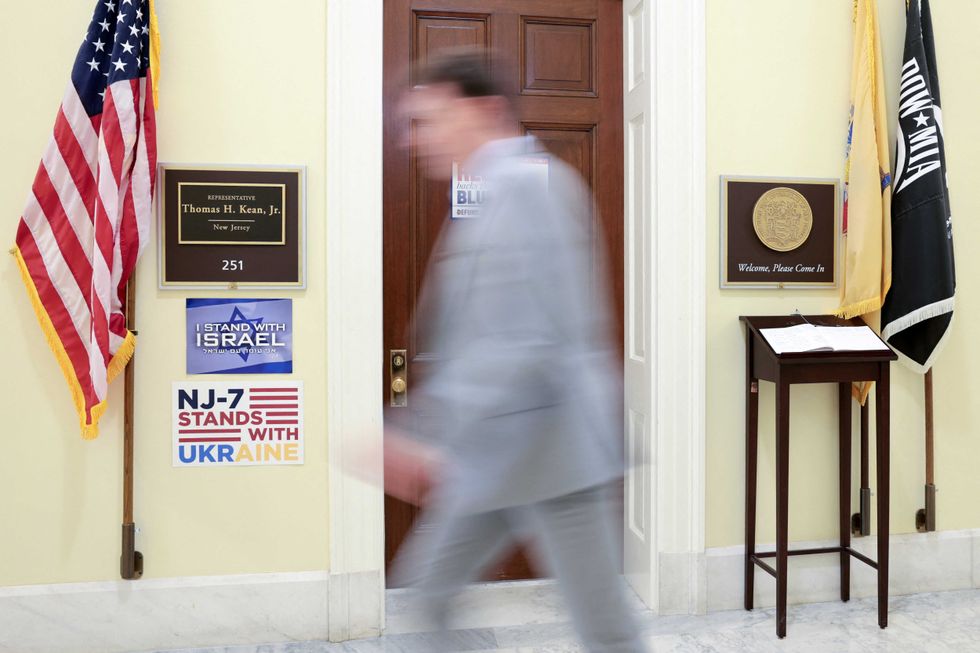
Rep. Tom Kean Jr. (R-NJ) has been mystifying Capitol Hill for months with his protracted absence due to an unspecified medical issue. Now he's introducing legislation — even though he hasn't actually returned to work yet.According to NOTUS, Kean "became the lead sponsor of H.R.9061" on Friday — a bill that would require clear guidance from the federal government to states on whether to cover early screenings for preeclampsia, a life-threatening pregnancy complication, in Medicaid and CHIP.This comes even though he is still out of work and nobody knows where he is.Republican lawmakers are growing increasingly concerned, as his absence has now extended past 75 days, and his office has not given any clarification on what his medical condition is or when he will be able to return to work. His aides are simply assuring the public that he will be back to work "soon."Filing legislation is not the only standard congressional activity Kean is carrying on with, despite not actually showing up to the Capitol. His office is also sending out his newsletter, with no indication that anything is amiss.Kean represents a New Jersey House district that will likely see a competitive race in November, where Democrats are strategizing how to capitalize on a wave of public anger at President Donald Trump and reclaim the House majority after having lost it in 2022.