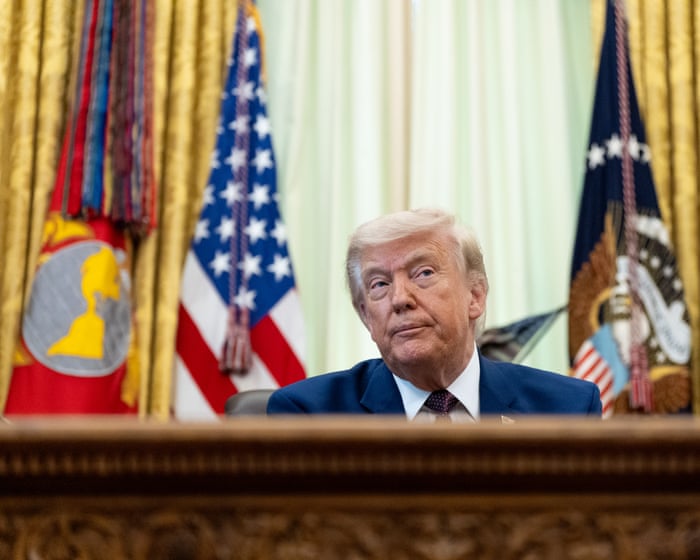
President Donald Trump's claim that he loves the inflation associated with his war in Iran is bad news for the average American's pocketbook, an economist said during a new CNN interview on Wednesday. Henrietta Treyz, an economist at Veda Partners, told CNN's Boris Sanchez that there's "nothing to like" about the 4.2% inflation reading that was captured in the latest economic data released on Wednesday. That's despite Trump saying in the Oval Office that he "loves the numbers" and that inflation will "drop like a rock" once the war in Iran ends. "The best I can say is that inflation everywhere else didn't also rise more than expected. That is not good news," Treyz said. "We're on day 104 of the war, if I'm not mistaken. We've spent $100 billion, and a lot of that is being borne by regular Americans." Trump's war in Iran has sent global energy prices skyrocketing because of the impacts to the Strait of Hormuz, a global waterway that accounts for 20% of all energy trade. The rising cost of energy has also driven up the prices of many goods, especially gasoline and groceries. Treyz noted that the average American household is paying about $460 more per year for gas now than it did when the war began. "It doesn't include the groceries that are more expensive. The surcharges on all your Amazon shipments, the additional 8% cost of just shipping mail around the country. This is a massive blow," she said. "And 4.2% inflation means that inflation is moving faster than our wages are keeping up. That's the problem for the president with this war."
Donations continue to pour for Karmelo Anthony, surpassing $627,000 online shortly after a Texas jury convicted the teenager of first-degree murder Tuesday.
U.S. and Iran exchange strikes after Apache helicopter is downed, takeaways from Tuesday's primaries in four states, House Republicans approve a bill to fund ICE for the remainder of Trump's term.
Since Idaho’s abortion bans took effect almost four years ago, an Idaho doctor says he’s had to send patients out of state for medically necessary abortions for a range of pregnancy complications under which he used to be able to provide abortions.Dr. Stacy Seyb, who treats high-risk pregnancies as a maternal fetal medicine specialist, answered questions under oath on the first trial day of his federal lawsuit seeking medical exceptions to Idaho’s near-total abortion ban. The lawsuit is one of several that have challenged Idaho’s abortion ban.Idaho has several abortion ban laws that, if violated, could allow doctors to be prosecuted and lose their medical licenses, as well as allow them to be sued for at least $20,000 by family members of a person who obtained an abortion. Idaho’s law allows abortions that are needed to prevent the death of the mother, but not to protect her health. Seyb’s lawsuit seeks medical exemptions that would allow abortion to prevent permanent health declines, death by suicide and fatal fetal conditions.Despite calls for change, including by the state’s top medical association, Idaho lawmakers have largely refused to modify Idaho’s strict abortion laws. After the state’s abortion bans took effect, Idaho lost more than a third of its obstetrician doctors, a study found last year. A group behind a proposed ballot initiative to end Idaho’s ban is awaiting confirmation from election officials on whether it will qualify for the November ballot.Under questioning from his attorney, Seyb said he and other doctors are unsure about when abortions are allowed under Idaho’s laws — and that he refers patients out of state for conditions under which he used to provide abortions.“It’s been very, very difficult trying to figure out what types of procedures … would not put you in harm’s way,” Seyb said at the trial in federal court.Labrador says U.S. Supreme Court made clear ‘that there is no right to abortion in the U.S. Constitution’Seyb’s lawsuit is against Ada County Prosecutor Jan Bennetts and the Idaho Board of Medicine, which licenses doctors. Neither side presented opening arguments at the first day of the trial, instead diving directly into questioning doctors who served as witnesses.Last week, Idaho Attorney General Raúl Labrador told the Idaho Capital Sun that the U.S. Supreme Court, in overturning Roe v. Wade, made clear “that there is no right to abortion in the U.S. Constitution, and that states have the right to decide abortion policy.”“This applies to all manner of abortions, including abortions that are done for a claimed medical reason,” he said in a written statement. “In short, abortion, regardless of the reason for the abortion, is not deeply rooted in this Nation’s history and tradition and is therefore not implicit in the concept of ordered liberty. Since there is no fundamental right to abortion, Dr. Seyb is unable to show that Idaho’s laws protecting the lives of unborn children are unconstitutional.”There is no jury in the trial, which is led by federal judge B. Lynn Winmill. It is set to continue until Monday, June 15.GET THE MORNING HEADLINES. SUBSCRIBEDoctor lists medical conditions that he has to refer for out of state abortions Labrador, the attorney for state officials and agencies, watched as one of his attorneys questioned Seyb and other doctors about their testimony. At several points, Labrador’s attorney, Jim Craig, sought to undermine Seyb’s case.Through Craig’s series of questions, Seyb acknowledged that he has not been criminally charged for providing an unlawful abortion, or been told he’s being investigated by the Idaho Board of Medicine.Craig repeatedly tried to get Seyb to admit he didn’t take time to understand how an Idaho court interpreted Idaho’s abortion ban as not requiring women face an “imminent” death risk to be allowed to lawfully receive abortions in Idaho.But Seyb seemed skeptical of that assurance.“I think there’s still a lot of controversy around those things,” he replied.Under questioning from his attorney, Seyb said he hasn’t seen guidance from Labrador, the Ada County Prosecutor’s Office and the Board of Medicine on how the state’s abortion bans work.Labrador’s office attempted to get the lawsuit dismissed before trial, claiming that Seyb didn’t understand how Idaho’s abortion law works. But in a ruling rejecting that request, Winmill wrote that “the contours of the life-of-the mother exception remain ambiguous” even to him.Seyb’s attorney questioned him on a list of medical problems — like preeclampsia, kidney disease and placental abnormalities — that in the past had prompted Seyb to perform medically indicated abortions in Idaho, that he now refers or feels he would need to refer patients to doctors in neighboring states for. Oftentimes, he said he’d send patients to Utah.
House Judiciary Committee Chairman Jim Jordan went on Fox News to warn that a key national security law is heading toward expiration Friday — and acknowledged that his own side may not be able to stop it.FISA Section 702, which Jordan described as responsible for more than 50 percent of the nation's most sensitive intelligence, is set to expire this week. Democrats are blocking reauthorization unless President Trump removes Bill Pulte from his role as Acting Director of National Intelligence. Jordan admitted to host Maria Bartiromo the two sides are at an impasse."It's a standoff," Jordan said.Pulte, who simultaneously serves as director of the Federal Housing Finance Agency, was installed as Acting DNI by Trump over Democratic objections that he lacks an intelligence background. Democrats have made his removal a condition for their votes on reauthorization.Jordan framed the Democratic position as political obstruction. "They're using this as leverage," he said. "This is typical Washington games. They want to play politics with national security."He defended Pulte as someone Trump trusts "to get the intelligence community back on track and focused on real threats, not going after conservatives or political opponents."But with the deadline days away and no deal in sight, Jordan's own description of the situation — a standoff — raises the possibility that a surveillance program Republicans have repeatedly called indispensable to national security could lapse because of a personnel dispute of the administration's own making.pic.twitter.com/q2QFsy4Z1Q— Rep. Jim Jordan (@Jim_Jordan) June 9, 2026