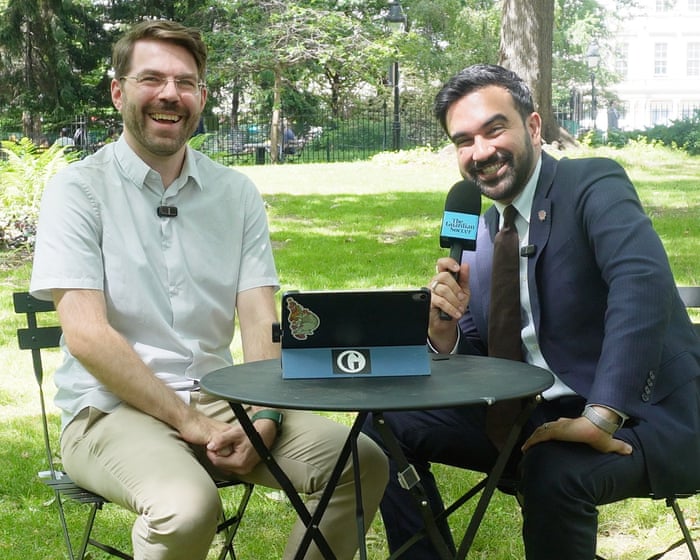
Zohran Mamdani plays the Guardian's Bracketology to predict World Cup winner – video
Source: US news | The Guardian · Bias: Center Left
Summary
The New York City mayor, Zohran Mamdani, briefly stepped away from City Hall to tackle the ultimate soccer challenge: predicting the entire World Cup bracket In the Guardian's exclusive interactive game. From shocking early exits to his definitive pick for the final, see how Mamdani maps out the world’s biggest tournamentBracketology: predict a path to World Cup victory Continue reading...
Zohran Mamdani plays the Guardian's Bracketology to predict World Cup winner – video
Center Left
The New York City mayor, Zohran Mamdani, briefly stepped away from City Hall to tackle the ultimate soccer challenge: predicting the entire World Cup bracket In the Guardian's exclusive interactive game. From shocking early exits to his definitive pick for the final, see how Mamdani maps out the world’s biggest tournamentBracketology: predict a path to World Cup victory Continue reading...
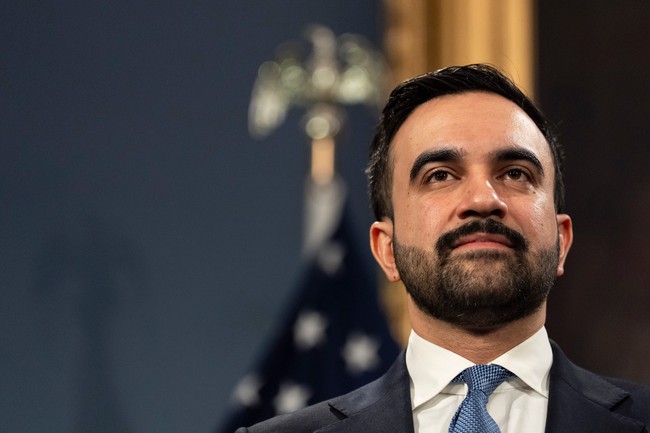
"Have you ever been to the U.S.-Mexico border?” “No.”One word. That may have been the most revealing moment of New York City Democratic Mayor Zohran Mamdani’s recent interview with the New York Times.Sanctuary policies are easy to defend from a podium at New York City Hall. They are much harder to defend before communities that have already paid the price.Mamdani defended his city’s sanctuary policies, which he reinforced after taking office by signing an executive order reaffirming them.The problem is not so much that Mamdani has never visited the border. It is that he seems unwilling to understand why communities that lived through the border crisis reached a very different conclusion.That lesson is visible far beyond the Rio Grande.Consider Goliad County in South Texas. The rural county has about 7,000 residents and sits roughly 160 miles from the U.S.-Mexico border.Testifying before the Senate Judiciary Committee last year, Sheriff Roy Boyd described how the crisis transformed the community he serves.Boyd’s office averaged 77 arrests a year during the five years before 2021. From 2021 through 2024, that average jumped to 413. Deputies discovered 16 cartel stash houses, and pursuits involving suspected human smugglers became routine.Residents began hearing voices and movement on remote properties after dark. Many no longer felt safe alone in their own homes.Those facts expose what Mamdani’s answer overlooks. The border crisis did not remain at the border. Cartel activity and illegal immigration reached inland communities that lacked the personnel and equipment to confront them. Former Border Patrol agent and Texas Public Policy Foundation senior fellow Ammon Blair calls cartels “hybrid threats.”As Blair puts it, “Cartels don’t just smuggle. They destabilize.” Boyd has described them as “contractors and subcontractors” in a network moving migrants and drugs from the border into Texas’ largest cities.That reality changed Texas’ response. In 2021, as illegal crossings surged under President Joe Biden, Goliad became one of the first inland counties to declare a local disaster. Boyd suggested giving local law-enforcement agencies flexible grants for overtime, new officers, patrol vehicles, and other equipment.Those grants became part of Operation Lone Star.According to Texas Republican Gov. Greg Abbott’s office, Operation Lone Star has produced more than 535,700 apprehensions and referrals, 57,400 criminal arrests, and 47,500 felony charges. Texas law enforcement has also intercepted more than 779 million lethal doses of fentanyl.RELATED: The revolution will not be televised — it will be livestreamed in 4K Andrew Lichtenstein/Corbis/Getty ImagesBoyd later launched the Operation Lone Star Task Force, which allows local agencies to share deputies, intelligence, and resources across jurisdictional lines while targeting human smuggling, cartel activity, and organized crime.New York has felt the downstream effects too. Former Mayor Eric Adams warned that the migrant crisis would “destroy New York City.” Mamdani nevertheless continues to defend sanctuary policies that impede cooperation with federal immigration authorities.Goliad’s experience carries a national lesson. Criminal organizations do not recognize state boundaries. The same networks that move people across the border traffic drugs, weapons, and money into communities nationwide. They exploit ports of entry, the northern border, and weaknesses far from either frontier.The farther those networks spread, the more Americans discover that border security is not someone else’s problem.Mamdani may be proud of New York City’s sanctuary stance.His one-word answer showed more than where he has never been. It revealed what he refuses to see.Sanctuary policies are easy to defend from a podium at city hall. They are much harder to defend before communities that have already paid the price.
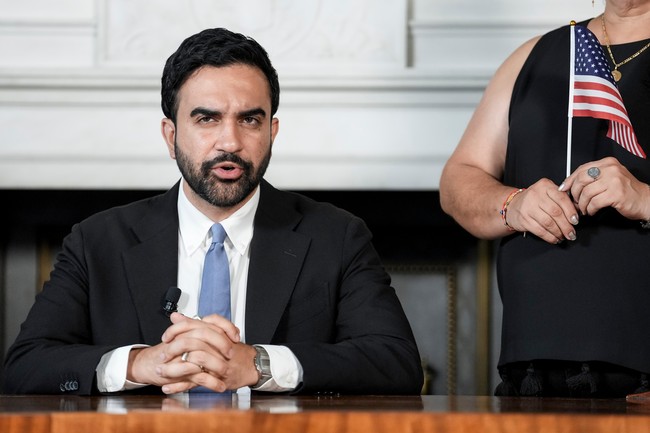
New York City's municipal bond prices continue to decline as Mayor Zohran Mamdani doubles down on his Marxist Third-Worldism, every minute of every day, it seems.
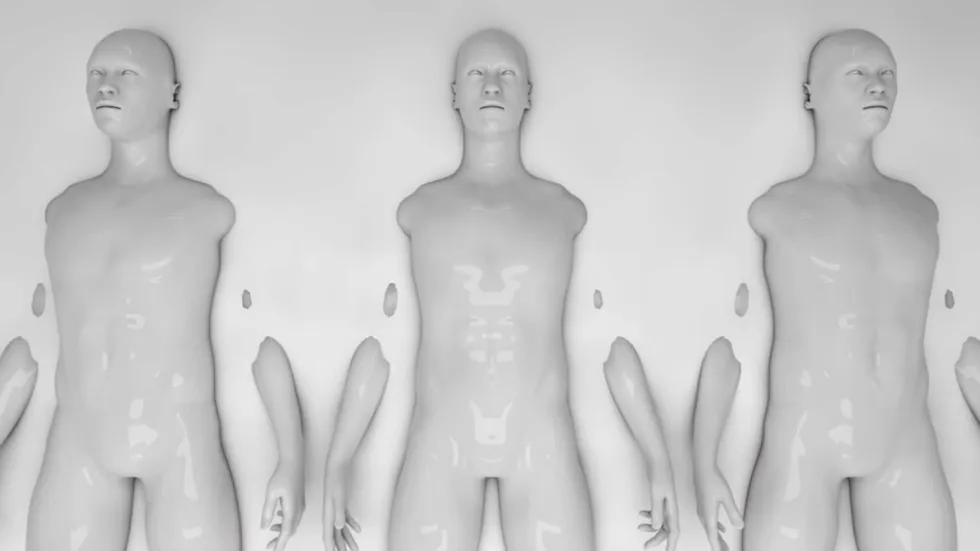
Social media's magicians spent decades perfecting the art of slicing human attention into advertising revenue. Is the next step on the corporate road map farming human tissue for spare parts?The tech is there, or almost there. The ideas have percolated for decades. All it takes, it seems, is the will.The concept of individual self-ownership becomes entirely obsolete.An early pitch deck for R3 Bio, a quiet biotech startup operating out of California, laid out a vision that makes classic horror fiction look rather mild. The company’s leadership, reports suggest, engaged in internal discussions regarding the production of brainless, nonsentient human bodies designed for the explicit purpose of organ harvesting, pharmaceutical testing, and eventual commercial deployment.They christened these biological monstrosities "organ sacks."The terminology speaks volumes to the moral framework seizing imaginations in the contemporary tech executive class. When a team of researchers and engineers looks at the human form and sees an inconveniently conscious container for marketable kidneys, the line between medical innovation and factory farming disappears completely.Executives at R3 Bio floated plans to reprogram monkey cells, cultivate complete organ systems, and engineer these living biological constructs to be intentionally primitive enough to bypass federal ethical guidelines.But this isn't some sudden Silicon Valley obsession. The ambition to redesign human biology has been gathering momentum worldwide for years.They have a dreamIn October 2022, biotech investors gathered in Zurich to debate the commercial viability of synthetic biology, openly celebrating the day human biology would be fully decoupled from traditional ideas of personhood. The attendees viewed the human body as an inefficient piece of legacy software requiring a total architectural overhaul. It was only a matter of time before the idea caught on.Scientists at R3 Bio defended their research behind the usual wall of righteous PR speak, insisting their work aims to end the chronic shortage of donor organs and cure terminal illnesses. They publicly insist that full-scale human organ fabrication remains outside their current operational scope and that their public website reflects a commitment to safe, traditional cell therapy.But the problem runs deeper than what R3 Bio says it is or isn't doing today. It's what history tells us can happen when scientific ambition outruns consent, oversight, and basic human dignity.The playbook never changes. In 1951, researchers extracted cancer cells from Henrietta Lacks without her knowledge or consent, creating the HeLa cell line that generated billions in profit for pharmaceutical giants while her family struggled to pay medical bills. The medical establishment transformed a living human being into a self-sustaining corporate product, establishing a precedent that today's biotech firms are eager to scale up to the entire human torso. There is an enormous amount of money to be made. And where the fevered dreams of high-tech immortality are concerned, human morality has a troubling habit of turning negotiable.RELATED: Anti-aging mogul's next act? He'll harvest organs from his own clone L-R: Bridget Bennett/Bloomberg/Getty Images; Aldara Zarraoa/Getty ImagesA society grounded in the belief that human life possesses inherent dignity treats the human body as an inherently sacred structure rather than a machine assembled from interchangeable parts. The secular technocracy reigning in Northern California views the human body as a collection of meat components that can be optimized, monetized, and swapped out.Death of the selfThe transition from healing the sick to manufacturing customized human vessels happened while everyone was distracted by social media algorithms. Engineers want to replace a failing heart, grow an artificial liver in a vat, construct a brainless body to house the spares, and call the whole process market efficiency. The language of human medicine was completely swallowed by the inhumane jargon of auto repair.This mechanistic worldview demands that every biological boundary be erased in the name of efficiency and infinite growth. If a brainless body exists as a legal product, the entity owning the patent exercises total property rights over a human biological shell. If a corporation can copyright the genetic sequence of a custom-grown torso, the concept of individual self-ownership becomes entirely obsolete.Tech elites frequently talk about death as a minor coding error awaiting a software upgrade. They invest billions in longevity protocols, upload schemes, and cellular rejuvenation, completely convinced that their wealth entitles them to bypass mortality itself.
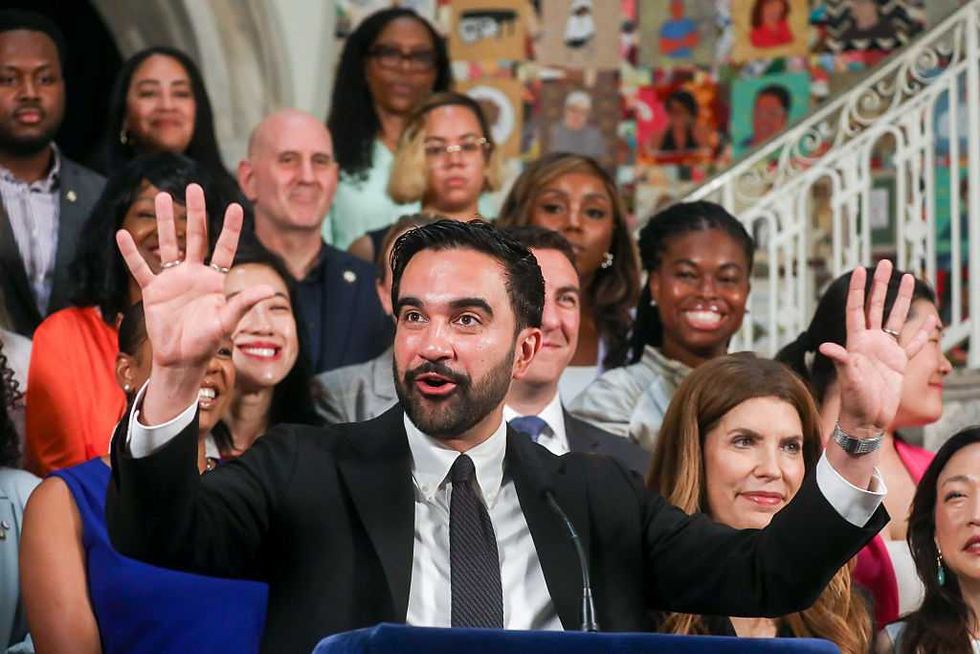
A group of 9/11 families has started a petition drive demanding NYC Mayor Zohran Mamdani be barred from attending the 25th anniversary ceremony honoring the nearly 3,000 lives lost during the Sept. 11, 2001 attacks – because they believe he’s a longtime terror apologist.