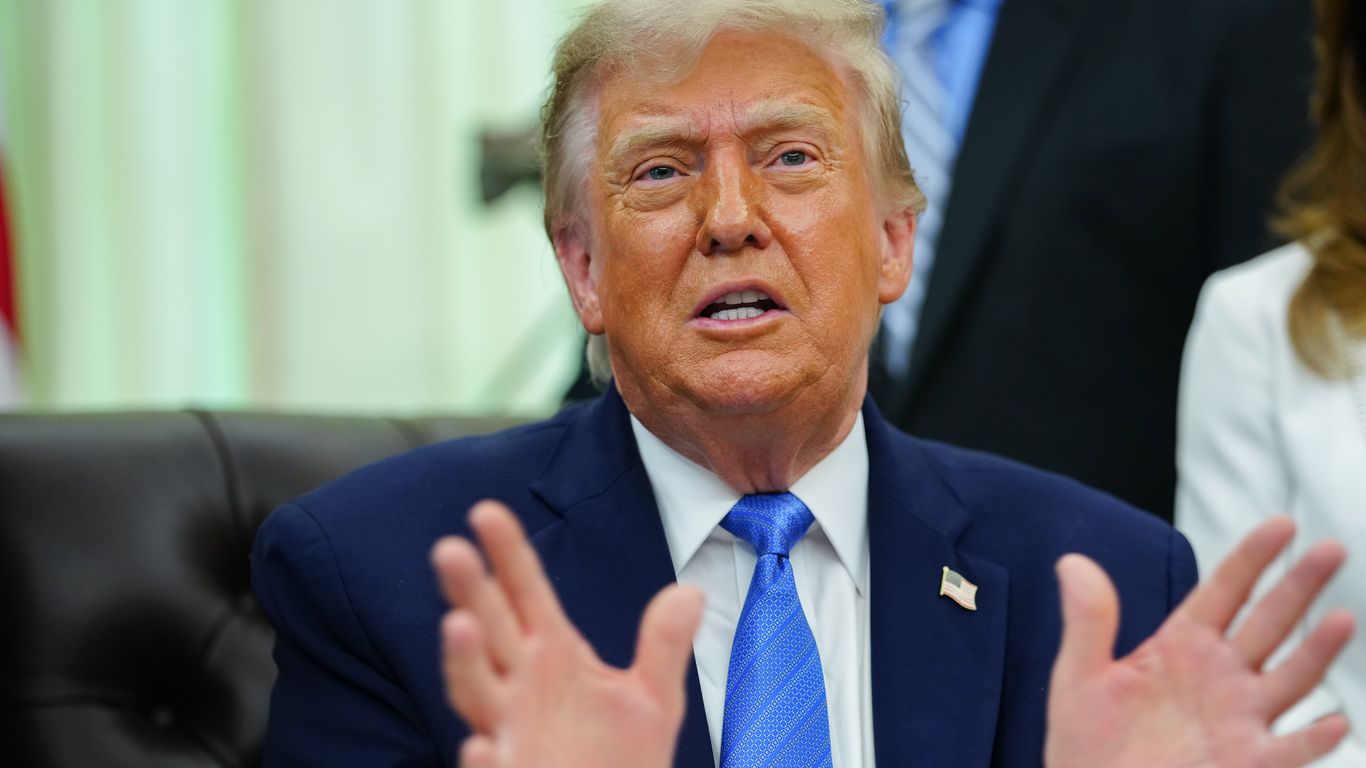
President Trump has been on a roll of rhetorical missteps that could come back to bite Republicans in the midterms.Why it matters: Trump has served up a platter of ready-made campaign ads to Democrats, suggesting he's fine with rising prices and unconcerned about Americans' financial struggles.Driving the news: Trump delivered three eye-popping quotes in the span of a month:"I don't think about Americans' financial situation," he said on May 12.Two weeks later, on May 27, Trump said, "I don't care about the midterms."And when Trump was asked Wednesday about the latest inflation numbers showing a 4.2% rise in prices, he responded, "I love the inflation."The big picture: Michael Kinsley famously defined a gaffe as "when a politician tells the truth — some obvious truth he isn't supposed to say."Trump's gaffes revealed something different: not an inconvenient truth, but the truth as he wishes it to be.Zoom in: The first came in mid-May, when Trump said, "I don't think about Americans' financial situation." His point was that he wouldn't let domestic financial pain prevent him from stopping Iran from obtaining a nuclear weapon. But that nuance is likely to be lost in the heat of campaign season."The president could have chosen different words, but this is what he thinks," a Trump adviser told Axios at the time. Two days later, Trump told Fox News it was "a perfect statement. I'd make it again."Trump's "I don't care about the midterms" remark came as he argued against letting Iran exploit the U.S. political calendar as leverage in the war.In the Oval Office Wednesday, Trump was asked about inflation hitting a three-year high. "You know what I really love? I love the inflation," he said, before predicting that prices would drop "like a rock" once the war in Iran is over.Between the lines: Trump's remarks — and his refusal to walk them back — show how consumed he is with winning the war, no matter the political cost to congressional Republicans.The party has pleaded for him to turn his attention to cost-of-living issues, but Trump has made clear that Iran is his priority.The context: Compounding the problem for Republicans, Trump has pushed for hundreds of millions of dollars for a White House ballroom and $1.8 billion for an "anti-weaponization" fund that could've benefited people who participated in the Jan. 6 attacks.The bipartisan pushback to both ideas revealed how hard they were for Republicans to defend.By the numbers: Just 29% of Americans approve of Trump's handling of the economy, while 63% disapprove — his worst numbers on the issue in either term, according to an Economist/YouGov poll out this week.Even at his 2023 low, former President Biden's economic approval never fell below 39%, according to the same Economist/YouGov polling — 10 points above where Trump sits now.The other side: Trump told the New York Post on Wednesday that he meant to say that he loved that inflation wasn't higher."Despite the fact that we're in a war, the numbers are much lower than anticipated, and when we're out of that war, the numbers will be at lower numbers than they were even before it started," he said."Delivering economic relief for the American people has been a Day One priority for the Trump administration," White House spokesman Kush Desai said in a statement, pointing to tax cuts and drug pricing deals.The bottom line: Congressional Republicans are focused on winning an election. Trump is focused on winning a war.