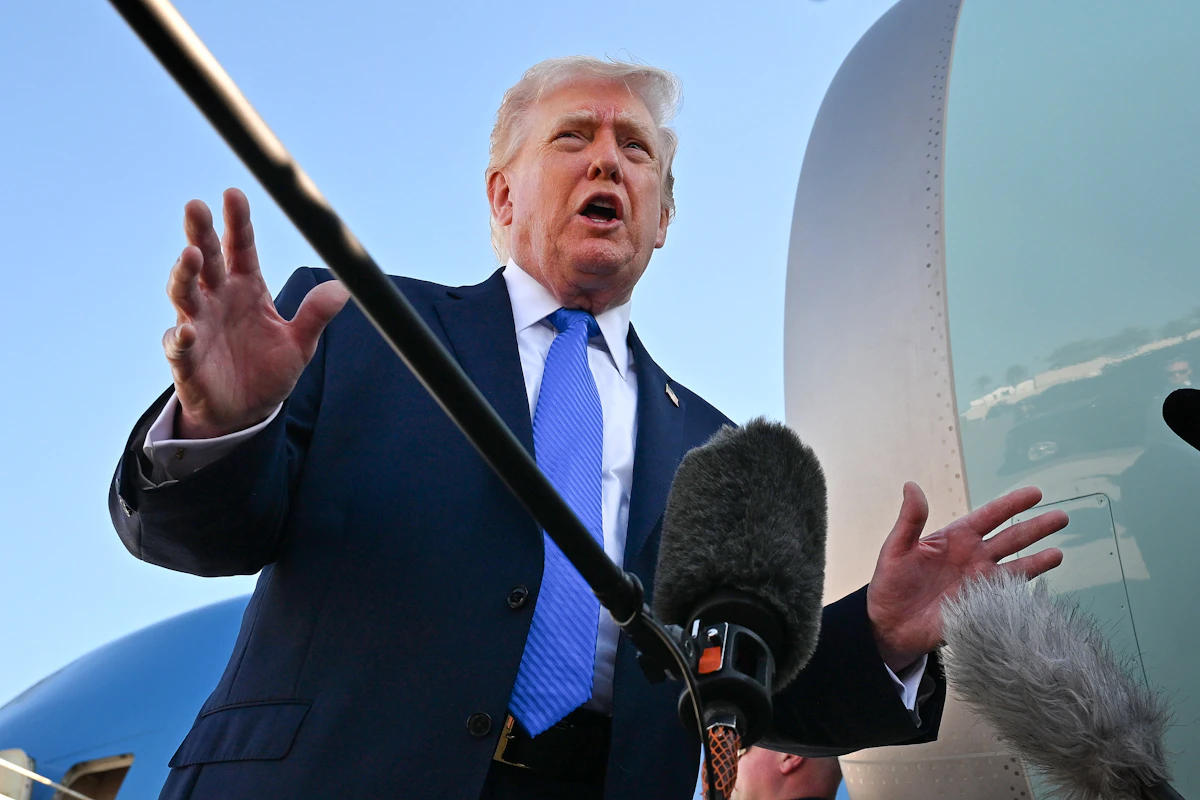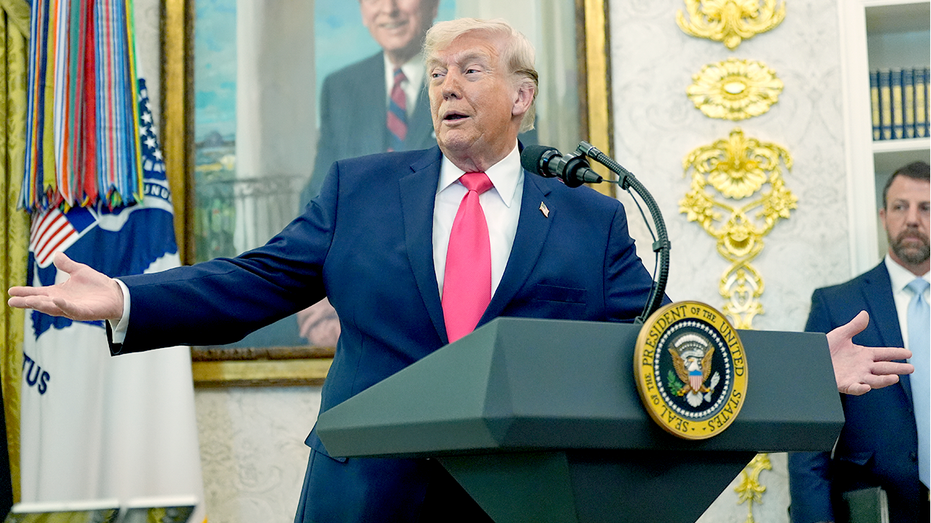
President Trump cited ‘major points of agreement’ in direct talks with the Iranian regime to end the war. But Iran denied there were any direct talks. NBC News’ Gabe Gutierrez reports.
President Donald Trump alarmed onlookers on Sunday after he went on an hours-long AI picture posting spree on Truth Social. In all, Trump posted more than 40 AI-generated photos over multiple hours on Truth Social. Some of the photos included Trump standing on top of an Iranian oil tanker declaring "It is our oil tanker now!" and three late-night comedians who recently drew the president's ire panhandling on a sidewalk. There was also the all-too-expected jab at Rosie O'Donnell, who has been feuding with the president for nearly two decades. The photos were posted on a day when reporters caught Trump out playing golf and inspecting the White House renovations. Political analysts and observers reacted with concern to Trump's posting spree. "Trump is having a mental health episode on social media right now," posted Harry Sisson, a Democratic influencer with over 394,000 followers on X. "He’s insane. 25th Amendment NOW.""If anyone still believes our president is not an unhinged sociopath, please check out his fake Twitter feed from this afternoon," S.V. Dáte, White House at HuffPost, posted on X. "A man who posts this 'joke' this many times is not joking. This is pure delusion," Vance Wilson, a liberal political commentator, posted on X. "I am confident he will try to find some way to run in 2028. He may not succeed at the Supreme Court, but I am nearly certain he doesn’t see this as a 'joke.'"
Figures are source of dispute as US defense department days ago reduced record of troops killed and woundedThe Pentagon updated its official war casualty database over the weekend, adding more than 140 wounded service members. The Defense Casualty Analysis System (DCAS) also introduced a new casualty category labeled “Overseas Operations” for personnel killed and wounded “starting July 7”.According to the updated database, the official toll for the earlier phase of the US-Iran war, known as Operation Epic Fury, now stands at 14 service members killed and more than 400 wounded in action. Continue reading...
Some progressive Democrats are fuming that the party's new schedule for 2028 presidential primaries could make it harder for one of their own to win the party's nomination.A powerful Democratic National Committee panel voted Friday to kick off the primary in South Carolina — the state where progressive icon Bernie Sanders suffered landslide losses in the 2016 and 2020 primaries.Why it matters: The panel's decision came with Democrats already divided over a wave of contentious 2026 primaries that have pitted an insurgent left against the party's more moderate establishment.Zoom in: From Wisconsin to Michigan to Maine, top Democrats are trying to halt the left wing's momentum in the run-up to this year's midterms, favoring relatively centrist candidates they see as more electable.Some progressives view the elevation of South Carolina on the party's 2028 primary calendar as part of that effort.South Carolina edged out Nevada for the first spot on the primary schedule, stinging progressives because Sanders won the primary in the Silver State in 2020.Puck reported that some DNC members were concerned that making Nevada the first state to vote would boost another socialist candidate.But even some DNC members were angry with the decision to put South Carolina first.A member of the DNC's Rules & Bylaws panel, which preliminarily OK'd the calendar, told Axios that "the public is swinging left, and the establishment is trying to fight the winds of change."The panel member added that putting South Carolina first could "shut down" a progressive presidential candidate, which is "not a strategy for winning the electorate."Branko Marcetic, a writer for the socialist magazine Jacobin, posted on social media that "the whole rationale is stopping a left-wing insurgent." Leftist streamer Hasan Piker snarkily suggested that South Carolina Rep. Jim Clyburn had too much power over the presidential nominating contest.The other side: South Carolina Democratic Party chair Christale Spain told Axios that a progressive candidate such as New York Rep. Alexandria Ocasio-Cortez "absolutely" could win the state's primary."I hate that the narrative kind of seems like 'Well, a progressive can't win in the South,'" said Spain, who worked for Sanders' 2016 campaign. "The work that you have to do in the South is retail politics."Between the lines: The debate between progressives and traditional Democrats over South Carolina has at times been racially fraught partly because Sanders, who's white, twice fared poorly in a state where a sizable chunk of Democratic voters are Black.At the same time, Black Democrats viewed South Carolina's victory in the debate over the primary schedule as overdue recognition of their importance to the party.The DNC panel's decision on the primary schedule still must be ratified by the full DNC.Whether progressives can break through with Black voters on a national scale is perhaps the most important question facing them ahead of the 2028 presidential primary.The left has had more recent success with Latino voters and Black voters under 50, especially in the Northeast, but it's not clear that would be enough to carry a presidential primary in which older Black voters across the South are a key constituency.Sanders performed well with Latinos and young Black voters, and it wasn't enough.The intrigue: Some progressives believe the new calendar could work to their advantage — but not necessarily because they think they could win in South Carolina.The state previously played a decisive role as the final contest before the traditional string of primaries on Super Tuesday. Now, they argue, South Carolina may serve more as a culling mechanism than a kingmaker.A former Sanders senior campaign aide said the senator "might have been unstoppable" in 2020 if the Democrats' new calendar had been in place then.
A small but growing number of Democrats are embracing their own version of "America First" in response to Donald Trump's ongoing war with Iran in partnership with Israel.Why it matters: Trump's war is scrambling the politics of a slogan he once owned, fracturing the right even as some Democrats — including potential 2028 presidential candidates — embrace it.Driving the news: Abdul El-Sayed, a progressive Senate candidate in Michigan who campaigned with Vermont Sen. Bernie Sanders and New York Rep. Alexandria Ocasio-Cortez (D-N.Y.) last weekend, told Axios: "I'm the most America First candidate in the country, proudly.""When you keep our money here rather than sending it to some other country's war machine, that's America First," he said.California Rep. Ro Khanna, who's weighing a run for the White House, also is embracing the label.In April, he said it's time to "put America first" when he reintroduced a bill to ban gas exports during periods of high gas prices.In February on the House floor, Khanna said that "another war in the Middle East is not America First."And Dan Osborn, a union leader running for Senate in Nebraska as an independent against the Republican incumbent, wrote on Friday: "We need to be putting America first, not Israel first.""We can't undermine the independence of the American military for any ally," he added, "much less an untrustworthy one that's already forced us to throw money at a useless forever war overseas."Zoom out: Some Republicans agree with Democrats that Trump's war with Iran was a betrayal of his pledge to put Americans first — and that it's given Democrats a political opening.Tucker Carlson, who introduced Trump at the Republican National Convention in 2024, lobbied the president against attacking Iran and has since apologized for "misleading people" about Trump.El-Sayed agreed with Trump's critics on the right, saying that "the MAGA version of America First is to make a show out of America First, only to sell you out.""They'll always be beholden to the interests of a foreign interest lobby like AIPAC, and always be beholden to the interests of the corporate war machine, the military-industrial complex, the folks who win every single time we send our weapons abroad," he added.Between the lines: Most national Democrats still stop short of using Trump's phrase, but they increasingly echo its main arguments.Campaigning in Memphis this month, Ocasio-Cortez — who's considering a run for president or the Senate in 2028 — said that "all that money we're spending on bombs abroad could be spent on schools right here."In a speech to Arkansas' Democratic Party in April, former Vice President Kamala Harris said, "To spark an American revival, we must start with a bold agenda where our public dollars go to affordable housing and healthcare and childcare, not spent on reckless foreign wars that no one wants."Trump himself repeatedly decried "stupid foreign wars" during the 2024 campaign.Beyond antiwar statements, many Democrats have embraced domestic industrial policies aimed at reviving American manufacturing.In June, Sens. Mark Kelly of Arizona and Cory Booker of New Jersey — both potential presidential contenders — were among those introducing the Make More in America Act.Kelly argued the bill would "build more things here at home and create good-paying jobs while reducing our dependency on foreign adversaries."Bottom line: Trump will finish his term in 2029, but the politics that led him to embrace "America First" now appear bipartisan, and here to stay.Polls indicate voters are tired of the decades of battles in the Middle East, particularly when they don't feel positive about their economic situation at home. Now politicians in both parties are trying to meet voters where they already are.
"I want to be crystal clear: The US military -- and I've verified this every which way -- has everything that it needs to conduct this campaign as effectively as it needs to be," Ambassador Mike Waltz told NBC's "Meet the Press."
President Donald Trump may have just laid down the tracks for one of his boldest election plots yet, according to one political analyst. John Heilemann, an MS NOW political analyst, said on Sunday's broadcast of "Deadline: White House: Weekend" that Trump's recent national address about election security was an attempt to "lay down the tracks" for his next wave of lies about the election results."I think he's just trying to lay down the tracks on which he can make false claims in the future," Heilemann said. "For him, it's enough to have said those things publicly so that when he does what he's going to do, whatever that turns out to be in November, he can look back and say, 'I told you so. I said, this was rigged. You didn't believe me. You didn't listen to me. But it was rigged then, and it's rigged now ... This is an illegitimate election. And here's what we're going to do going forward.'" Heilemann noted that recent polling appears to back up his assertion. A recent poll from The Economist and YouGov found that 67% of Americans, including 77% of independent voters, thought Trump was trying to sow doubt about American elections during his national address rather than back up his claims of election interference with concrete facts. "So, all of this is about pretext, not about persuasion, and not about some kind of good faith attempt to govern," he added. "It's about ... laying the groundwork for what comes nextcomes next."