Son of rapper Lil Jon drowned after ingesting hallucinogenic mushrooms
Source: US news | The Guardian · Bias: Center Left
Summary
Body of Nathan Smith, known professionally as DJ Young Slade, found in pond north of Atlanta in FebruaryThe son of the rapper Lil Jon drowned after ingesting hallucinogenic mushrooms, officials in the US state of Georgia said.The body of Nathan Smith, known professionally as DJ Young Slade, was found in a pond north of Atlanta in early February. Continue reading...
Son of rapper Lil Jon drowned after ingesting hallucinogenic mushrooms
Center Left
Body of Nathan Smith, known professionally as DJ Young Slade, found in pond north of Atlanta in FebruaryThe son of the rapper Lil Jon drowned after ingesting hallucinogenic mushrooms, officials in the US state of Georgia said.The body of Nathan Smith, known professionally as DJ Young Slade, was found in a pond north of Atlanta in early February. Continue reading...
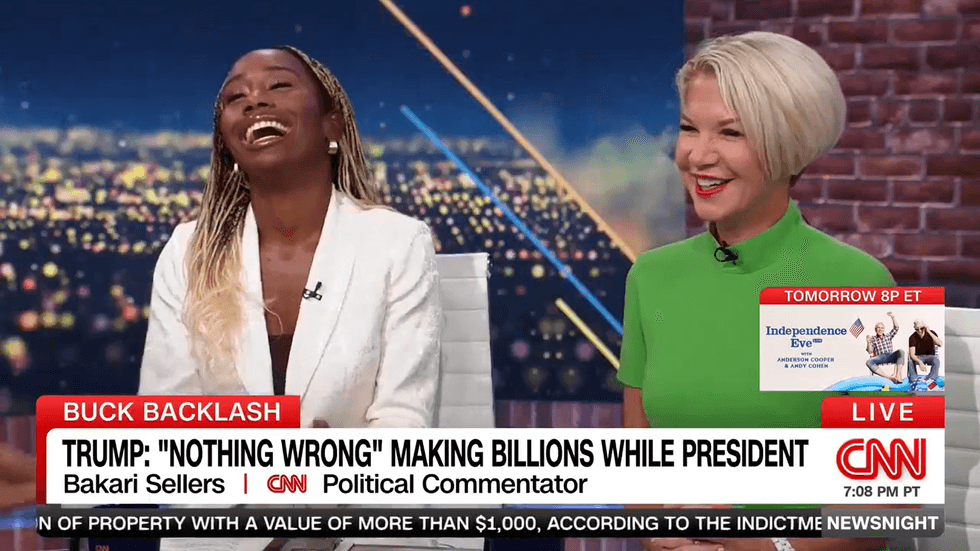
A CNN panel had a good laugh as a GOP pundit twisted himself in a "pretzel" defending the Trump family.While discussing recent revelations about how much money Trump and his family made since returning to office last year, conservative podcaster Ben Ferguson had everyone around him in stitches.Ferguson, the host of "The Ben Ferguson Show," argued that the Trump family isn't corrupt for its involvement in billion-dollar ventures involving cryptocurrency and tungsten mining because they were engaged in "actual business."CNN anchor Abby Phillip, who described the Trump family as "real estate developers," shot back by asking, "What do the Trump sons know about mining rare earth minerals? What do the Trump sons know about robotics?"Ferguson's response was, "A lot, clearly, they made a lot of money off of it because they actually invest in it."The panel around him, which included political analyst and attorney Bakari Sellers, former Biden White House staffer Yemisi Egbewole, and former Bush White House official Ashley Davis, could be heard laughing together as Ferguson responded.Sellers chimed in by remarking, "I do hot yoga, and I feel like you're doing a little hot yoga too for that pretzel you got yourself in," which led to Egbewole and Davis laughing more."The president makes $400,000 a year," Sellers pointed out. "This quarter, he's made over $1 billion on crypto alone...that fundamentally is unethical. You can call it what you want."While Sellers mentioned Trump's presidential salary, Ferguson threw in one more defense: "he gives it all away," which also caused laughter around the table.
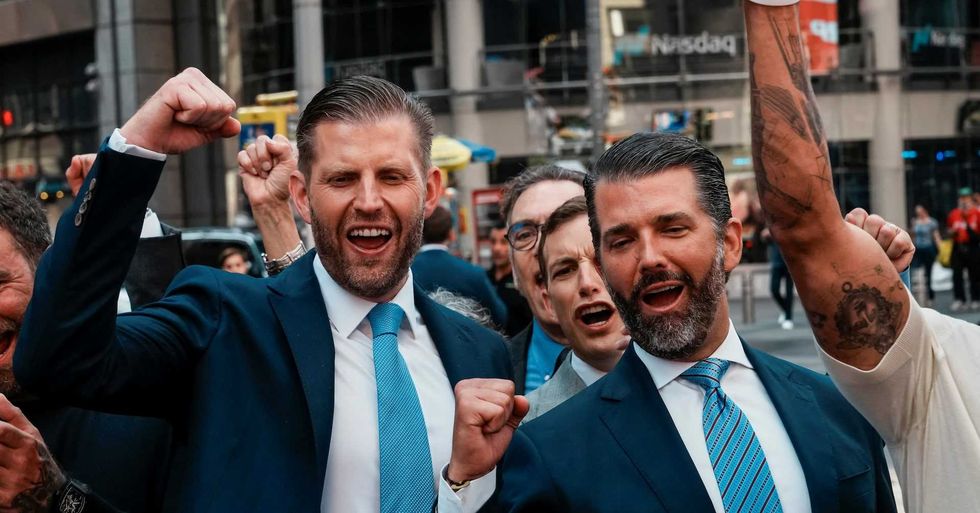
President Donald Trump’s sons are profiting off of their father’s connections, including in a previously-undisclosed deal over a lucrative metal.“Their sons were soon doing business with partners in a deal that their fathers were negotiating, continuing a pattern of self-enrichment in the second Trump administration that has few precedents in American history,” wrote The New York Times’ Paul Sonne and Eric Lipton on Sunday. The report covered how Donald Trump Jr. and Eric Trump availed themselves of a meeting between Commerce Secretary Howard Lutnick and Kazakhstan President Kassym-Jomart Tokayev in September to grant a little-known American company called Kaz Resources access to their tungsten mines.Prior to that meeting, the Trump administration approved preliminary applications for up to $1.6 billion in federal financing for Kaz Resources to break ground on the project in rural Kazakhstan. Dominari Securities, which is partly owned by the Trump sons, agreed to take a 20 percent stake in the tungsten projects.“Around the same time, Cantor Fitzgerald, an investment company controlled by Mr. Lutnick’s family and overseen by his sons Brandon and Kyle Lutnick, helped one of the lead investors working with Dominari on the Kazakh deal raise $210 million in new capital for a related entity,” Sonne and Lipton wrote. “Such rounds of fund-raising typically net Cantor millions of dollars in fees.”They added, “The Kazakh deal was ultimately signed on Nov. 6, six days after the investment involving the Trump sons and their partners, which was not publicly disclosed at the time. The arrangement is hardly an outlier. One or both families have financial ties to at least 14 companies that are actively working with the federal government on critical mining deals, including the Kazakhstan project, according to federal filings examined by The New York Times.”This is not the only occasion when the Trump family has come under scrutiny for profiting from the White House, as has Trump himself. Earlier this month the American Economic Liberties Project and Groundwork Collaborative released a joint report called “The Price of Corruption: How Trump’s Pay-to-Play Administration is Driving Up Costs for Working Families,” which described how the Trumps’ alleged corruption has literally cost ordinary Americans a lot of money.“When Trump rolled out TrumpRX earlier this year, the administration claimed it was a way for Americans to access more affordable prescription drugs,” the report pointed out. “Instead, the platform fails to disclose information about less expensive generic alternatives and, in some instances, charges consumers more for products that are available for less elsewhere.”It added that TrumpRx “serves as free advertisement for Big Pharma and may be lining the pockets of the president’s eldest son, Donald Trump Jr., who is on the board of prescription drug platform BlinkRX, which stands to benefit from the administration’s promotion of direct-to-patient medicine sales.”It also observed that Trump’s tariffs have raised the cost of imported goods for consumers while also enriching Trump himself, citing as one example when he reduced Swiss tariffs “just a few days after Swiss business leaders presented him with a personalized gold bar worth more than $130,000 and a Rolex desk clock.” Conversely, when Trump’s fellow right-winger, former Brazilian President Jair Bolsonaro, faced legal consequences for plotting a coup to illegally stay in power after losing an election to current President Luiz Inácio Lula Da Silva, Trump used tariffs to retaliate.“Americans paid the price for Trump’s international allies breaking the law,” the report pointed out, “as coffee imported from Brazil surged to a 40% increase in price.”