Republican Rifts Deepen Over $95 Billion Budget Plan for Iran War and SAVE Act
Source: NYT > U.S. > Politics · Bias: Center Left
Summary
A House panel approved the measure. But Republicans are divided over its size, cost and policy provisions, and many are concerned about the timing before the midterm elections.
Republican Rifts Deepen Over $95 Billion Budget Plan for Iran War and SAVE Act
Center Left
A House panel approved the measure. But Republicans are divided over its size, cost and policy provisions, and many are concerned about the timing before the midterm elections.
Senator Lisa Murkowski’s concerns about the SAVE America Act are legitimate, and they can be fixed with amendments rather than a no vote.
The post Exclusive—Jenny Beth Martin: Senator Murkowski, Let’s Get You to ‘Yes’ on the SAVE America Act appeared first on Breitbart.
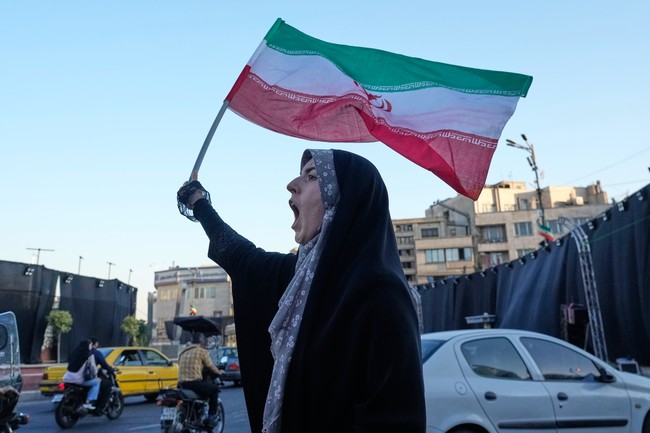
President Trump directed the U.S. military not to conduct new strikes in Iran on Friday, breaking a nearly two-week streak of daily attacks, two sources with knowledge of the decision said.Why it matters: The president's directive came after he approved daily strikes over the previous 13 days. It is unclear if Trump's order on Friday was a one-off or whether the lull will continue. Trump's decision reflects both his willingness to provide more space for diplomacy and a recognition that — short of a return to major combat operations — the current level of U.S. strikes has reached the limit of its effectiveness. If Trump orders a return to strikes, the U.S. military can mobilize on relatively short notice. The U.S. military is still preparing plans for a possible return to major combat operations, but Trump hasn't given orders to move in that direction, the sources said. The White House did not respond to a request for comment.Driving the news: Every afternoon for the last two weeks, Trump has approved strike plans submitted by the military. They were conducted within hours.On Friday, Trump received a similar plan but did not give a green light. Instead, he directed the military not to conduct strikes, the sources said. Shortly after he gave the Friday directive, Trump told reporters at the White House that he has the option of continuing strikes or even escalating them, including "knocking out everything they have." But he made clear that he thinks the "smarter strategy" is to "make a deal" with Iran. "We're talking to [the Iranians] right now. I think they're getting more and more serious as the days go by. We're locked and loaded and ready to go, but we're talking to them," Trump said. Later on Friday, during his remarks at the White House Correspondents Association dinner, Trump said he didn't think Iran is ready to make a deal at the moment, "but I'm willing to listen." State of play: Trump's order to hold fire was given several hours after an Omani delegation arrived in Tehran Friday for talks on a new arrangement to reopen the Strait of Hormuz.Two regional sources with knowledge of the negotiations said progress has been made in the talks and that an agreement between Oman and Iran could be reached over the weekend. President Trump would then have to decide whether to accept the proposed deal.
Iran's leaders are fighting each other almost as much as they're fighting the West, with some senior politicians scrambling to save US talks while the powerful Islamic Revolutionary Guard Corps leans into the renewed war, regional sources told The Post.
Iran-backed Houthi rebels announced Saturday they fired missiles and drones toward Saudi Arabia, claiming retaliation for Saudi attacks on Yemen’s coastal city of Hodeida. Brig. Gen. Yahya Saree, the militant group’s spokesperson, said in a social media post that the Houthis executed two military operations “in response to this blatant and criminal aggression” from Saudi…
Maine Democrats on Saturday are poised to announce their nominee to replace Graham Platner in the race to unseat incumbent Sen. Susan Collins (R-Maine). Former state Sen. Troy Jackson is the likely pick. Platner withdrew his bid earlier this month following allegations of sexual abuse. Meanwhile, President Trump has issued warning after warning to Iran…
America remains deeply divided over whether the 2020 presidential election was stolen from Donald Trump. Millions believe the system failed them, while the media, intelligence bureaucracy, and the left have treated their doubts as something to suppress rather than investigate.The documents released this week by the Trump administration do not close the case. They reopen it — and make the “nothing to see here” narrative indefensible.Start with communist China.The released intelligence reports that approximately 220 million American voter records are in Chinese hands. Tens of millions of records across 18 states were bought, stolen, or hacked and included names, addresses, phone numbers, party preferences, and other sensitive information.A sovereign nation must know that the people selecting its government are its citizens. That does not prove China changed a single ballot, but it does prove Beijing possessed a political targeting asset. When a strategic rival aggregates enormous datasets and applies modern analytics, it gains the ability to identify, target, and influence American voters at industrial scale. The most disturbing disclosure involves the President’s Daily Brief — the president’s most sensitive and consequential intelligence product. In one released email, an official wrote: “We have deliberately massaged our one pending PDB to avoid any direct links to the election.”In a separate internal chat, a counterintelligence official boasted: “I’m basically running a shadow government across the FBI at this point.”The left has spent years ridiculing concerns about a “deep state” as conspiracy theory. These revelations make that ridicule look increasingly like camouflage.Then comes the voting-system reveal.A Cybersecurity and Infrastructure Security Agency report included in the administration’s document release identifies weak access controls, outdated operating systems, flat networks, inadequate monitoring, and legacy remote-access pathways across state and local election environments. During multiple penetration tests and red-team exercises, CISA assessors gained full control of election-office networks within hours or days.Separately, the report cites research involving one ballot-marking system showing that barcode-encoded votes could be altered without changing the human-readable selections displayed to the voter.The release also includes intelligence concerning methods allegedly developed by Venezuela’s Maduro regime to manipulate electronic totals while concealing the changes.Precision matters. A Venezuelan capability is not proof of an American operation. A demonstrated vulnerability is not proof it was exploited. The documents do not establish that American vote totals were secretly changed in 2020.But they demolish the claim that election technology is immune from manipulation. These are computer systems with software, databases, vendors, administrators, updates, and attack surfaces. Compromise must be anticipated and independently detectable.RELATED: America needs an artificial intelligence coalition, not an AI fortress Burcu demir/Getty ImagesA limited Department of Homeland Security review raises another alarm. The White House says it identified approximately 278,000 potential noncitizen registrations. DHS’ public follow-up described more than 250,000 preliminary potential matches in California, New Jersey, Nevada, and Pennsylvania — only four states.No serious person should dismiss numbers of this magnitude. Biden’s certified Georgia margin in 2020 was 11,779 votes. In 2016, Trump carried Michigan and Wisconsin by a combined 33,452 votes — and Michigan, Wisconsin, and Pennsylvania by just 77,744.The media formula — “the documents do not prove vote totals changed; therefore they prove nothing” — is analytical malpractice. Absence of final proof is not proof of institutional innocence.The proper question is whether this new information raises the probability that foreign influence, intelligence suppression, ineligible registrations, or exploitable technology played a larger role in the 2020 election environment than Americans were told — and whether future elections remain at risk.The answer to both questions is yes.That is why Congress must pass the SAVE America Act before November. The House-passed legislation requires documentary proof of citizenship for federal voter registration and photo identification for federal voting.These are basic risk controls. Pew found that 83% of Americans — including 71% of Democrats and 95% of Republicans — support government-issued photo identification. A sovereign nation must know that the people selecting its government are its citizens. A constitutional republic must demonstrate — not merely assert — that its elections are accurate.Congress should stop stalling and pass the SAVE America Act.