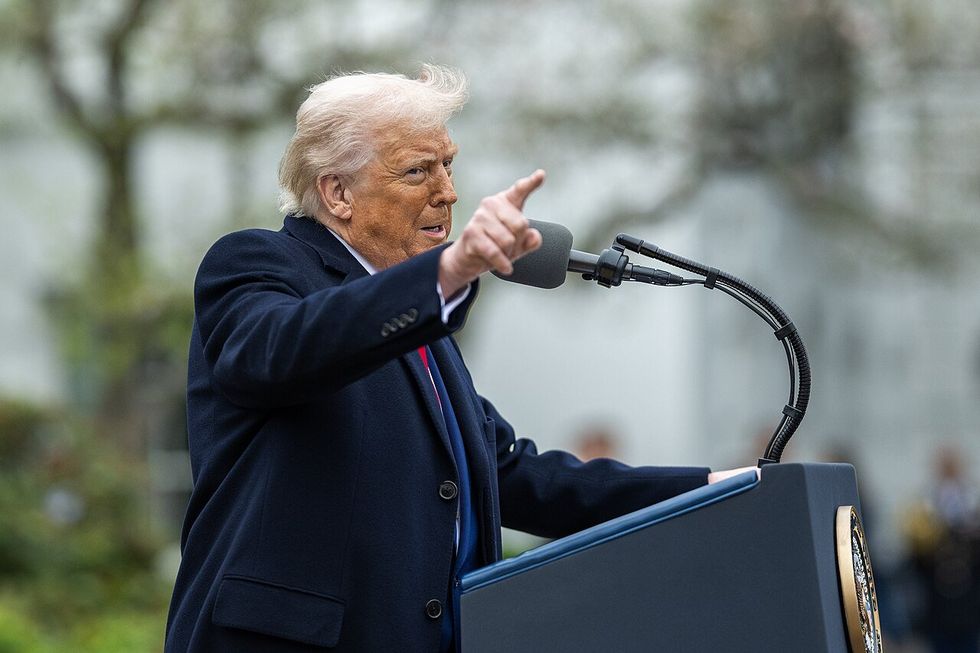
In December 2025, Trump axed today’s holiday — Juneteenth, the official celebration of the Emancipation Proclamation — from the free admission days at the more than 100 national parks across America. He also axed Martin Luther King Jr. Day as a free admission day. Instead, he substituted his own birthday, June 14, as a free admission day. There you have it: the venal combination of Trump’s white supremacy and his malignant narcissism. It’s much the same with Trump’s celebration of America’s 250th birthday. He has erased any mention of the slavery that scarred most of America’s first century and of Jim Crow, during most of the next — and has instead merged the nation’s anniversary with his own 80th birthday. In 2020, Trump scheduled a campaign rally for himself on Juneteenth in Tulsa, Oklahoma — the site of the 1921 Tulsa Race Massacre. (After a wave of criticism, he rescheduled it for the next day.) America can probably survive Trump’s malignant narcissism. It’s unclear how well we can endure his white supremacy. On May 21, Trump eased the regime’s cap on the number of refugees who can enter the United States by 10,000 slots — from 7,500 to 17,500 — all reserved for white South Africans. The ostensible reason: an “emergency … due to recent increases in the incitement of racially motivated violence on the part of the Government of South Africa.”Rubbish. According to investigative reporters in South Africa, such as Nechama Brodie, who has written extensively about farm murders there, white South Africans are not being persecuted. “Studies consistently show that white South Africans have the highest employment levels, highest education levels and highest income levels of all groups in South Africa, despite being a minority,” Brodie said.Trump’s advocacy for white Afrikaners is in sharp contrast to his dismantling of America’s refugee program for people of color (between 2004 and 2019, refugee allocations were divided among Africa, East Asia, Europe and Central Asia, Latin America/Caribbean, and Near East/South Asia). Trump has a long history of white supremacist activities, beginning with the 1973 lawsuit brought against Trump management for allegedly discriminating against Black renters. He took out full-page ads in 1989 calling for the death penalty for the five Black and Latino teenagers eventually exonerated in the Central Park jogger case.Trump played a major role in spreading the debunked, racially charged conspiracy theory that Barack Obama was not born in the United States. He infamously said there were “fine people on both sides” of the violent white supremacist rally in Charlottesville. He has hosted prominent white nationalist Nick Fuentes at his Mar-a-Lago residence. He has sought to erase Black history from America’s classrooms. He’s eliminated all government diversity, equity, and inclusion programs and is trying to stop them in the private sector. On this Juneteenth, it is important to acknowledge — both in sadness and in outrage — that the person occupying the position of president of the United States is a white supremacist.Robert Reich is a professor of public policy at Berkeley and former secretary of labor. His writings can be found at https://robertreich.substack.com/
In his first term of office Donald Trump achieved the lowest average job approval ratings (41%) among Americans since the end of the second world war. In his second term he has fallen well below that with an approval rating of only 35% in a recent Economist/YouGov poll.Much of this can be explained by voter perceptions of the state of the US economy. The chart below shows the relationship between the percentage of Americans who approve of the president’s handling of his job and consumer confidence. It covers almost 50 years of monthly data with the consumer confidence data coming from surveys conducted at the University of Michigan.The two series track each other closely and so demonstrate a moderately strong relationship with a correlation of 0.44 (If they were unrelated the correlation would be 0 and if they were exactly the same it would be 1). In both cases higher scores denote greater approval and increasing consumer confidence. This confirms the well-known fact that the state of the economy is a big driver of presidential approval. If we look closely at the consumer confidence index, the average score over the entire period was 84. In the late 1970s Jimmy Carter had low and falling approval ratings and consumer confidence scores. This goes a long way to explaining why he was a one-term president who lost to Ronald Reagan in the 1980 election. A decade later, when Republican George HW Bush was president between 1989 and 1993, consumer confidence plummeted as an official recession in the US economy was declared in July 1990, leading to declining growth and rising unemployment. The Federal Reserve, which is responsible for US monetary policy, exacerbated a weak financial situation by raising interest rates in order to combat inflation. The result was that Bush senior became another one-term president and lost the 1992 election to his Democrat rival, Bill Clinton (whose campaign motto was famously: “It’s the economy, stupid.”). However, the largest fall in consumer confidence over this period occurred after the financial crash of 2007-2008, which in turn produced a serious recession and rapidly declining consumer confidence. On this occasion George W Bush was in his second term as US president and his collapsing approval ratings paved the way for the victory of Barack Obama in the 2008 presidential contest.Finally, when Donald Trump won the presidential election in November 2016, consumer confidence was relatively high. In January 2017 at the time of his inauguration the consumer confidence index stood at 99. Four years later in January 2021 when Joe Biden was inaugurated as president the index was at 79, a dramatic decline in historical terms.The midterm elections for the House and the Senate take place in November this year and currently things do not look good for the Republicans. Pollsters have been asking what is called a “generic” question in their surveys about who respondents would vote for if the midterm elections took place today. They are virtually unanimous in their agreement that the Democrats will win control of the House of Representatives. In addition, it is possible, though less likely, that the Democrats will win control of the Senate.A thought experimentAn interesting thought experiment is to suppose that we were looking at a presidential election in November rather than the midterms. What light does the current consumer confidence data throw on such a hypothetical election? The second chart shows the relationship between voting for the incumbent’s party in the 19 presidential elections since 1978 and consumer confidence in the month of these elections.Once again, the relationship is moderately strong between the two series with a correlation of 0.43. Voters reward or punish the incumbent president or his party’s candidate depending on how they feel about the economy. As we observed in the first chart, the consumer confidence score was at its lowest at 55 in the 2008 election which Obama won. But the score on the index in June 2026 was 49, so – if consumer confidence continues to fall – then in a hypothetical presidential election in November Trump would lose very badly. This is a thought experiment rather than a prediction of what is likely to happen in the presidential election of 2028. But when the war in the Middle East launched by the US and Israel threatens to produce a global recession it seems unlikely that consumer confidence in the US will improve any time soon.Trump will not be on the ballot in 2028. But the Republican candidate in that election is likely to take a historical beating if the US and world economies do not improve in the meantime. Paul Whiteley, Professor, Department of Government, University of Essex This article is republished from The Conversation under a Creative Commons license. Read the original article.
The memorandum of understanding that the Trump administration has signed with the remaining leadership of the Islamic Republic of Iran has nothing to do with nuclear weapons, ballistic missiles, or state-sponsored terrorism. It has everything to do with the fact that the United States failed in its military objective to control the Strait of Hormuz, […]
Daniel Grand, an Orthodox Jewish man living in University Heights, Ohio, has asked the U.S. Supreme Court to take up…
The post Brickbat: Without a Prayer appeared first on Reason.com.
With 24 hours to go before a memorandum of understanding with Iran is scheduled to be signed in Switzerland, Vice President JD Vance threw doubt on whether the ceremony will occur.