Mike Pence says GOP ‘lost our way’ after nominating Ken Paxton ‘but Democrats have lost their mind’
Center Left
Former Vice President Mike Pence tells Meet the Press Democrats have “lost their mind” and Republicans can still hold onto their Senate majority, but says the party has “lost our way” after Texas Republicans nominated Ken Paxton for Senate.
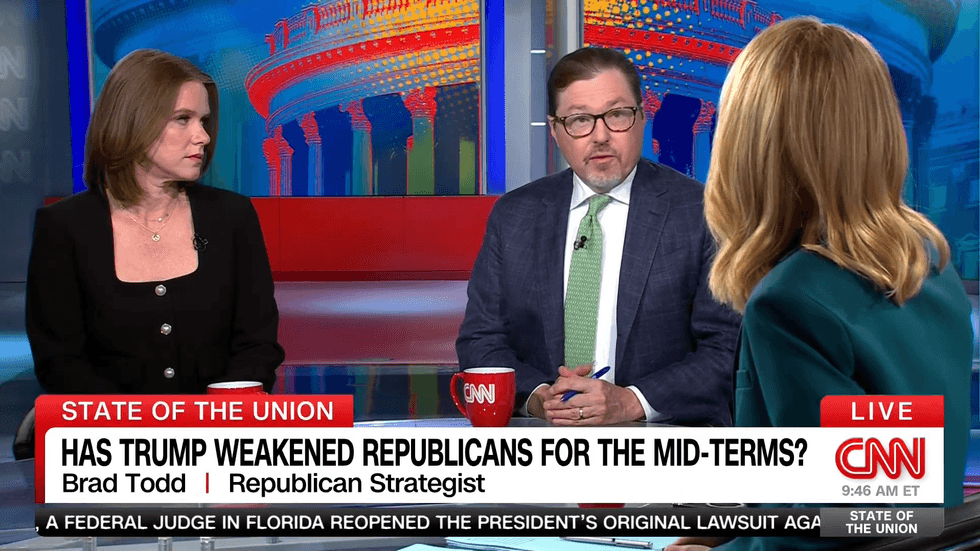
With President Donald Trump’s favorability at historically low levels as his policies continue to economically ravage Americans, GOP strategist Brad Todd issued the president a tight deadline to turn things around, or risk a devastating collapse of power.Trump’s tariffs and his decision to launch a war against Iran have sent prices for a number of goods skyrocketing, leading to a considerable backlash from voters that has led analysts to predict a historically poor midterm election performance from the GOP. Todd noted, however, that Trump’s personal grievances with members of his own party – grievances that have put several GOP lawmakers at odds with the president – may compromise his ability to win back support from voters ahead of the midterms, and urged the president to focus on rebuilding his coalition before it’s too late.“Right now, there are eight senators in the Republican conference out of 53 who are pretty put out with the White House. That is a bad margin when you still have bills to pass and bills to pay,” Todd said Sunday during an appearance on CNN. “Some of these problems are self-inflicted – they didn't have to happen this way.”Dave Urban, another GOP strategist and former senior advisor for Trump’s campaign, echoed Todd’s concern, warning the president that he was facing “giant problems” that didn’t “get any easier” to address “when you've got a bunch of angry Republicans.”Just before the segment ended, Todd issued Trump a tight deadline he argued would be necessary to meet in order to save Republicans from a devastating loss this November.“The next 30 days is big,” Todd said. “The president has 30 days to turn this ship.”
Republican Rep. Nancy Mace responded to being snubbed by President Donald Trump by posting a public declaration of loyalty on Saturday, touting a "100% lifetime voting record supporting Trump" — a move that drew immediate ridicule from critics on the left and the right, including some of Trump's most devoted online supporters.Mace, who is running for governor of South Carolina and had been seeking Trump's endorsement, appeared to be auditioning for his support with the post despite Trump already formally endorsing her opponent. Even MAGA world wasn't buying it.Catturd, one of Trump's most prominent social media boosters, called it out directly. "This is so cringe because Trump didn't endorse her," he wrote.George Santos, the former congressman convicted of fraud, was equally dismissive. "This is misleading," Santos wrote. "Mace is not endorsed by President Trump and has been snubbed by most of MAGA due to her insane meltdowns and insanity."Jonah Goldberg, the conservative commentator and co-founder of The Dispatch, skipped the words entirely and responded with a GIF captioned with "so thirsty."Critics outside the MAGA world went further. Libertarian leader Caryn Ann Harlos offered a one-line translation: "She is an empty brain."Anthony Sisk, a business strategist, dug up Mace's history, reminding her that she distanced herself from Trump in the immediate aftermath of January 6, 2021, when she believed his political career was finished. "What'd you do just 2 months after voting Trump in 2020 when you thought his political career was over?" Sisk wrote. "Cut and ran with the establishment. You're not cut out to be Governor."Political commentator David Marcus noted the episode could serve as a meaningful test of Trump's endorsement power, observing that Mace is harder to dismiss as an obstructionist than other Republicans Trump has targeted.Trump has not publicly responded to Mace's loyalty declaration.This is so cringe because Trump didn’t endorse her. 🤮 https://t.co/3NyRijhwOm— Catturd ™ (@catturd2) May 31, 2026
A brand-new scandal is embroiling Maine Democratic Senate Candidate Graham 'Nazi tattoo' Platner's campaign after he previously assured America that there was nothing more salacious in his background.
The post Democrat Senate Candidate Graham ‘Nazi Tattoo’ Platner’s Words Come Back to Haunt Him as a Salacious New Scandal Threatens His Campaign (VIDEO) appeared first on The Gateway Pundit.
Jonathan Reiner, the cardiologist who served as Vice President Dick Cheney's physician and has become one of the most prominent medical voices scrutinizing presidential health disclosures, raised several pointed questions over the weekend about President Donald Trump's latest physical, starting with why the president received a second coronary artery CT scan just six months after his last one."We don't typically scan patients 6 months later unless we are concerned about a finding on the initial scan," Reiner wrote on X. "What prompted the repeat CT?"That was just the first of seven questions Reiner posed about the exam conducted by White House physician Dr. Barbabella, whose overall assessment was that Trump is in good health.Reiner also flagged a discrepancy in how the report described Trump's ankle swelling, noting it stated the condition had "improved compared with last year" when Trump's previous exam had recorded no ankle edema at all. He questioned why Trump is taking a dose of aspirin four times higher than what is recommended for cardiovascular protection, and asked about bruising on Trump's left hand that the report did not address.He also noted that Trump has now undergone at least three MOCA cognitive screenings in recent years and asked why another was administered. The MOCA, or Montreal Cognitive Assessment, is a tool used to detect early signs of cognitive impairment.Reiner further questioned whether the White House medical team had evaluated Trump's "apparent daytime fatigue and sleepiness," and pushed back on the report's use of an AI tool to assess Trump's "heart age" as equivalent to that of a 66-year-old, calling it "not a clinically utilized tool."Trump himself referred to the visit as a "semi-annual physical," which prompted Reiner's final question: why is the president now being examined twice a year rather than annually?I’m glad Dr. Barbabella’s overall assessment is that the president is well. A few questions.1. Why did the president have another coronary artery CT? He was last scanned in Oct. We don’t typically scan patients 6 months later unless we are concerned about a finding on the…— Jonathan Reiner (@JReinerMD) May 30, 2026
Donald Trump may be close to a legal reckoning on the classified documents case, according to a legal expert.Joyce Vance, the former United States attorney who has become one of the most widely read legal analysts of the Trump era, says a key appeals court is signaling it has lost patience with the judge who has spent more than a year blocking the release of the classified documents portion of Jack Smith's special counsel report — and that Trump's strategy of rigging legal proceedings in his favor by eliminating genuine opposition is running out of time."It's starting to look like time is up," Vance wrote in her Civil Discourse Substack on Saturday.At the center of the dispute is Volume II of Smith's report, which covers the classified documents found at Mar-a-Lago. Judge Aileen Cannon, the Trump appointee who has consistently ruled in his favor, blocked the report's release on Inauguration Day and refused for months to act on requests by American Oversight and the Knight First Amendment Institute to intervene and argue for its release. The Eleventh Circuit Court of Appeals previously cited "undue delay" from Cannon and ordered her to rule within 60 days. She ruled against the media organizations, and they appealed.Now the Eleventh Circuit has ordered a full briefing schedule, with all briefs due by July. Vance notes the order was signed by Judge Nancy Abudu, a Biden appointee, and says the court's track record of correcting Cannon's errors gives her reason for optimism.Vance connects the classified documents fight to the IRS slush fund case, arguing both share the same fatal flaw: Trump occupying both sides of the legal dispute, with the Justice Department acting as his ally rather than a genuine adversary. Courts, she argues, are finally forcing him to face real opposition."Trump's past is finally catching up with him," Vance writes.
Data: U.S. Census Bureau, Vintage 2025 Population Estimates; Chart: Russell Contreras/AxiosAs exurban cities near booming metro areas explode in growth, hundreds of U.S. communities are losing residents at a pace that signals deep structural decline.Why it matters: The shrinking cities are a crisis in plain sight.They concentrate poverty and tend to have aging infrastructure and limited job growth.They struggle to attract doctors and teachers and have few of the amenities drawing younger Americans to boomtowns like Celina, Texas or Apex, N.C.Zoom in: An Axios analysis of census estimates found more than 600 incorporated places of 20,000 or more lost population between April 2020 and July 2025.Many of the fastest-declining cities are majority-Black communities in the Deep South, working-class Mexican American and Native American cities in the Southwest or legacy industrial towns in the Midwest. By the numbers: Big Spring, Texas, lost 15.3% of its population since 2020 — the steepest percentage drop of any U.S. city of 20,000 or more, per the Axios review of Census estimates.Greenville, Miss., was second, falling 10.6%, dropping from 29,690 to 26,530.Gallup, N.M. — the largest city on the Navajo Nation's edge and a hub for Indigenous commerce along Route 66 — lost 8.8% of its residents. The city's daily newspaper, The Gallup Independent, closed in January after what publisher Bob Zollinger described as the area's economic "collapse."Zoom in: Big Spring's decline came after two privately operated federal detention centers closed in 2021, costing the area several hundred jobs.Big Spring's fortunes in the Permian Basin also have long been tied to the volatility of the West Texas oil economy.Mississippi alone has three cities in the top 10 fastest-declining list: Greenville, Vicksburg, and Jackson. All three are majority-Black cities facing compounding crises: chronic underinvestment, high poverty rates, deteriorating infrastructure and outmigration of younger residents to metro areas.Zoom out: The U.S. has added millions of housing units since 2020, but that construction is almost entirely happening in the booming metros in the South and Mountain West, not in the communities shrinking fastest.Yes, but: Population loss isn't always a death spiral. St. Louis, for example, has been shrinking for 70 years and retains a functioning civic economy, major universities, and a regional healthcare system.And some of the fastest-declining cities by percentage are starting from small enough bases that raw numbers remain manageable.Between the lines: The racial geography of decline is impossible to ignore. The majority of the top 10 fastest-shrinking cities — in Mississippi, Arkansas and Louisiana — are majority-Black communities in the South. These are cities that never fully recovered from decades of disinvestment, and the current growth era is not reaching them. Meanwhile, federal housing and infrastructure dollars are increasingly flowing toward the fast-growing exurbs that need new roads, schools, and utilities.That leaves shrinking cities competing for fewer resources with diminishing political representation as their congressional clout shrinks with their populations.Caveat: It's also worth noting that Twentynine Palms, Calif. — with a steep decliner of -7.6% — is home to a U.S. Marine Corps base, so its losses may reflect military deployment cycles as much as economic flight.The bottom line: The Census data presents two Americas in sharp relief. One is building, expanding, and filling in the outer rings of Sun Belt metros at a pace unseen in decades. The other is contracting — losing people, tax base, and political power in a slow bleed that rarely makes national headlines.
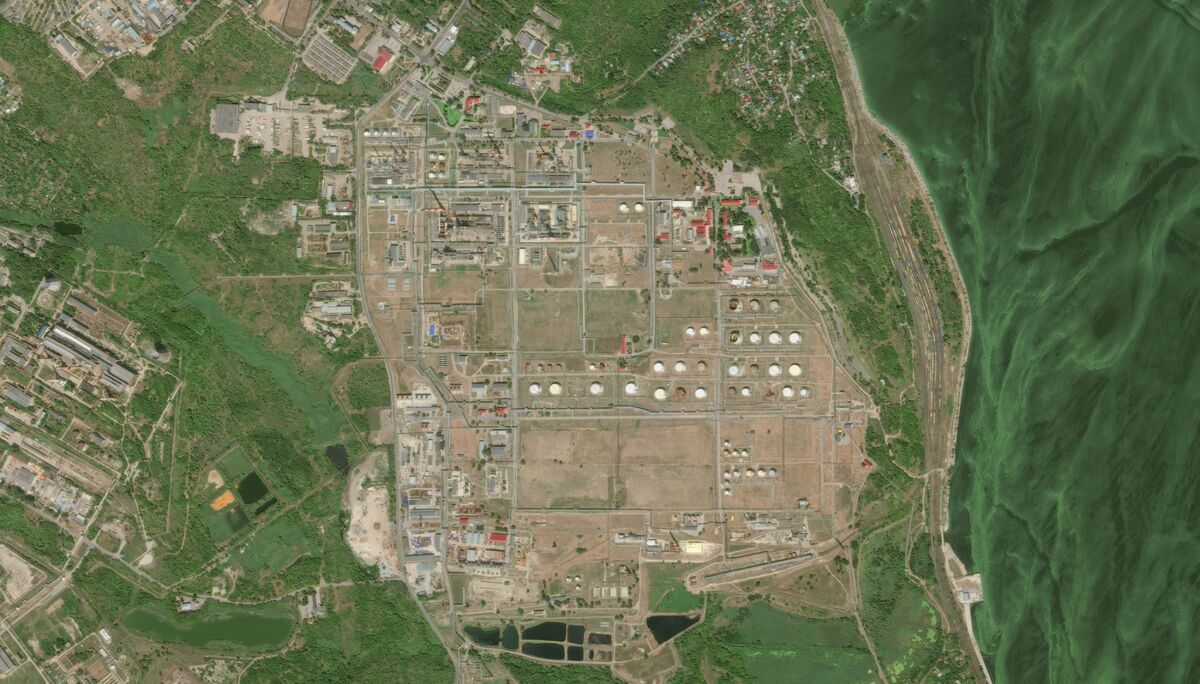
Ukraine’s military said it attacked the Rosneft PJSC’s Saratov oil refinery in southwestern Russia and an oil-pumping unit elsewhere, while local authorities reported overnight drone fires and attacks at undisclosed industrial facilities.