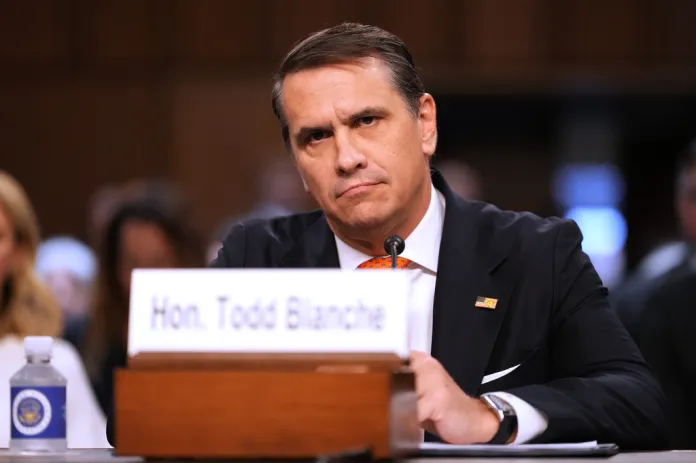
Blanche questioned on Epstein files, crime and IRS settlement in confirmation hearing
Source: NBC News Politics · Bias: Center Left
Summary
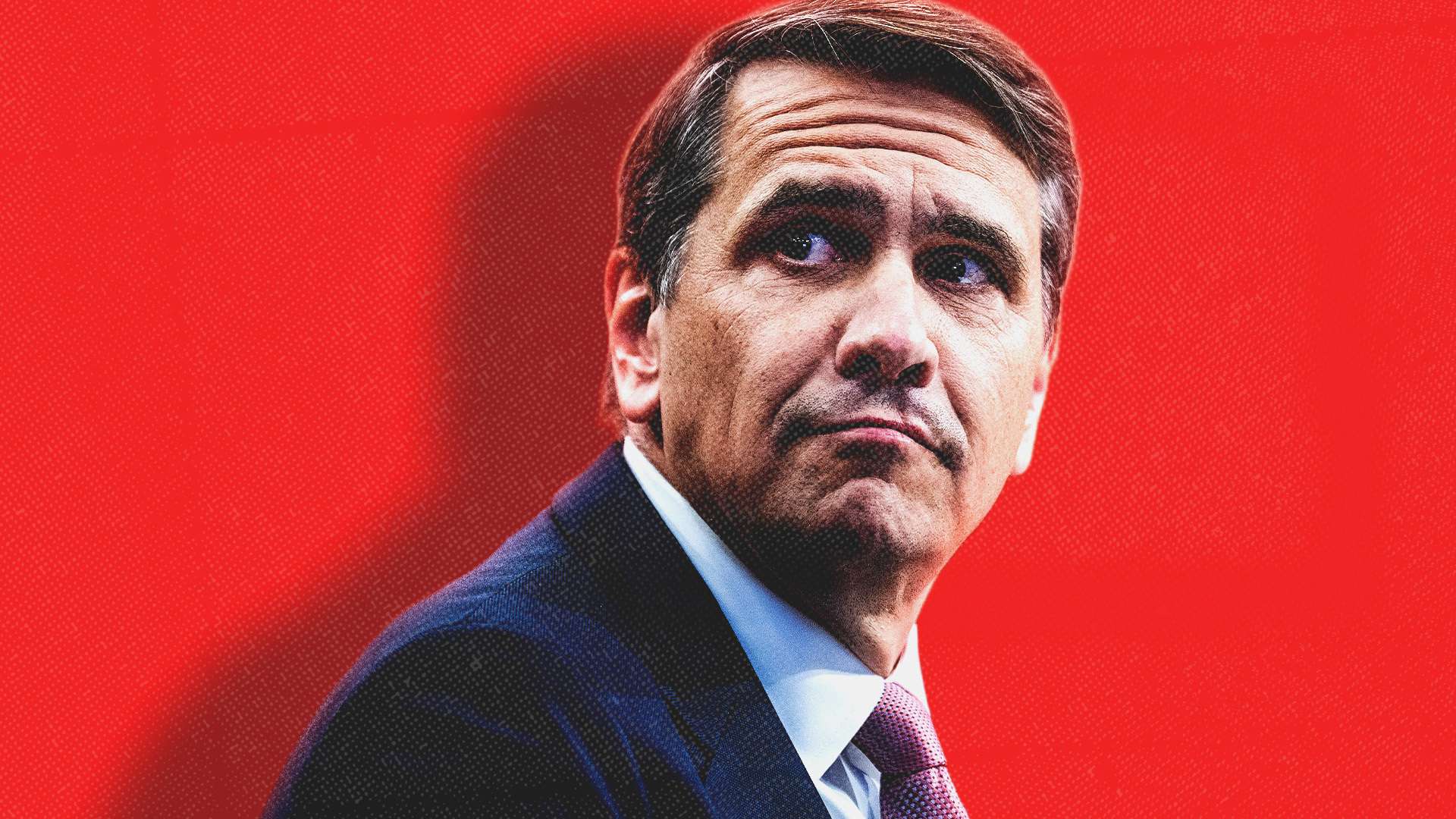
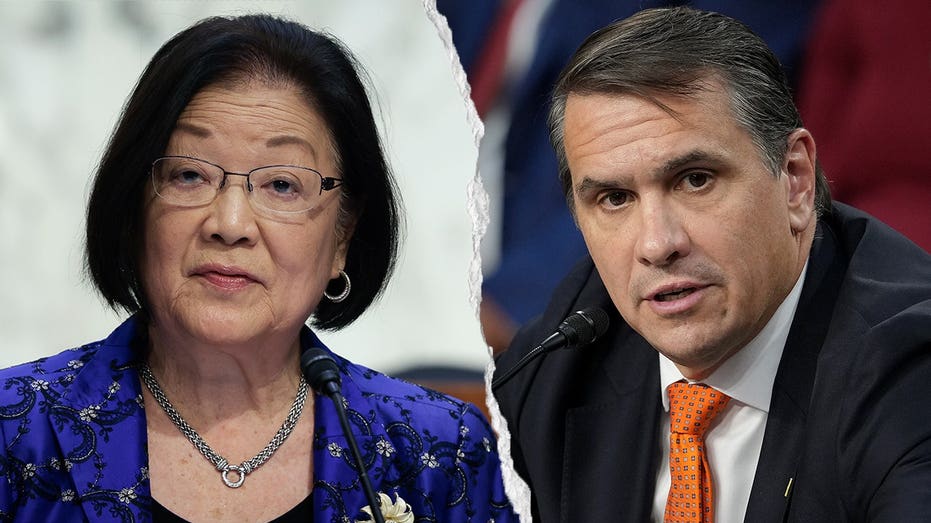
Acting Attorney General Todd Blanche faced questions from senators on the handling of the Epstein files, crime statistics and a Trump settlement with the IRS during his confirmation hearing to permanently serve in the position. NBC News' Julie Tsirkin reports from Capitol Hill on what lawmakers highlighted in their questioning.
Blanche questioned on Epstein files, crime and IRS settlement in confirmation hearing
Center Left
Acting Attorney General Todd Blanche faced questions from senators on the handling of the Epstein files, crime statistics and a Trump settlement with the IRS during his confirmation hearing to permanently serve in the position. NBC News' Julie Tsirkin reports from Capitol Hill on what lawmakers highlighted in their questioning.
A federal judge's “unexpected” demand to Attorney General Todd Blanche regarding the Epstein files proves a bedrock judicial principle is “on life support," a legal expert argued Sunday.Federal Judge Emmet Sullivan gave Blanche five days to provide the court with unredacted versions of certain Epstein-related files for private review as it litigates a lawsuit filed by lawyer and media figure Katie Phang. Phang sued Blanche for allegedly violating the Epstein Files Transparency Act by unlawfully redacting certain files.Blanche provided the court with an explanation as to why certain files were redacted, but Sullivan, doubting Blanche’s explanation, demanded he provide proof supporting his claims. Such a demand, as noted by Joyce Vance, former U.S. attorney for the Northern District of Alabama, demonstrated how the Trump administration had all but gutted the key judicial principle known as the “presumption of regularity.”“It was commonly used to advance the idea that in the absence of evidence to the contrary, courts should presume government employees, including DOJ lawyers, acted properly in the execution of their duties. Now it’s on life support and Judge Sullivan’s order is another nail in its coffin,” Vance wrote in an analysis published Saturday on her Substack.“This most recent order suggests that Judge Sullivan doesn’t believe the government when it says something is the case, even when that ‘something’ is as simple as the identity of the person in a ‘to’ line in an email. But the government has acted like it has something to hide, even after Congress passed the Transparency Act and Trump signed it into law.”Specifically, Phang has raised doubts that redacted names on a handful of Epstein-related files were lawfully withheld. The Justice Department (DOJ) has claimed the redactions in question were permitted under the Epstein Files Transparency Act, but Sullivan is refusing to take the DOJ at their word.“So the Judge isn’t accepting what the government has represented to it as truthful, and is requiring documentation to support its claims,” Vance wrote.“Under any other president, the Attorney General would have been disturbed by the suggestion prosecutors couldn’t be trusted. There would be disciplinary review. But here, the acting Attorney General is the defendant in the case. It’s paradigmatic of how far DOJ has fallen.”
Three subcontractors claim nearly $900,000 in unpaid work on Home Court, the Obama Presidential Center's basketball facility hosting WNBA All-Star events.
The Maine Democratic Party may have just nominated a candidate who may be worse than the nominee previously forced out of the race, and there are even questions about whether he's eligible to run.
The post Worse Than Graham Platner? Troubling Personal Questions Emerge for Maine’s New Democrat Nominee for Senate – And He May Be Ineligible to Run appeared first on The Gateway Pundit.
White House press secretary Karoline Leavitt's one-word answer was flagged Saturday as a clear sign of the damage Jeffrey Epstein has wreaked on MAGA.Asked whether President Donald Trump or his administration planned to intervene in the UK extradition case against Andrew and Tristan Tate, Leavitt replied flatly: "No." The i Paper columnist Sarah Baxter argued Saturday that the single syllable reveals how thoroughly Trump's ties to the late Jeffrey Epstein have depleted his political capital. The president, she wrote, can no longer afford to spend it defending a pair of accused sex abusers — despite them being major allies.Secretary of State Marco Rubio echoed the posture a day earlier from the Philippines. "There's no role for us to play at this moment or maybe ever in that regard," Rubio told reporters, according to Axios.The cold shoulder marks a striking reversal. In February 2025, the Financial Times reported that Trump officials pressured Romania to ease travel restrictions on the Tates, and days later the brothers boarded a private jet to Fort Lauderdale.The Tates, dual British-American citizens, were arrested by U.S. Marshals in Miami on July 18 after British prosecutors filed 38 new sex-crime charges, bringing their combined total to 59 counts. Andrew Tate faces 42 charges including rape, sex trafficking and offenses relating to indecent images of a child; Tristan Tate faces 17.Their lawyer, Joseph McBride, who previously represented January 6 defendants, has tried to press familiar buttons. He wrote on X that the brothers were being held as "political prisoners on American soil" in solitary confinement. Andrew Tate himself claimed he was locked in a unit next to "a cannibal who screams throughout the night."None of it has moved the administration.On Capitol Hill, Rep. Yassamin Ansari (D-AZ), a House Oversight Committee member, sent a letter to Chair James Comer this week requesting an investigation into "potential political interference" surrounding the Tates' case. Ansari also asked that Barron Trump be called to testify about any knowledge of the brothers' alleged crimes. A spokesperson for the Tates has previously called reports linking Barron to Andrew Tate fake news.
America remains deeply divided over whether the 2020 presidential election was stolen from Donald Trump. Millions believe the system failed them, while the media, intelligence bureaucracy, and the left have treated their doubts as something to suppress rather than investigate.The documents released this week by the Trump administration do not close the case. They reopen it — and make the “nothing to see here” narrative indefensible.Start with communist China.The released intelligence reports that approximately 220 million American voter records are in Chinese hands. Tens of millions of records across 18 states were bought, stolen, or hacked and included names, addresses, phone numbers, party preferences, and other sensitive information.A sovereign nation must know that the people selecting its government are its citizens. That does not prove China changed a single ballot, but it does prove Beijing possessed a political targeting asset. When a strategic rival aggregates enormous datasets and applies modern analytics, it gains the ability to identify, target, and influence American voters at industrial scale. The most disturbing disclosure involves the President’s Daily Brief — the president’s most sensitive and consequential intelligence product. In one released email, an official wrote: “We have deliberately massaged our one pending PDB to avoid any direct links to the election.”In a separate internal chat, a counterintelligence official boasted: “I’m basically running a shadow government across the FBI at this point.”The left has spent years ridiculing concerns about a “deep state” as conspiracy theory. These revelations make that ridicule look increasingly like camouflage.Then comes the voting-system reveal.A Cybersecurity and Infrastructure Security Agency report included in the administration’s document release identifies weak access controls, outdated operating systems, flat networks, inadequate monitoring, and legacy remote-access pathways across state and local election environments. During multiple penetration tests and red-team exercises, CISA assessors gained full control of election-office networks within hours or days.Separately, the report cites research involving one ballot-marking system showing that barcode-encoded votes could be altered without changing the human-readable selections displayed to the voter.The release also includes intelligence concerning methods allegedly developed by Venezuela’s Maduro regime to manipulate electronic totals while concealing the changes.Precision matters. A Venezuelan capability is not proof of an American operation. A demonstrated vulnerability is not proof it was exploited. The documents do not establish that American vote totals were secretly changed in 2020.But they demolish the claim that election technology is immune from manipulation. These are computer systems with software, databases, vendors, administrators, updates, and attack surfaces. Compromise must be anticipated and independently detectable.RELATED: America needs an artificial intelligence coalition, not an AI fortress Burcu demir/Getty ImagesA limited Department of Homeland Security review raises another alarm. The White House says it identified approximately 278,000 potential noncitizen registrations. DHS’ public follow-up described more than 250,000 preliminary potential matches in California, New Jersey, Nevada, and Pennsylvania — only four states.No serious person should dismiss numbers of this magnitude. Biden’s certified Georgia margin in 2020 was 11,779 votes. In 2016, Trump carried Michigan and Wisconsin by a combined 33,452 votes — and Michigan, Wisconsin, and Pennsylvania by just 77,744.The media formula — “the documents do not prove vote totals changed; therefore they prove nothing” — is analytical malpractice. Absence of final proof is not proof of institutional innocence.The proper question is whether this new information raises the probability that foreign influence, intelligence suppression, ineligible registrations, or exploitable technology played a larger role in the 2020 election environment than Americans were told — and whether future elections remain at risk.The answer to both questions is yes.That is why Congress must pass the SAVE America Act before November. The House-passed legislation requires documentary proof of citizenship for federal voter registration and photo identification for federal voting.These are basic risk controls. Pew found that 83% of Americans — including 71% of Democrats and 95% of Republicans — support government-issued photo identification. A sovereign nation must know that the people selecting its government are its citizens. A constitutional republic must demonstrate — not merely assert — that its elections are accurate.Congress should stop stalling and pass the SAVE America Act.
{beacon} Energy & Environment Energy & Environment The Big Story Grant cancellations ‘based solely’ on politics: filing Federal green grants canceled last year were selected “solely” based on a state’s political affiliation, the Trump administration said in a recent court filing. Greg Nash In the filing, Department of Energy (DOE) lawyer Jeff Novak said the…