Trump’s $10 Billion Shakedown of IRS Takes Unnervingly Corrupt Turn
Source: The New Republic · Bias: Left
Summary
Would it be legal for President Donald Trump to effectively order a major U.S. government agency to hand over huge piles of taxpayer money to a group of his political allies? We may be about to find out.ABC News reports that Trump is likely to drop his $10 billion lawsuit against the Internal Revenue Service as part of a new settlement that amounts to one of his most corrupt schemes yet. It would create a new $1.7 billion fund to compensate allies supposedly victimized by the Biden administration’s “weaponization” of the legal system—potentially including the January 6 insurrectionists.According to ABC, the settlement would create a “commission” with “total authority” to settle “claims” brought by those who allege such weaponization. Per ABC, this not only includes the insurrectionists; it could even settle purported claims by “entities associated with President Trump himself.” By all indications it would operate with little-to-no congressional oversight.“This is a shocking new betrayal of the Constitution,” Representative Jamie Raskin, the ranking Democrat on the Judiciary Committee, told me.This saga captures something essential about how the political economy of Trumpism really functions. It helps explain why his supporters stick by him through one episode after another of the most corrupt self-dealing we’ve seen from any U.S. president in modern history. To recap: In January, Trump sued the IRS over an unauthorized leak of his tax returns when he was president the first time, demanding $10 billion in damages. This lawsuit is absurd on the merits, as my colleague Timothy Noah demonstrates, functionally inviting Trump’s own government to settle a lawsuit massively in his favor, a ground-breaking innovation in self-dealing.Indeed, in recent days, we learned that the White House has entered into talks with the Justice Department—which is theoretically supposed to defend the government against the lawsuit—to settle Trump’s claim. Trump controls the DOJ, so functionally he’s been “negotiating” a “settlement” with an entity he controls, in which that entity would direct taxpayer money to Trump or his associates or pet causes.Enter this ABC report. The new MAGA slush fund would be drawn from the Treasury Department’s Judgment Fund. That’s something the federal government uses to pay settlements and court judgments, but in this case, Trump would wield quasi-direct control over that money.That’s because ABC also reports that under the settlement, Trump can remove commission members overseeing the new fund without cause. And it wouldn’t be required to disclose its decision-making involving who gets awarded compensation:Trump’s proposed commission is expected to be composed of five members who would issue monetary awards based on a majority vote, and the process for awarding money and the identities of the recipient could be kept private, according to sources.In short, Trump’s own DOJ is reaching a “settlement” with him that sets up a new MAGA slush fund of over $1 billion in taxpayer money. It’s overseen by people who can hand out the loot with no transparency, people whom Trump can fire for any reason—say, for not giving money to whoever Trump wants them to give it to. Including his army of insurrectionists.In our interview, Raskin pointed out other glaringly corrupt aspects to this. He noted that Treasury’s Judgment Fund is supposed to dole out its settlements and lawsuit judgments in accordance with actually existing court or administrative proceedings involving genuine victims of the government. As Raskin’s staff notes, depending on the details, the relevant agencies and government officials must sign off on these payments, and they’re disclosed to Congress and the public.But with the new fund, it’s not clear the payments will look anything like this. It appears to transfer control over its payments to Trump alone, Raskin’s staff says, and decouples them entirely from all those agency processes.“The Judgment Fund exists to settle valid judgments against the United States government,” Raskin told me. Trump and his allies, Raskin said, are “trying to take money from the Judgment Fund while eliminating any controls and oversight” and putting it under Trump’s “direct unilateral control.”On top of that, Raskin added, this circumvents Congress in another way, since Congress never voted to create a fund structured this way. Which potentially renders it unconstitutional, too.“Congress never would have passed a $1.7 billion slush fund for his friends—this is completely outside of our constitutional framework,” Raskin said, called this “an outrageous desecration of congressional power of the purse.”There’s still more.
Related Coverage
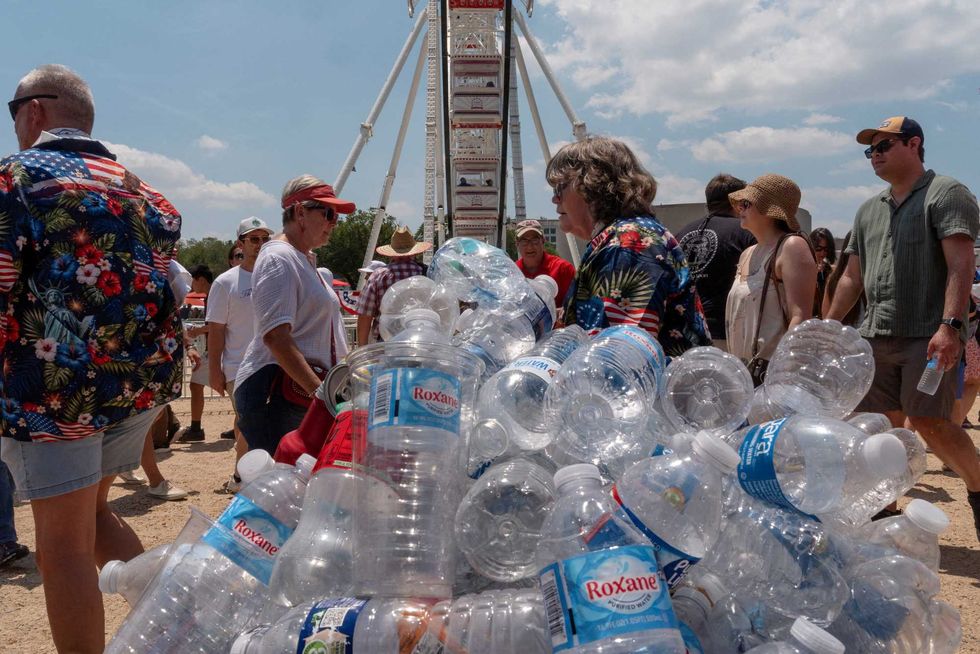
- Feds tout 'well-prepared' Trump fair after blistering heat wave hospitalized attendees (Far Left — Raw Story)
- Trump announces new pardons after privately weighing "Diddy" clemency, sources said (Center — Politics - CBSNews.com)
- Trump Heads to Mount Rushmore, Where He Wants to See His Face (Center — WSJ.com : U.S. News)
- 'Total disaster' at Trump's fair as scorching heat leaves 7 on 'advanced life support' (Far Left — Raw Story)
- Trump, ballot seizures and a ‘declaration’: Gavin Newsom teases tiresome July 4 address to the state (Right — New York Post)
- 'Not mentally well': MAGA suspects Trump sabotaged by liberals armed with weather machines (Far Left — Raw Story)
- 'God is angry': Internet bemused as Mother Nature comes for Trump's Mount Rushmore speech (Far Left — Raw Story)
- ‘The second-most good-looking president’: Trump entertains on Usha Vance’s program (Far Right — WorldNetDaily)
Daily Analysis
Read the full Parallax Pulse for May 15, 2026 — an AI-powered analysis of how Left and Right media covered the biggest stories this day.
More Headlines From May 15, 2026
- Mullin rips Spanberger for ‘criminalizing’ DHS while ICE arrests illegal alien felon in her ‘sanctuary’ state (Right)
- The CIA Lands in Havana: Trump Sends a Direct Message to the Cuban Regime (Far Right)
- Do gas tax holidays actually bring relief at the pump? (Center)
- Key takeaways from Trump's China trip (Center)
- How A.I. Was the Elephant in the Room at the Trump-Xi Summit (Center Left)