Bloomberg Politics
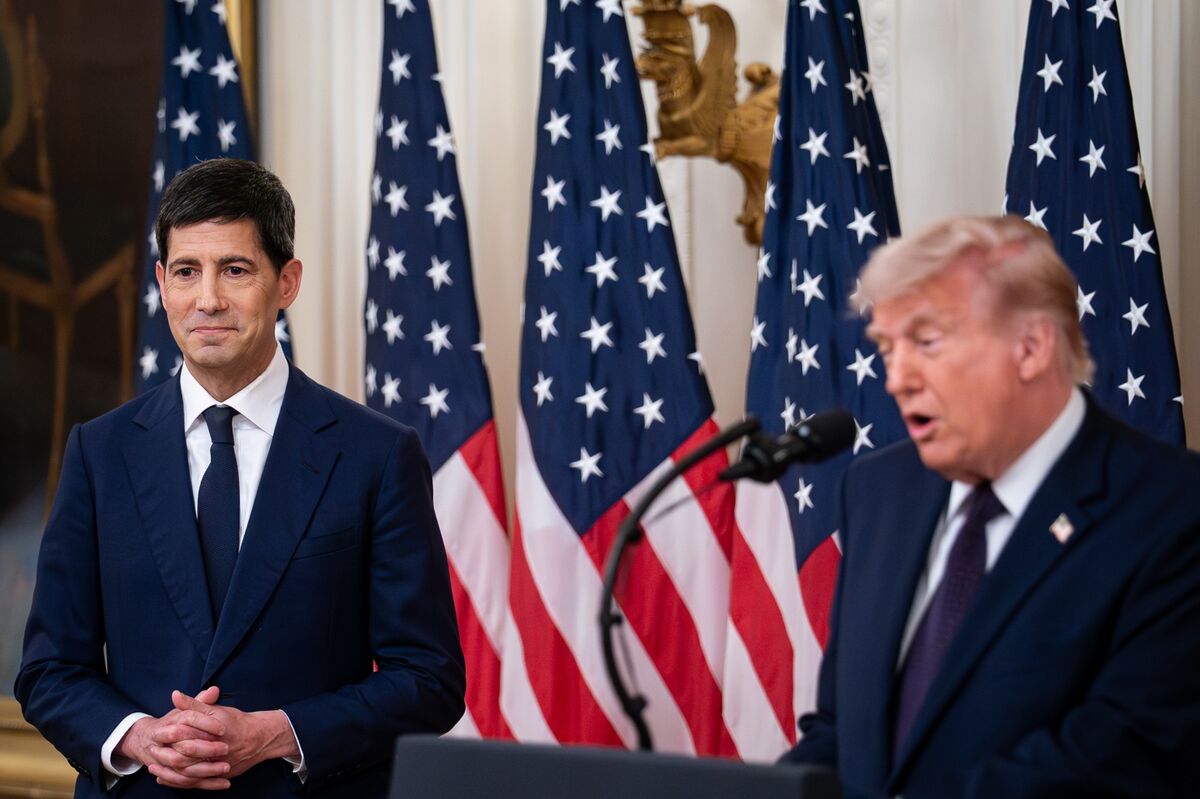
Kevin Warsh Makes His Fed Debut With Trump Pushing for Rate Cuts
Serious changes are likely coming to the central bank.
Center
The following is a lightly edited transcript of the June 16 episode of The Daily Blast podcast. Listen to it here. Greg Sargent: This is The Daily Blast from The New Republic, produced and presented by the DSR Network. I’m your host, Greg Sargent.Donald Trump has signed a deal with Iran to cease hostilities and reopen the Strait of Hormuz. We still haven’t seen the document, but all of the reporting suggests a very simple story: Trump lost. He got nothing of any significance. Trump himself plainly has no idea what happened, as he revealed in a strange ramble to reporters. But JD Vance does know what happened, even though he’s trying very hard to sugarcoat it in a pretty revealing way.We’re really lucky to be talking about all of this with Tom Nichols, a staff writer for The Atlantic, who has a good piece arguing that Trump capitulated to Iran. Tom, great to have you on, man.Tom Nichols: Good to see you, Greg.Sargent: So let’s just sum up where we are. We haven’t seen the document, but all the reporting suggests that while the Strait of Hormuz will reopen, all that does is return us to where we were before Trump’s war. Meanwhile, they’ve punted the discussion over Iran’s nuclear program until later. And the Iranian regime has survived. So basically, Trump’s tens of billions of dollars in bombing didn’t compel Iran to do what he said he’d make them do. Tom, is that basically the size of things?Nichols: I think it’s worse than that. The bigger problem is that he counted on regime change. This was what the war was really about. So when that wasn’t going to happen, when it became clear a week or so in that this regime wasn’t going to collapse, this outcome, I think, was more or less inevitable.And I think the people that are now waiting and saying, well, we need to see the details of this MOU—that’s fine. But even without knowing the details of the MOU, the Americans have been defeated here. And that pains me to say as an American. Because the regime is still intact, their nuclear material is still in their country. They’re actually politically more powerful now that they’ve flexed muscle and done some serious harm to the other Gulf states as a warning not to cooperate with the United States. There’s going to be some money going back into Iran, whether it comes through third parties or not.I think if you had said any of this to Donald Trump on the first night of the war, he would have said, that’s impossible, we’re going to get unconditional surrender. Well, we didn’t. And all of these things are going to happen. Even without knowing what’s in the MOU, you can know at least this much.Sargent: Right. Trump absolutely did expect unconditional surrender, even though he was told by lots and lots of different people within his administration, including the chairman of the Joint Chiefs, that that wouldn’t happen. He was told that the strait would be closed by Iran and that that would exercise leverage over the global economy and over us. Trump couldn’t fathom that possibility because he’s strong. It’s just that simple, right? He’s strong, he wins, he’s a winner, he’s strong, so there’s no way that things won’t go exactly the way he says they will.Nichols: Yeah, this is—it’s bitten him before and caused him problems before—but there’s this kind of weird quirk in Trump’s personality where he really believes that saying things makes them real. That, like a child, he can sort of wish-cast things into existence. And you can play that game with domestic politics and tariffs and taxes and do some fancy dancing around where the money is in terms of things like revenue. You can bully other Republicans to agree with you. What you can’t do is do that with a war where the enemy gets a vote.Every day that Trump said they’re eager to make a deal, there’s going to be a deal, a deal is imminent—the Iranians are not Republican House members. They are a foreign country and an enemy of the United States. And there’s nothing to stop them from saying no, there is no deal. And now that we have one, it’s not great. It’s basically an acknowledgment that the United States failed to gain any of its strategic objectives.Sargent: That seems beyond clear. So Trump talked to the media about his deal today. He blasted Obama’s 2015 nuclear deal, which unfroze tens of billions of dollars that Iran could then access in foreign accounts. Listen to Trump.Donald Trump (voiceover): It was a horrible deal for the United States. It was a deal where billions of dollars was given to Iran. It was a deal where $1.7 billion in cash was put on a Boeing 757—well, not a 757, I guess, right? But on a big, beautiful Boeing 757. They needed a Boeing 747, to be honest with you, because it was a lot of cash. $1.7 billion was taken out of the banks and given to Iran. And on top of that, tens of billions of dollars was spent. So they tried to bribe them to make a deal and that didn’t work.