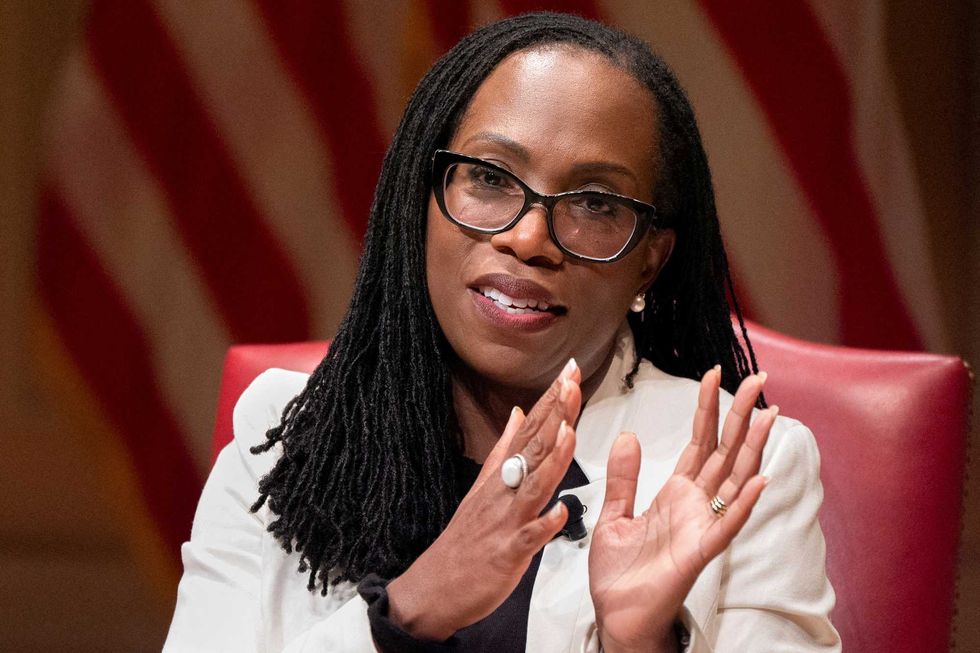
As the Supreme Court handed down a landmark ruling on the last day of its term protecting birthright citizenship and invalidating a signature policy of President Donald Trump's administration, Justice Clarence Thomas took a swipe at the majority in his dissent, stunning legal experts with an argument that would have effectively rewritten 14th Amendment protections out of the Constitution for millions of people.But Justice Ketanji Brown Jackson went out of her way in her concurrence with Chief Justice John Roberts' majority opinion to demolish Thomas' argument — and in particular, point out that he was talking out of both sides of his mouth on how to interpret constitutional rights."I write separately to respond to some of the themes in the principal dissent," wrote Jackson. "Despite his longstanding endorsement of a 'colorblind' Constitution, Justice Thomas now surprisingly suggests that the Citizenship Clause was a race-conscious remedial measure, relating only to 'freed slaves such as Dred Scott,' ... and those who shared with them certain characteristics ... It is for this reason, he says, that 'children who were born in the United States but [to parents] not domiciled here' are not entitled to claim birthright citizenship."This, noted Georgia trial lawyer and legal analyst Andrew Fleischman in a post to X, is a "pretty good burn here.""Justice Thomas says that the 14th Amendment does not allow us to treat people differently on the basis of their race to help them (affirmative action, voting rights). But then he says it was also laser-focused on restoring citizenship for black Americans," he wrote. Ultimately, Jackson's concurrence noted, Thomas is wrong on the latter point anyway."That narrow vision of the 14th Amendment bears little relationship to the history of its ratification," she wrote. "Even worse, Justice Thomas's telling elides the entire point of the Second Founding: The Reconstruction Amendments were an anticaste, antisubordination reset for the Nation, not a mere spot treatment for the dark stain of slavery."The majority opinion by Roberts agrees with this assessment, noted Slate's Mark Joseph Stern, detailing the history that proves Congress in the 1860s understood and affirmed birthright citizenship would apply to the children of immigrants.
Congressional Republicans are redoubling their support for the SAVE America Act, a bill that has left Washington in gridlock for months, after the Supreme Court ruled states can count mail-in ballots that arrive after Election Day. The 5-4 decision in Watson v. Republican National Committee rejected a GOP-led push to end laws that permitted mailed […]
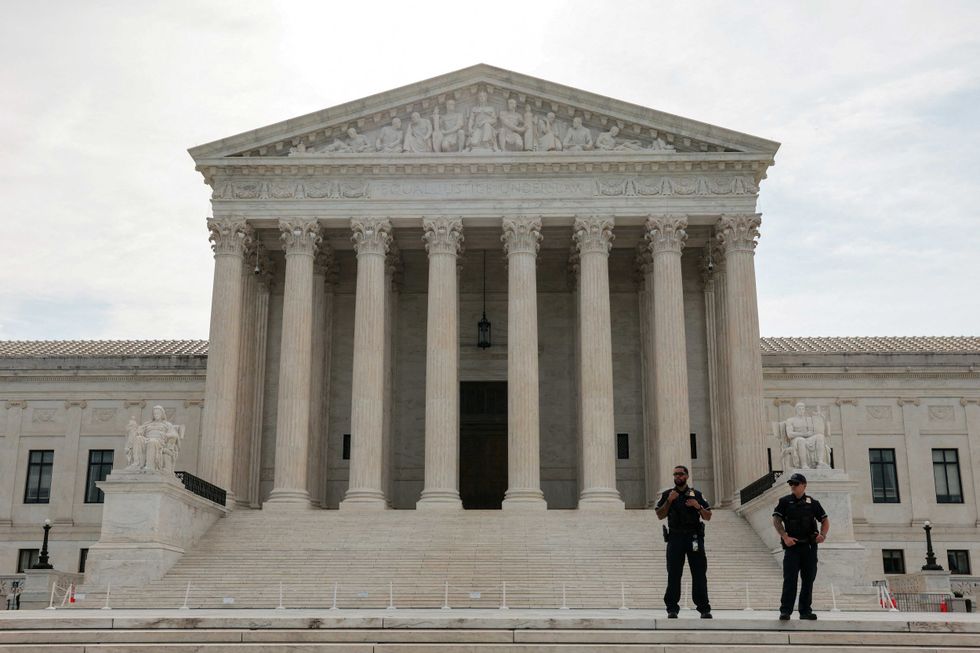
With “little fanfare,” the Supreme Court is quietly working to double its own police force, Politico’s Josh Gerstein reported on Sunday, a push that justices and court officials apparently “loathe” discussing.“The push for a rapid security buildout stems from the substantial threats to the justices at a moment of growing political violence in the U.S. and the sense that the system has just not been up to the task of keeping them safe,” Gerstein wrote. “That’s a belief that appears to be shared by at least some of the justices themselves.”While a Supreme Court spokesperson declined to respond to Gerstein’s request for comment, an “in-depth review” of budget documents and interviews with “court insiders” revealed that the Supreme Court Police Department, which for years had less than 200 officers, may soon double its ranks amid the court’s plummeting favorability among Americans.“It’s often said that the Supreme Court has no army,” Gerstein wrote. “Yet, with little fanfare, the size of the Supreme Court’s police force has begun mushrooming.”The growing taxpayer expense from the Supreme Court’s ballooning security budget has even roiled some lawmakers, including Rep. Rosa DeLauro (D-CT), the leading Democrat on the House Appropriations Committee.“We provide money for the Supreme Court,” DeLauro said back in April. “I’ve been here a long time – they’ve never come up and tell us what they’re doing with the money that we appropriate. I want to give them all the security they need, but the court has to come up here [and] tell us what [they’re] doing.”
I will never forget reading New York Times book critic Dwight Garner’s 2002 review of Jared Kushner’s loathsome memoir, Breaking History, because if you cull it down and paraphrase it, it becomes a perfect description of Kushner the person.So I’ll attempt to use the magic of Garner’s wonderful wordsmithing.Kushner is a soulless, mannequin-like vanity project. He is the ultimate political arsonist, happily burning down the very democratic foundations and institutional norms that he relies on to sustain his global grift.His efforts on behalf of his equally grifting and crooked father-in-law are queasy-making money-grabbing stunts that feel exactly like watching a cat lick a dog’s eye goo. He is a deeply uncomfortable, unnatural experience. He is superficial and self-serving.Oh, there is so much more to say about Kushner, but column space prohibits me from expanding on my rewording of Garner’s poetry.Kushner is nothing more than a spoiled real estate heir who got his job because he married Trump’s daughter before Trump did. I’m referring, of course, to Donald’s well-documented incestuous infatuation with Ivanka.What business did he have negotiating nuclear disarmament with Iran? That sentence, however, gives it all away. Because his business is an illicit and, arguably, illegal one.The original JCPOA nuclear deal was negotiated over years by the U.S., U.K., France, Germany, Russia, and China, with nuclear physicists and non-proliferation experts, and ran to 159 pages.Now, you tell me why a guy whose business dealings have frequently hovered near severe financial distress was sitting at a table yammering about nuclear weapons.Iranian officials were reportedly confused when the White House kept sending Kushner and his partner Steve Witkoff, since neither has any background in nuclear policy. One former senior State Department official who participated in actual Iran nuclear negotiations said it plainly: “I’m not saying you need to be a diplomat to be a good negotiator. But you need to have some sense of history, and you need to know geography.”If you base your assessment of Jared Kushner’s diplomatic chops and sense of history on those criteria, you can once again relegate him to dog-eye goo.And since this deal involves enormous sums of money, Kushner’s association with companies in financial distress should instantly preclude his participation. The framework deal released, and presumably the one the prodigal whiz-kid helped cook up, would release up to $24 billion in frozen Iranian assets, authorize Iran to sell oil on global markets in U.S. dollars, and, if a final deal is reached, lift all sanctions on Iran entirely.Energy analysts say Iran could ramp up exports to roughly 2 million barrels per day, one-third higher than before the conflict, potentially unlocking hundreds of billions of dollars for the Iranian regime. Iran’s total frozen assets abroad are estimated at somewhere between $124 billion and $167 billion.From the looks of it, “negotiator” Kushner is giving away money fast and furiously, much like Saudi Arabia gives money to Kushner.And just who in Iran will see that money? The Iranian people have lived under crushing poverty and religious authoritarianism for nearly half a century. The regime that runs Iran doesn’t build hospitals and schools with windfall money from the Kushner cash machine. No, it funds proxy militias, builds missiles, and pays for the apparatus of repression that keeps its own citizens in line, and they will never see a dime of it. They never do. And J.D. Vance’s comments about turning over a “new leaf” in the relationship with Iran are as naive as…well, Jared Kushner!I will wager money I don’t have that Jared is involved in all this wheeling and dealing because he is representing the interests of his father-in-law and two brothers-in-law, dunce Donny Jr. and dim-witted Eric. It’s all so blatantly obvious, and no one is sounding the alarm.Let’s be abundantly clear about why Kushner was really there, and that was to make sure the Trump family gets their cut.Whether it’s reconstruction contracts, sweetheart investment deals, or some back-channel percentage of the billions being unlocked, Kushner is the family’s eyes on the money. He and Trump couldn’t care less about Iran’s nuclear program, its regime, or its people. They care about the cash and making sure some of it flows back to them. That’s the only reason he was in the room.Kushner’s investment firm, Affinity Partners, has garnered $6.16 billion in assets with an eye-popping (not eye-goo in this case) 99 percent of its funding derived from foreign nationals, including sovereign wealth funds operated by the governments of Saudi Arabia, the UAE, and Qatar.Saudi Arabia’s sovereign wealth fund invested $2 billion into Affinity, despite senior Saudi officials registering their own opposition, which was overruled by Crown Prince Mohammed bin Salman himself.