The World Cup in an Age of Strongmen
Source: The New Republic · Bias: Left
Summary
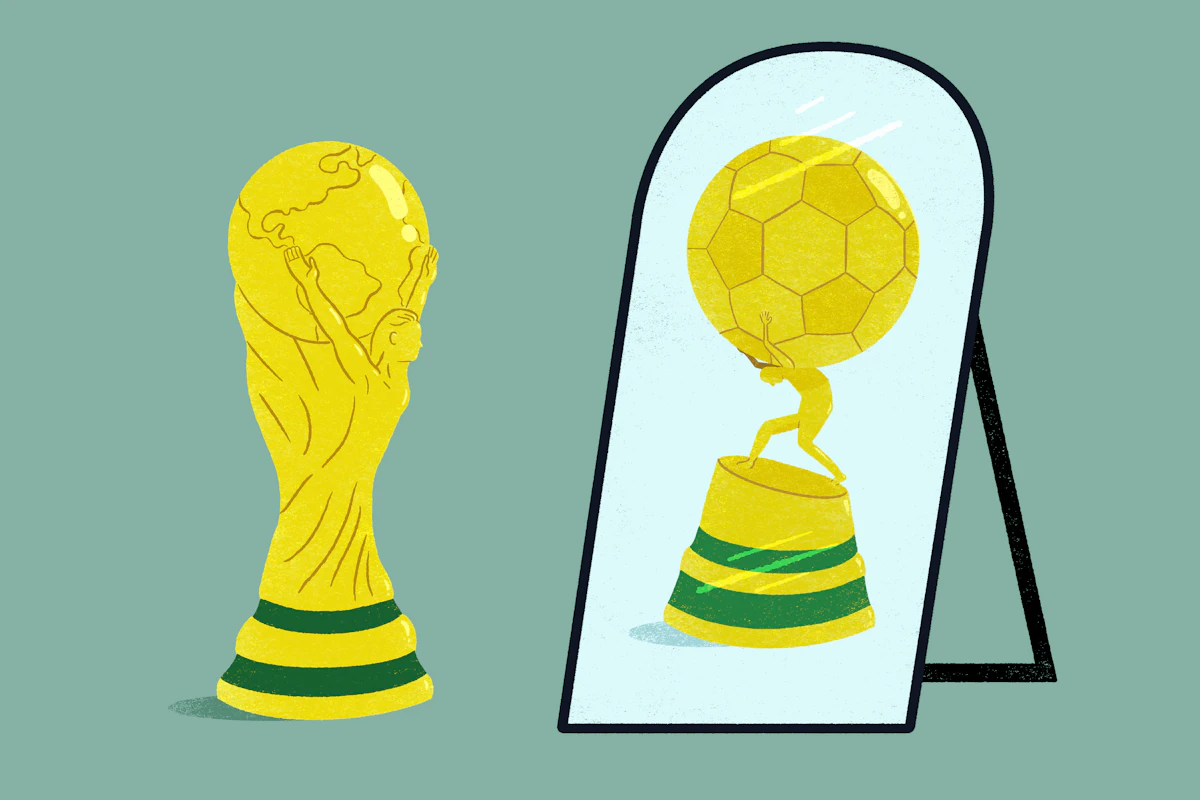
The ball smacked the net. Germany had just scored for the fourth time in 26 minutes, brutally exposing the Brazilian squad. As I watched the match in my father’s São Paulo apartment, I heard a woman outside shriek, an understandable reaction. Ours was silence. Germany would score three more times before the referee’s merciful final whistle. Brazil—the only team to have qualified for every World Cup and the sole country to have won five times—had managed a single goal in the dying minutes of the match, a stab at dignity where none remained. On that day of infamy—July 8, 2014—it was clear to all that Brazil was the hapless victim of a skilled, brutally efficient, cold-blooded sadist.It was not supposed to go this way. When FIFA, soccer’s international governing body, chose Brazil to host the 2014 World Cup in 2007, national leaders dreamed of a global showcase that would cement the country’s image as a rising power, a land of rhythm and joy welcoming the world with competence and grace. More than 60 years had passed since Brazil hosted a World Cup. On that occasion, the home squad fell to tiny Uruguay in a heartbreaking final upset. This time would be different. Stadiums would shine, fans would flood the streets, and the national team would lift the trophy once again on domestic soil, uniting a populace long accustomed to football glory.But those dreams frayed in the years leading up to the tournament. Construction delays and spiraling costs fueled public outrage in a country still bedeviled by gross inequalities. Promises of lasting infrastructure improvements fell short. Multiple corruption scandals tainted FIFA and Brazil’s political class alike. Indeed, some of the largest protests ever seen in Brazil occurred in 2013, targeting the country’s self-dealing elite and fueling a toxic surge of anti-political sentiment. By the time the games began, the pageantry had lost its luster for many Brazilians. Journalist Dave Zirin described a “World Cup seen through tear gas,” with regular protests fouling up the otherwise palpable ebullience. The host’s historic humiliation at German hands was the sharpest proof in a growing body of evidence that something profound was amiss in Latin America’s largest nation. The 7–1 final score would epitomize a dispiriting decade.“World Cups don’t change the world,” according to journalist Simon Kuper, “but they do illuminate it.” In World Cup Fever: A Soccer Journey in Nine Tournaments, he tries to explain how. Kuper writes for the Financial Times and is the author of several books about soccer and other topics. He is one of the few writers who has been to every World Cup since 1990. His personal experiences with the quadrennial tournament, relayed in short vignettes, form the heart of World Cup Fever (notably, he considers the 2014 Cup in Brazil to be the best he’s attended). But this is also a historical, sociological, and political examination of the Cup’s enduring yet shifting significance since it was first held in 1930.Founded on lofty ideals of international communion, FIFA has become a vector of corruption and cultural commodification. One review of the body’s litany of scandals concluded, “in an organization that produces a pseudo-public good and is nonprofit—yet which is run by a private entity without accountability to key stakeholders—the misaligned incentives are clear.” In many ways, FIFA’s notorious venality is of a piece with the shady state of contemporary global politics. As the games begin this summer in Mexico, Canada, and on the shaky ground of Donald Trump’s United States, the spectacle will be inseparable from the uncertain political moment. How can the United States extend a welcoming hand to the world when the current administration has balled its fists? We are all anxious to find out.The fate of a sporting event may seem trivial in a world beset by multiple overlapping crises, of course, but soccer is no mere diversion. It is by far the most popular sport in the world, a shared language that binds billions across borders, classes, cultures, and regimes. This year’s tournament thus poses a critical question: Is a more transparent and democratic version of international soccer even imaginable in a world veering toward reactionary authoritarianism?Soccer’s roots run deep. Unruly games referred to as folk or mob football were played across early modern Britain, often with entire villages used as playing fields. Rules for these localized affairs were standardized in the 1860s into two distinct games—rugby football and association football. At Oxford, the latter was shortened to “assoc” football.
Related Coverage
- Egypt’s World Cup staffers clash with Dallas police in wild scene (Right — New York Post)
- How the world's top AI models were revived (Center Left — Axios)
- AI Industry Is Creating a New Age of Imperial Extraction and Labor Exploitation (Far Left — Truthout)
- "Empire of AI": Karen Hao on How AI Is Threatening Democracy & Creating a New Colonial World (Far Left — Democracy Now!)
- Photos of the Week: World Cup, Wine Battle, White Kimono (Center Left — The Atlantic)
- MAGA world shrugs as Trump reports $2.2 billion in personal gains (Far Left — Raw Story)
- US heatwave threatens 250th anniversary events and World Cup (Center Left — US news | The Guardian)
- Photos of the Week: World Cup, Wine Battle, White Kimono (Center Left — The Atlantic)
Daily Analysis
Read the full Parallax Pulse for June 5, 2026 — an AI-powered analysis of how Left and Right media covered the biggest stories this day.
More Headlines From June 5, 2026
- The Seven Republicans Who Voted With Democrats in Attempt to Block Trump’s White House Ballroom (Center Left)
- Six GOP senators vote to block Trump from reviving anti-weaponization fund (Center)
- Sen. Brian Schatz offers first show of support for scandal-ridden Graham Platner (Center Left)
- When you’re a judge and there’s a conflict of interest, it can pose a huge problem — especially with a controversial decision (Far Right)
- US Senate passes $70bn immigration bill after clashes over settlement fund (Center Left)