

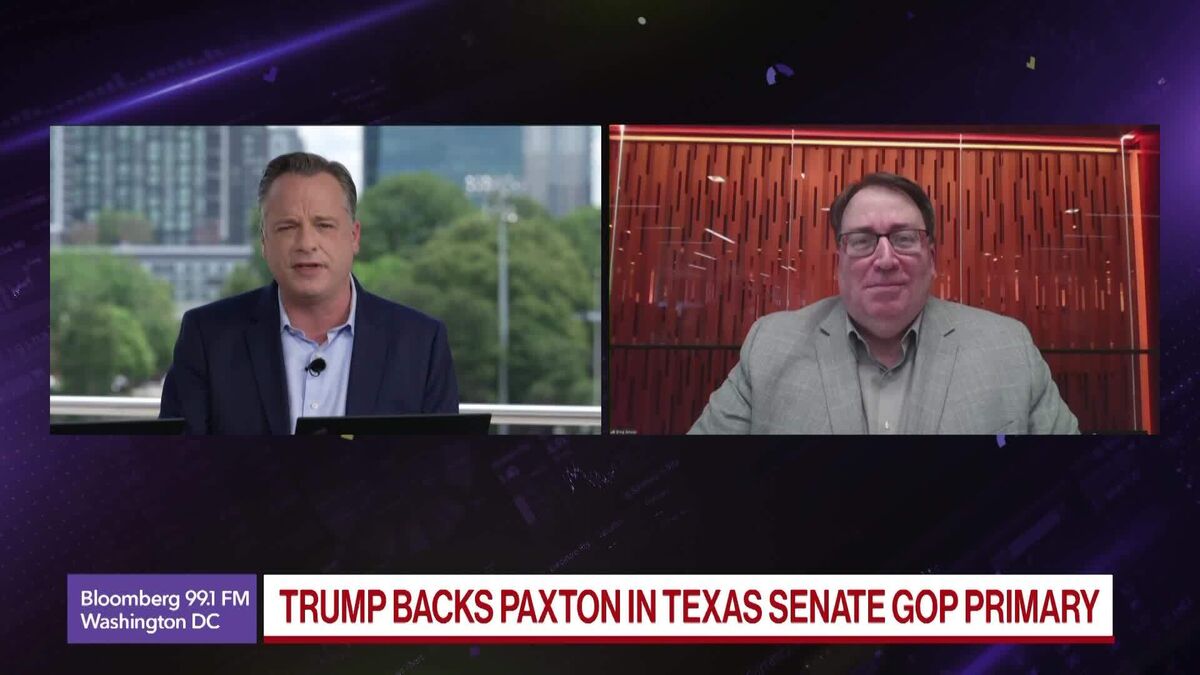
In mid-May, around two weeks before the Texas Republicans’ Senate primary runoff election, state Attorney General Ken Paxton dropped yet another ad smearing his opponent, incumbent John Cornyn, for having “turned his back on President Trump.” Accompanied by a cinematic score, replete with intense, brassy blasts (BRAAAM!), the ad spliced together Cornyn admitting “the idea of a [border] wall is somewhat off-putting to a lot of people” and that “in politics, unless you can win an election, you’re pretty much irrelevant.” These aren’t exactly barn-burning statements. The latter is only scandalizing, to some, because he was referring to Trump’s odds of winning in 2024. (He was, of course, wrong.) On practically every other level, Cornyn is about as orthodox a neoconservative as they come—trafficking the same revanchist, free-market dogma as decades of Republicans before him. (After the U.S. Supreme Court decision to repeal Roe v. Wade, for instance, he tweeted, “Now do Plessy vs Ferguson/Brown vs Board of Education.”) But in his 24 years as senator—six of which were spent as Republican whip, the second-highest ranking position in the Senate Republican Conference—the ground has shifted beneath his feet. This isn’t to say the party “left him,” as other longtime politicians have lately complained. If anything, Cornyn has gone great lengths to keep with the times, and in an increasingly cloying manner. On May 12, he introduced a bill to rename U.S. Highway 287 to “Interstate 47,” in honor of Trump’s term as the 47th president. A day prior, he downplayed his previous opposition to lifting the federal gas and diesel tax after Trump floated the idea to combat costs due to his war in the Gulf. And online, the septuagenarian frequently rails against Democrats with “Trump Derangement Syndrome.” It’s all somewhat undignified, but these are undignifying times. In any case, these self-flaggelations weren’t enough. On May 19—already a day into early voting—Trump endorsed Paxton, christening him a “true MAGA Warrior.” “John Cornyn is a good man, and I worked well with him,” Trump continued, “but he was not supportive of me when times were tough.”Trump had been uncharacteristically quiet about who he supported leading up to his last-minute endorsement. In early March, The Atlantic claimed Republican strategists “expected” him to endorse Cornyn. (It wasn’t the first rather convenient rumor of this sort.) While Cornyn has far outraised his opponent, the latest poll from the University of Houston’s Hobby School of Public Affairs shows Cornyn trailing Paxton by three points. With Trump’s (albeit late) endorsement, Paxton likely has the momentum needed to clinch the primary. Before the March primary, he endorsed more than 130 Republican candidates across Texas; most of them won.Paxton is, according to the aforementioned ad, “the conservative fighter they couldn’t cancel.” The “they” here refers to a sizable cohort within the Texas Republican Party—and maybe his ex-wife, state Senator Angela Paxton, who divorced him last July “on biblical grounds” (i.e. adultery). When it comes to the general election against the Democrats’ choir boy, James Talarico, most polls agree that Paxton is weaker than Cornyn, due largely to all of the former’s dirty laundry.In 2015, less than a year into his first term as attorney general, Paxton was indicted on securities fraud changes. In 2020, seven of his most senior staff members accused him of “abuse of office, bribery and other potential criminal offenses.” A couple years later, he was impeached by a Republican supermajority state legislature, only to be narrowly saved by the state senate. In 2023, federal prosecutors tried picking up where the impeachment left off, but weeks before Trump took office, the Department of Justice decided against pursuing charges. One might think this record would damage him in the eyes of voters—and in fact, Cornyn’s cohort is banking on it—but, as Paxton’s campaign website states (directly above a photo of himself with Trump), “He’s taken the hits and kept fighting,” again and again and again.Last March, in an excellent Texas Monthly piece, Christopher Hooks argued Trump’s silence surrounding the senate primary “may have set in motion a subtle shift in the way Republicans here think about [Trump] and plan for the post-Trump era.” Whereas a decade ago Trump was the insurgent candidate bulldozing the Republican establishment, today he is the party establishment, and “a short-termer, if not yet a lame duck.” Come November, the race against Talarico may actually prove competitive; it may have made more sense for a president approaching the midterms to fall in with the more palatable candidate—to prioritize “electability,” broadly construed—but that would’ve snubbed the very crowd Trump relied on to consolidate power.
The Wanton Destruction of the Texas GOP Senate Primary
