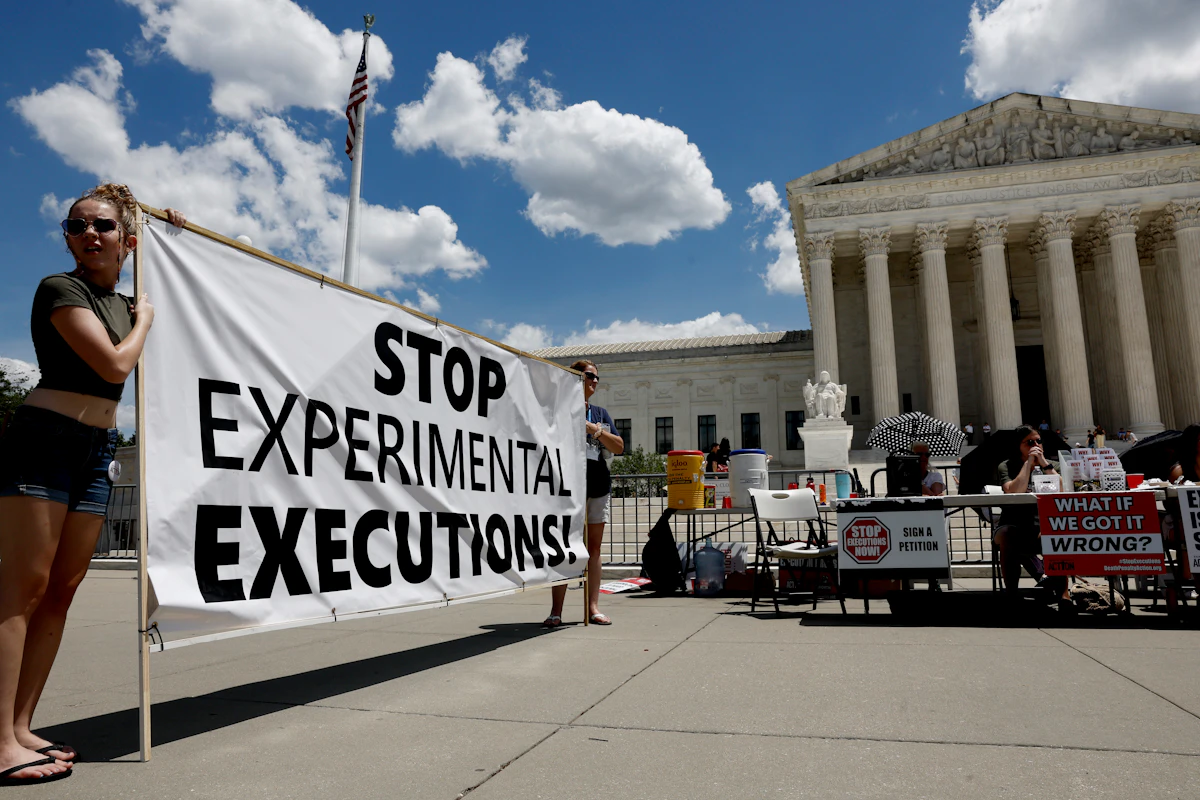
The Supreme Court Hands a Surprising Death-Penalty Defeat to Alabama
Source: The New Republic · Bias: Left
Summary
The Supreme Court did something extraordinary on Thursday night: It refused to help the state of Alabama carry out an execution. Since the retirement of Justice Anthony Kennedy in 2018, the Supreme Court’s conservative majority has almost never intervened in capital cases on the defendants’ behalf. The justices have even overridden lower courts’ stays so that executions could take place on the state’s preferred schedule, even in cases where serious constitutional issues were at stake.But in Lovelace v. Lee, the court declined to step in at Alabama’s request. The case is important for three reasons. First and foremost, it appears to be the first successful constitutional challenge to a specific execution method since the Eighth Amendment’s ratification in 1791. Jeffrey Lee, a death-row prisoner who was convicted of killing two people in 1998, filed a federal lawsuit last year to challenge Alabama’s plan to execute him via nitrogen hypoxia. Alabama adopted the new method in 2018; Lee argues that it would violate the Eighth Amendment’s ban on cruel and unusual punishment.Nitrogen-hypoxia executions are fairly simple in theory. Earth’s atmosphere is roughly 78 percent nitrogen and 20 percent oxygen, with trace elements rounding out the remaining two percent. Humans have evolved to breathe large amounts of nitrogen, and we can do so indefinitely as long as some oxygen is present. Alabama’s plan is to simply subtract the oxygen—or, more accurately, to place a mask over Lee’s face so that he only breathes pure nitrogen until he dies.The state has already killed seven death-row prisoners by this method; Louisiana also executed a man via nitrogen hypoxia last year. Three other states have authorized the method. Proponents describe it as relatively simple and largely painless, even compared to lethal injection. Justice Sonia Sotomayor described it differently in a dissenting opinion last year:Take out your phone, go to the clock app, and find the stopwatch. Click start. Now watch the seconds as they climb. Three seconds come and go in a blink. At the thirty-second mark, your mind starts to wander. One minute passes, and you begin to think that this is taking a long time. Two . . . three . . . . The clock ticks on. Then, finally, you make it to four minutes. Hit stop.Now imagine for that entire time, you are suffocating. You want to breathe; you have to breathe. But you are strapped to a gurney with a mask on your face pumping your lungs with nitrogen gas. Your mind knows that the gas will kill you. But your body keeps telling you to breathe.Sotomayor said that the death-row prisoner in that case would “immediately convulse,” “gasp for air,” and “thrash violently against the restraints holding him in place as he experiences this intense psychological torment until he finally loses consciousness” before finally dying about 15-20 minutes later. The justice’s description also assumes that everything goes as planned. Unsurprisingly, Lee asked the court to let him be executed by firing squad instead, which can be virtually instantaneous when done correctly.A federal district court judge in Alabama rejected those claims, citing the high threshold for execution-method challenges laid out by the Supreme Court in the 2015 case Glossip v. Gross. (More on that later.) The Eleventh Circuit Court of Appeals reversed that ruling and instead that there would be a “substantial risk of serious harm,” then asked the district court to consider whether Lee’s firing squad recommendation would be viable. The district court concluded that it would be and entered judgment in Lee’s favor.In its appeal to the justices, Alabama claimed that the ruling amounted to “the first-ever permanent ban on a legislatively enacted method” in American history. The Supreme Court itself has never explicitly held a specific method of execution to be unconstitutional. Though the justices have suggested in passing that the Eighth Amendment forbids certain medieval methods of execution, such as breaking someone on a wheel or burning them as the stake, the high court have never before compelled a state to abandon its preferred option.Instead, execution methods have changed over the years largely due to public pressure and criticism. Hanging was the most common method of execution in the 19th century, but it was often administered by unskilled amateurs. A competent hangman would ensure that the prisoner’s neck snapped at the first drop. More common outcomes were grisly scenes of strangulation or, in rare cases, decapitation.By the early 20th century, states began to experiment with alternatives. New York carried out the first execution by electric chair in 1890 after the Supreme Court rejected the prisoner’s Eighth Amendment challenge. Electrocution was billed as a more scientific and humane method of execution in the early 1910s, but the reality was far more grim.
Related Coverage
- Trump Scores Appeals Court Victory in Battle Over National Park Historical Displays (Right — RedState)
- Lawfare: Kangaroo court picks fight with state’s conservative attorney general (Far Right — WorldNetDaily)
- UPDATE: Louisiana Supreme Court Temporarily Blocks Politically Motivated Indictment Against AG Liz Murrill (Far Right — The Gateway Pundit)
- Iran’s supreme leader bails on first day of late dad’s funeral ceremonies (Right — New York Post)
- Louisiana court halts criminal indictment against state attorney general (Center Left — US news | The Guardian)
- Some Thoughts on the Court's Opinion(s) in the Birthright Citizenship Case (Center Right — Reason.com)
- Dissecting the Supreme Court's Scary 'Birthright' Betrayal (Center Right — RealClearPolitics - Homepage)
- The Supreme Court ruled seven years ago. Taxpayers are still paying the price (Center Right — Washington Examiner)
Daily Analysis
Read the full Parallax Pulse for June 13, 2026 — an AI-powered analysis of how Left and Right media covered the biggest stories this day.
More Headlines From June 13, 2026
- ‘You just pissed me off!’ Florida sheriff blasts reporter for distracting from child predator sting (Far Right)
- Trump says Iran deal ‘scheduled to be signed’ Sunday, trashes Obama-era pact (Center)
- Florida Sheriff ERUPTS on Reporter Who Tried to Hijack Child Sex Predator Sting Press Conference with Unrelated Questions: ‘This Conference is Solely for Those Pieces of Sh*t’ (Far Right)
- Poland to End Fuel Subsidies as US-Iran Peace Talks Heat Up (Center)
- US Oil & Gas incinerates Sen. Ed Markey over Elon Musk criticism (Far Right)