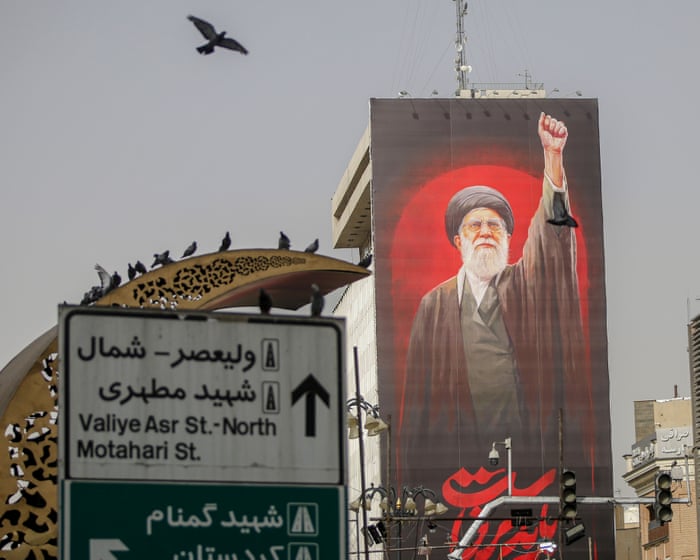
Iran's entire regime made a red carpet entrance to the first of three funeral ceremonies for late Supreme Leader Ali Khamenei — except the dead ayatollah's own son and successor.
Ceremony for Ali Khamenei intended to be epic display of national power. Plus, the expected wedding of Taylor Swift and Travis Kelce pays dividend to good causesGood morning. Final preparations are under way for Ali Khamenei’s six-day funeral. The farewell to the former supreme leader is expected to draw millions in Iran. Khamenei was killed in the opening salvo of the US-Israeli attack on the country in February, and the funeral is intended to be an epic display of personal mourning, national power, resilience and social cohesion.Iran’s first vice-president, Mohammad Reza Aref, who is the lead funeral organiser, described the ceremony, which begins on Saturday in Tehran and will end with Khamenei’s burial on Thursday in Mashhad, as “the most important event of this century” and the most attended event since the 1979 revolution. The scale of the funeral has been conceived to relay political and religious messages of resistance to the rest of the world. At the request of Iraqi politicians, Khamenei’s body will also be carried through the Iraqi Shia cities of Karbala and Najaf.Will Ali Khamenei’s successor take part? Khamenei’s son and successor, Mojtaba Khamenei, is not expected to make an appearance at his father’s funeral. He was severely injured in the same US-Israeli strike that killed his father and also killed Mojtaba’s wife and his 14-month-old daughter. The extent of Mojtaba’s injuries is unknown and he has so far issued only written statements, including one that distanced himself from the ceasefire negotiations but sanctioned their continuance. Israel’s defence minister, Israel Katz, threatened to kill him this week, saying he was marked for death.Why is Trump so unhappy with Nato? Aside from the failure of countries such as the UK and France to join in with the US-Israeli war on Iran, Trump has long complained that Europe does not spend enough on defence. Under pressure from the US, Nato leaders agreed at a gathering last year to boost defence-related spending to 5% of GDP by 2035. Continue reading...
For America’s 250th birthday, the Washington Examiner is taking you to Virginia’s Historic Triangle, where the story of our nation began. From the Jamestown settlement, the first permanent English colony in America; to the Yorktown battlefield, where the fight for independence was won; to Williamsburg, where America’s founding principles were debated and shaped. Step back […]
President Trump is redefining what it means to be a U.S. ally in the AI era.Why it matters: For the White House, it's now about how partners can help the U.S. win the AI race.For decades, shared values and security interests have underpinned alliances with Europe and other partners around the world. Under Trump, that's no longer enough.As AI becomes central to economic and military power, frontier AI models, chips and infrastructure are turning into new instruments of American influence.Driving the news: The Trump administration is blocking allies from accessing the world's most powerful models, playing it close to the vest and criticizing Europe for not having its own robust AI industry.With export controls on Fable and Mythos lifted on Tuesday, Anthropic and the Trump administration are continuing Project Glasswing efforts, which the company previously said would give access to Mythos to 150 more organizations across more than 15 countries.Fable is also back.Commerce retains the power to pull back access when it deems appropriate. "The problem we have is that we are leading everybody by a lot," Trump said in a recent interview with "The Axios Show." "Europe has to be very careful. They're losing their way entrepreneurially."Trump pointed to the U.K. not tapping into energy sources in the North Sea because of environmental concerns: "It's crazy." Between the lines: The Trump administration's AI restrictions are part of a broader transactional approach to alliances.Catch up quick: Vice President JD Vance's speech last year at the Paris AI Summit set the stage for a confrontational relationship with the European Union.The U.S. was quick to rebuke the EU's focus on safety over innovation with Trump entering his second term laser-focused on deregulation. But the president now finds himself behind an ad hoc licensing regime that's creating its own regulatory uncertainty, both domestically and abroad.OpenAI's GPT-5.6 was forced into a staggered rollout last month due to government concerns.What they're saying: European Commission spokesperson Thomas Regnier on Wednesday said the bloc is looking forward to "intensifying" discussions with Anthropic to gain access to Mythos through Project Glasswing and that, in the meantime, it has access to GPT-5.5-Cyber.The EU has a delegation in the U.S. to determine the scope of a future tech dialogue, the frequency of meetings and the level at which they'll be held.The dialogue is expected to include frontier AI models, chip supply chains and cybersecurity."But we have one clear line," Regnier said, "which is that our sovereign legislation is not up for negotiation."Omran Sharaf, the United Arab Emirates' assistant foreign minister for advanced science and technology, told Axios "it's very important that trusted partners and strategic partners are included in the process."That way it is "synchronized and we're applying similar standards in controlling such technologies, rather than having something that gets imposed."The big picture: AI is changing what the White House wants in its alliances.Just last week, the EU and several European governments signed onto Pax Silica, the U.S.-led effort to secure AI supply chains and critical minerals, even as the White House restricts their access to frontier AI models.For the U.S., Europe is all of the above: a restraint, an indispensable partner and a competitor.The administration is simultaneously rejecting Europe's AI rules, inking deals with the region to secure supply chains and blocking access to cutting-edge technology.The bottom line: With the most advanced AI, allies will have to adjust to being considered trusted U.S. partners only in some cases."The conclusion that governments are coming to is: We'll be part of Pax Silica, yes. We'll work with the U.S. ecosystem where we can. We'll build around what we can't," A.J. Bhadelia, Cohere's head of global government affairs and external affairs, told Axios.
Tucker Carlson said that he’s going to help build a third party, although he denied that he intends to run for president as its candidate. The conservative […]