Stephen Colbert was right
Source: Alternet.org · Bias: Left
Summary
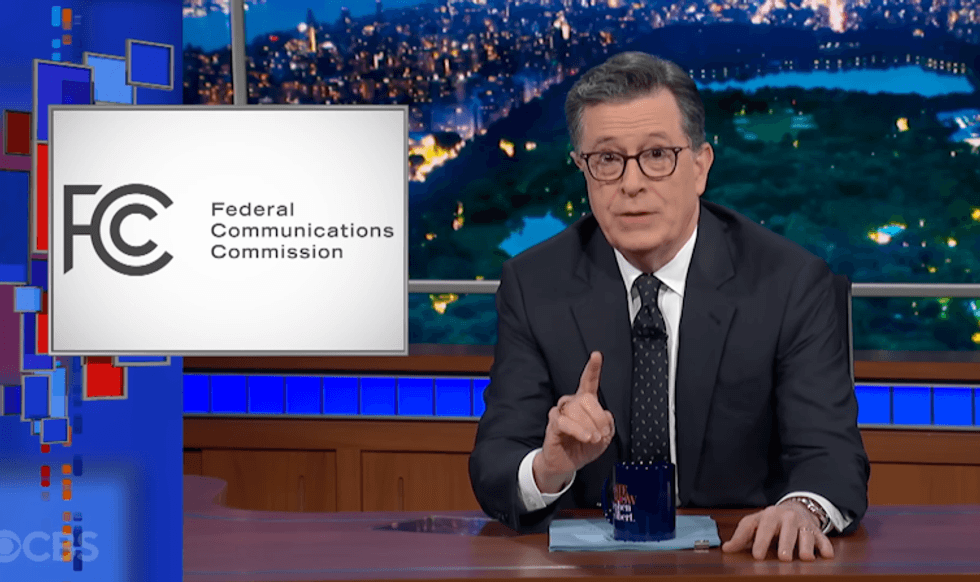
Talk show host Stephen Colbert made headlines on Feb. 17, 2026, when he wrapped a network statement in a dog-waste bag and tossed it in the trash.He did it live, while on air.The move came after CBS lawyers reportedly told him he could not broadcast a scheduled interview with Democratic Texas Senate candidate James Talarico on his show, Late Night with Stephen Colbert. According to Colbert, the network warned him that broadcasting the interview could trigger the Federal Communications Commission’s equal time rule, which requires broadcasters to allow political candidates equal access to the nation’s airwaves.CBS said it gave Colbert “legal guidance” that airing the segment could raise equal time concerns and suggested other options. Colbert countered that in decades of late-night television, he could not find a single example of the rule being enforced against a talk show interview. He ultimately posted his Talarico interview on YouTube instead, where broadcasting rules don’t apply.As a media scholar, I believe Colbert is right about the law. Congress has deliberately protected editorial discretion to prevent equal time rules from chilling political speech. And the FCC has extended this privilege to shows like his. To understand why, you have to go back to 1959 and to a forgotten fight over the role of broadcasting in a democratic society.Amending ‘equal time’Because the airwaves have been viewed as a scarce public resource, radio and television broadcasting have been regulated to balance the First Amendment rights of the press with public interest obligations. That includes the need to provide reasonable access to the airwaves for candidates for office – so citizens can hear what they have to say, whether in the form of paid advertising or unpaid news coverage.After first appearing in the Radio Act of 1927, the equal time provision was codified in Section 315 of the Communications Act of 1934. That law created the FCC and still governs the use of the nation’s airwaves today. It requires broadcast licensees to provide “equal opportunities” to legally qualified candidates in a given election if they allow one candidate to “use” their facilities. The requirement was intended to prevent broadcasters from favoring one candidate over another and to foster robust political debate that would serve the public interest. But the statute did not clearly define what counted as a “use.” That ambiguity was a known issue, but it came to a head in 1959, when Lar Daly, a fringe Chicago mayoral candidate, filed a complaint with the FCC. He argued that if stations aired news clips of his opponents – including the incumbent mayor – as part of their routine coverage, he was entitled to equal time on air. The FCC agreed. And it created a ruling that meant even routine news coverage of a candidate could trigger equal time obligations. Broadcasters immediately warned that the decision would make political journalism nearly impossible. If every news interview or campaign clip required providing comparable time to every rival – including minor or fringe candidates – stations would either have to book everyone or drastically scale back political coverage. NBC president Robert Sarnoff issued a thinly veiled threat in a message that was not lost on politicians who would be affected by the change: “Unless the gag is lifted during the current session of the Congress, a major curtailment of television and radio political coverage in 1960 is inevitable.”Later that year, Congress stepped in and amended Section 315 to create explicit exemptions for “bona fide” newscasts, news interviews, news documentaries and on-the-spot coverage of news events. As my colleague Tim P. Vos and I note in our research on the history of the amendment, Congress rejected calls to repeal equal time altogether. Instead, lawmakers preserved the rule for candidate-sponsored advertising while shielding news programming. Persuaded by broadcasters, lawmakers determined that professional journalism, guided by norms of balance and fairness, would best serve democratic discourse.In signing the 1959 legislation, President Dwight D. Eisenhower highlighted the “continuing obligation of broadcasters to operate in the public interest and to afford reasonable opportunity for the discussion of conflicting views on important public issues.”Eisenhower concluded by appealing to the good intentions of the nation’s broadcasters: “There is no doubt in my mind that the American radio and television stations can be relied upon to carry out fairly and honestly the provisions of this Act without abuse or partiality to any individual, group, or party.”The talk show exemptionOver the decades, the FCC has interpreted the 1959 exemptions broadly. Programs ranging from Meet the Press to The Jerry Springer Show to The Tonight Show and other interview-based broadcasts have been treated as “bona fide news interviews,” even when hosted by comedians.
Related Coverage
- 'Perverted little fantasy': Stephen Miller instantly buried after bizarre post (Far Left — Raw Story)
- 'You're screaming in front of children!' Right-wing activist all he can handle in Philly (Far Left — Raw Story)
- Karoline Leavitt warns ‘full-blown Communist revolution’ taking place right NOW (Far Right — BizPac Review)
- Time for Congress To Make the Right To Carry a National Right (Center Right — RealClearPolitics - Homepage)
- Milton Friedman Was Right About Monetary Fine-Tuning (Center Right — National Review)
- Britain’s Labour Party Is Proving Why America Was Right to Ditch Parliament (Right — PJ Media)
- Trump Hypes Tech Company Right After Buying Stock in It (Left — The New Republic)
- The court got party spending right. Foreign money is still the problem (Center Right — Washington Examiner)
More Headlines From February 23, 2026
- Trump fumes at 'fake news' after 3 separate reports reveal general’s White House warning (Left)
- The Supreme Court Makes a Prudent Ruling on the Trump Tariffs (Center Right)
- Conservative National Review blasts 'angry toddler' Trump over Supreme Court attack (Left)
- Top general warns White House as 'ongoing debate' consumes Trump’s 'brain trust' (Left)
- US women's hockey team won't visit Trump's White House (Left)