Louisiana Republicans Seem Content to Let New Orleans Drown
Source: The New Republic · Bias: Left
Summary
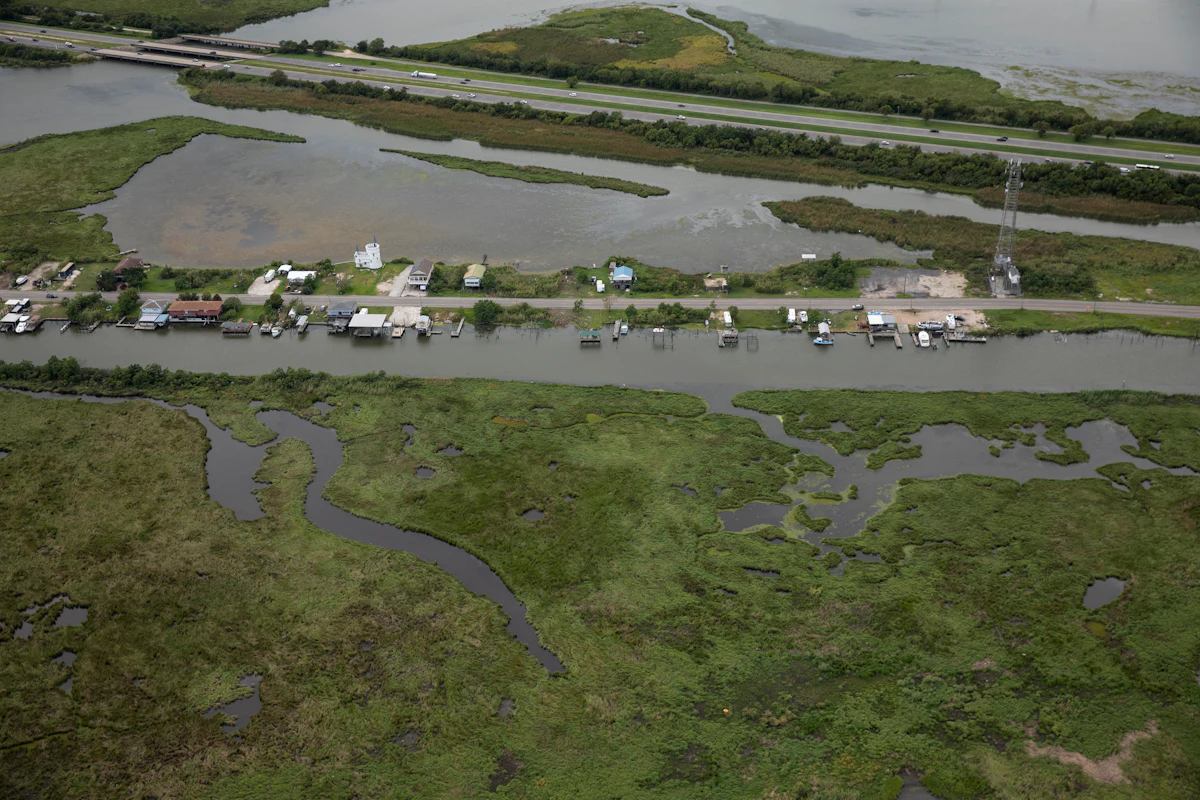
In the coming decades, New Orleans will be surrounded by ocean. That’s the contention of a paper published this week in Nature Sustainability. It finds that the city has already passed a “point of no return.” The authors recommend taking immediate action to start relocating the more than one million residents there and across coastal Louisiana who are being placed “in harm’s way” by the rapid loss of coastal wetlands, a loss increasingly driven by rising sea levels. The study suggests that the “widespread conversion” of low-elevation coastal zones in the Mississippi Delta into “open water” is “probably unavoidable.” “Between the chronic stress of land loss and sea level rise, New Orleans’s days are numbered—at least as we know it today,” said Jesse Keenan, a co-author of the paper and an expert in climate adaptation at Tulane University. To some extent, this transformation is already happening: Louisiana is losing a football field’s worth of land every 100 minutes. New Orleans has lost 25 percent of its population since 2005, when Hurricane Katrina caused more than 1,500 deaths and more than $150 billion worth of damage. Some neighborhoods are sinking by as much as two inches per year. Rather than planning for a looming inundation exacerbated by climate change, politicians in Louisiana have been busy trying to keep Democrats in majority-Black districts from governing. Republican leaders there recently moved to eliminate the New Orleans clerk of criminal court position just days before the Democrat voters had overwhelmingly elected for that job was due to take office. The Supreme Court late last month sided with Louisiana Republicans’ bid to throw out the state’s congressional maps; the decision significantly weakened the Voting Rights Act of 1965. Republican Governor Jeff Landry promptly suspended primaries for Louisiana’s U.S. House seats from May 16 to July 15, when redrawn maps are expected to eliminate one of the state’s two majority-Black Democratic districts. Landry appears devoted to the project of one-party rule. He has been much less enthusiastic about preparing for a future where large parts of his state no longer exist. Last year, he ditched a project to rebuild more than 20 square miles of coastal wetlands over the next 50 years, aimed at restoring the natural flow of the Mississippi River in select areas and directing sediment toward eroded areas. Landry argued that the Mid-Barataria Sediment Diversion project was too expensive, but it was primarily funded by the fees and settlement BP was forced to pay out from its role in the 2010 Deepwater Horizon disaster—the largest oil spill in the history of marine oil drilling operations, which deposited four billion barrels of oil from a damaged well, devastating wildlife, coastal residents, fishing operations, and tourism. The project would buy time, Keenan said, but would hardly preserve coastal Louisiana as is. Instead of putting BP’s money to use protecting coasts, some Louisiana Republicans have fought to keep oil and gas companies from having to pay for any other damage to the state’s shrinking coasts. As with the attacks on voting rights, the Supreme Court recently handed them a major win. In April, SCOTUS voted 8–0 to allow energy companies to move lawsuits over their environmental damages to friendlier federal courts. A bill currently making its way through the Louisiana legislature—House Bill 804—would “effectively give energy companies legal immunity from liability related to illnesses, injuries, deaths or other damages stemming from the climate effects of industrial air pollution,” the Louisiana Illuminator reports.Louisiana’s representatives in Washington aren’t keen to talk about their state’s increasingly dire situation. Just one member of the state’s congressional delegation responded to multiple requests for comment about how Louisiana should prepare for the events described in the Nature Sustainability paper; what role local, state, and federal governments should play in that process; how it should be financed; and whether lawmakers should act to mitigate climate change so as to stem additional displacement. I also asked if they agreed with Landry’s decision to cancel the diversion project. The lone respondent was Republican Clay Higgins, whose coastal district stands to be largely swallowed by the three to seven feet of sea level rise the Nature Sustainability paper notes that southeastern Louisiana is “probably committed to.” Higgins’s response was brief: “I read the paper yesterday. ‘The Earth’s going to change’ … is most certainly true. Always has been true. Always will be true.” The phrase “the Earth’s going to change” does not appear in the paper.
Related Coverage
- Taylor Swift and Travis Kelce married at New York City’s Madison Square Garden (Center Left — US news | The Guardian)
- Business Leader Calls on New York City to Resist Mamdani (Far Right — The Gateway Pundit)
- UPDATE: Louisiana Supreme Court Temporarily Blocks Politically Motivated Indictment Against AG Liz Murrill (Far Right — The Gateway Pundit)
- Luka Doncic weighs in on new-look Lakers roster amid heavy criticism (Right — New York Post)
- This Republican Has a Wild Idea for Fixing Housing Prices: Let the Market Actually Work (Far Right — Townhall)
- Pay-to-play cycle behind GOP's corporate tax cuts exposed in new report (Far Left — Raw Story)
- ‘Heat for thee, but not for me’: Mamdani lets City Hall go chill as he tells residents to sweat it out (Far Right — WorldNetDaily)
- Mamdani mocked by GOP for telling New Yorkers to set thermostats to 78 (Center — The Hill News)
Daily Analysis
Read the full Parallax Pulse for May 7, 2026 — an AI-powered analysis of how Left and Right media covered the biggest stories this day.
More Headlines From May 7, 2026
- 5 Takeaways From the California Gubernatorial Debate (Center Left)
- U.S. destroyers in Strait of Hormuz fight off Iranian attacks (Center)
- Trump upends Democrats' strategy on Iran war powers (Center Left)
- 8 Things Doctors Want You to Know Before Your Colonoscopy (Center Left)
- California gubernatorial candidates debate affordable housing (Center Left)