DOJ Declares Trump Has Right to Bulldoze Statue of Liberty
Left
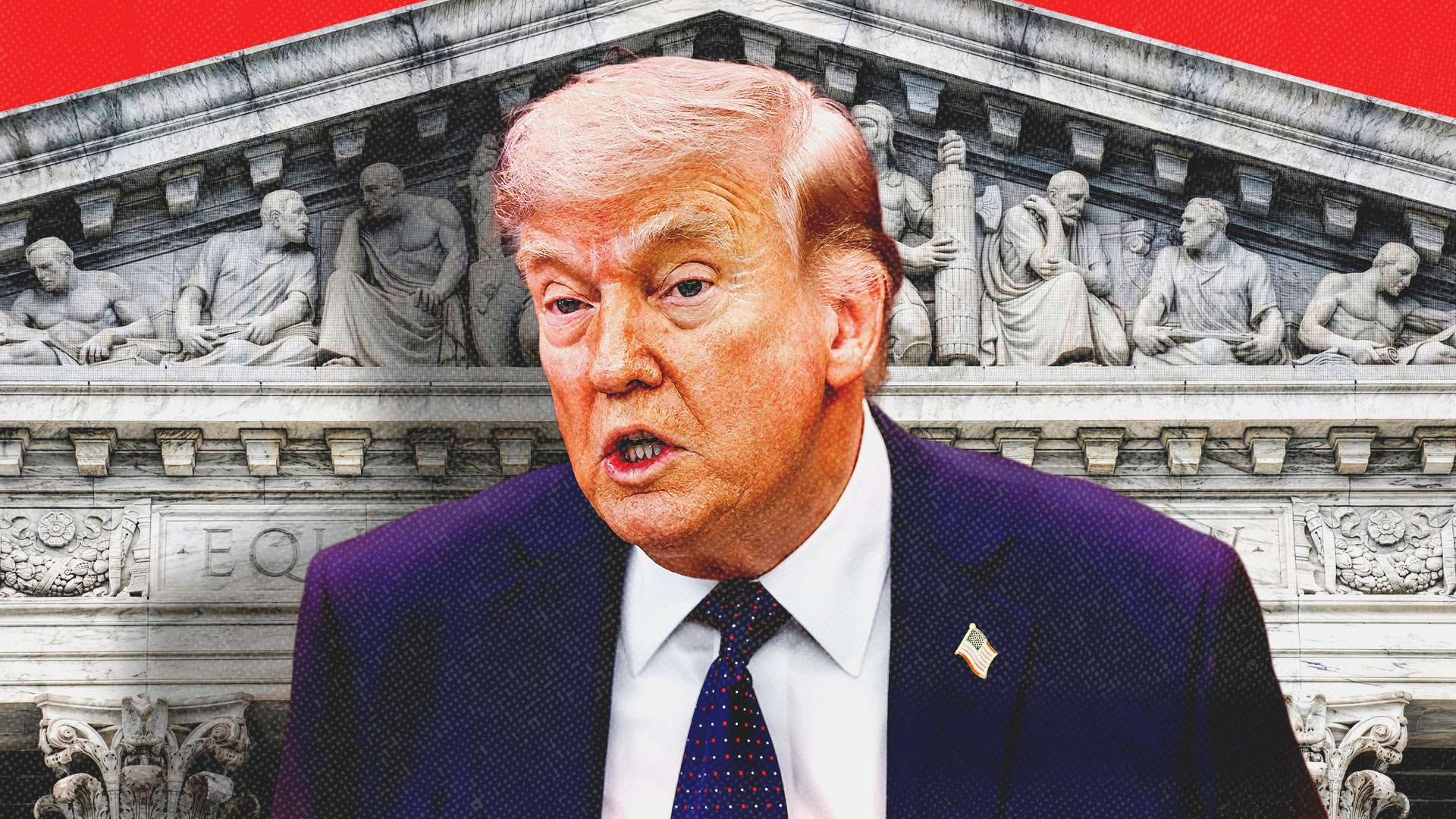
Why in the world did the Department of Justice just declare that President Donald Trump has the right to demolish the Statue of Liberty?During oral arguments before the U.S. Court of Appeals in Washington Friday, lawyers for the DOJ presented the government’s case for continuing construction on Trump’s increasingly expensive White House ballroom without the approval of Congress. In order to demonstrate Trump’s supposedly far-reaching power to destroy and alter national monuments at whim, the DOJ lawyers claimed that if the president wanted to bulldoze the Statue of Liberty in New York, there would be no one with the standing to challenge him. “If the government decides very quickly to bulldoze the Statue of Liberty, the people whose ancestors—that was the first thing they saw coming to this country, but the government moved too fast—nothing can be done?” Judge Patricia Millett asked, according to Politico’s Kyle Cheney. “I think that’s right, yes,” the government responded. The Statue of Liberty, like the White House, is managed by the National Park Service. Demolishing it would require legislative approval and rigorous public and regulatory review under the National Historic Preservation Act. This argument features in the DOJ’s primary claim that the National Trust for Historic Preservation, the group behind the lawsuit, has no standing to challenge the construction. The DOJ also argued that construction on the ballroom can’t actually be stopped by the courts, and could only be stopped by Congress. All of this further illustrates just how powerful the Trump administration believes itself to be: Its modus operandi is simply to break our nation’s laws with such speed that no one can stop it.
President Donald Trump has instructed Bill Pulte, the controversial new acting head of the Office of the Director of National Intelligence (ODNI), to execute sweeping personnel cuts across the nation's 18 federal intelligence agencies and units before a permanent successor is confirmed.In an interview with The Wall Street Journal, Trump revealed his explicit mandate to Pulte, who lacks the necessary security clearances, to dramatically reduce the size of an agency he views as "unnecessary and/or too big.""I'd like to see it smaller. I think there are a lot of people in there that shouldn't be there," Trump admitted to The Journal, specifically targeting career officials from the Biden and Obama administrations. When asked directly if he was ordering firings, Trump confirmed the instruction. "I want him to 'start the process,'" Trump said, adding that his eventual permanent nominee should continue the purge once confirmed.Trump bluntly framed Pulte's temporary status as an operational advantage rather than a limitation. "You're less shackled," Trump said of the acting designation. "It sort of gives you more power, you know, for a somewhat limited period of time."The president outlined a calculated strategy to complete major structural changes before his permanent appointee takes office, allowing the future ODNI to inherit a smaller, ideologically aligned agency rather than managing the cuts themselves."Frankly, it might be good for him to shake it up before people come," Trump explained. "Because, if he [Pulte] reduced the size, in conjunction with me…and in conjunction with possibly the person coming in…he can do a lot of the hard work and we wouldn't have to saddle somebody that goes in."The approach reflects Trump's broader effort to reshape the intelligence community according to his preferences, The Journal reported. Pulte, who has no prior intelligence experience and has been highly critical of the FBI and other agencies, is widely viewed as unlikely to survive Senate confirmation despite his acting appointment.Pulte and ODNI representatives declined to comment to The Journal on the directives.
On Friday, the Trump administration celebrated a better-than-expected jobs report, which showed the U.S. gained 172,000 jobs in May. But while President Donald Trump may be patting himself on the back, one respected economist warns that the good news misses a “clear paint point” that shows the economy is shakier than the job numbers suggest. “This is the clear pain point in the economy,” posted Heather Long, chief economist at Navy Federal. “Wage growth in May was the lowest in 5 years. May wage gains: 3.4 percent (for past year). May inflation: Likely to be ~4 percent.”That’s bad math for the economy, meaning that inflation is outpacing wage gains. Or as Long puts it, “It's easier to get a job now, but it's hard to find a job where your pay will keep up with current inflation.” What’s more, Long notes that wage gains have hit their lowest point in five years, since May 2021, when the pandemic was still wreaking havoc on the global economy. Other experts have agreed with Long’s not-so-fast assessment of Friday’s positive job report.According to Bankrate Senior Economic Analyst Mark Hamrick, “It's very likely, given recent trends, that real wages will continue to fall and workers and their families will find it increasingly difficult to make ends meet.” Hamrick also argues that affordability challenges have reduced job mobility, and that what job growth there has been is limited to a few sectors, which doesn’t bode well for economic strength overall. At the same time, he suggests that a strong labor market makes it less likely that the Fed will cut the interest rate, resulting in higher borrowing costs and slower business expansion. And as U.S. economic policy expert and former chief economist for the GOP Ways and Means Committee, Donald Schneider, noted, there is an interesting correlation between the rising job numbers and the removal of a key Trump policy: tariffs. Schneider shared a chart that plots both the effective tariff rate and job growth, saying, “These things might be related.”The chart indicates that as Trump’s tariffs began to fall at the end of last year, the plunging job growth rate started leveling off. Then tariffs plummeted after the Supreme Court slapped them down in February, and lo and behold, that’s precisely when the job numbers began racing upwards. So as Scheider points out, there appears to be a direct link between the two trends. Trump has announced his intentions to reintroduce tariffs.Europac chief economist Pete Schiff noted another issue with the job news, posting, “Unfortunately, all of those jobs were either in leisure and hospitality, or in government or government-related services. That drives demand for imported goods, increasing trade deficits and goods prices.”As one of his respondents explained, “We are subsidizing consumer demand without creating the domestic goods to match. Pumping government payrolls and service wages gives consumers cash to spend, but since the U.S. isn't producing physical goods, that liquidity immediately leaks out of the country to buy foreign imports.”“Exactly,” Schiff agreed.
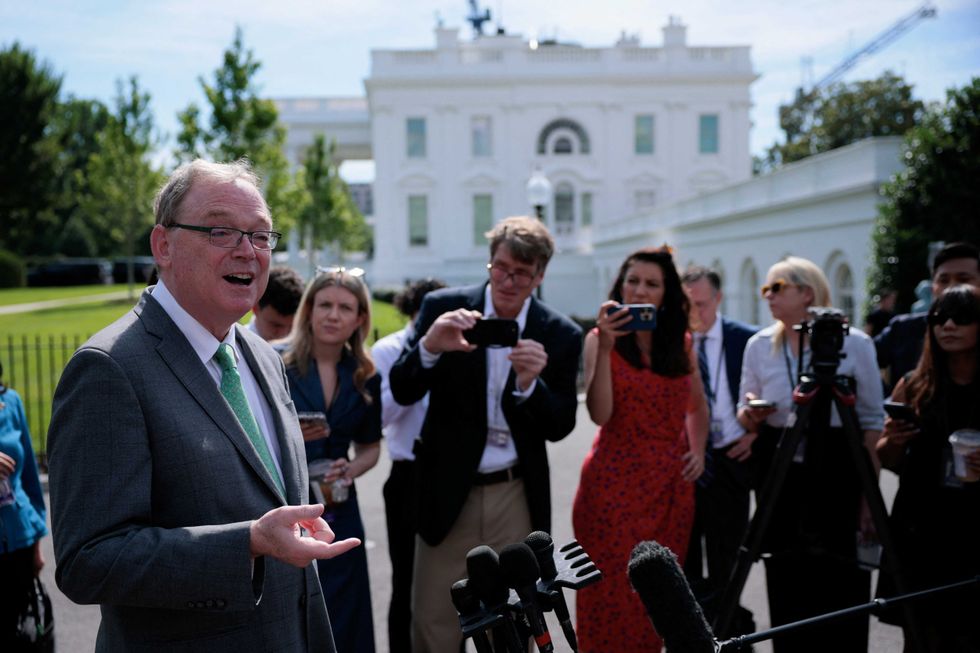
Kevin Hassett, Director of the National Economic Council, told Fox News on Friday that the economy under President Donald Trump was booming — and hilarity ensued.Hassett claimed "the Trump boom" wouldn't be reported by "the fake news," and that the One Big Beautiful Bill has massively helped to improve the economy — dismissing affordability concerns among Americans."Right now, Wall Street just doesn't understand that the Trump economy is really creating an economic golden age," Hassett said.Onlookers immediately attacked."Can the numbers be trusted??" Attorney and former public defender Frank Amari, who has more than 64,000 followers, wrote on Bluesky."It sure is, for the 1%. Not for Main Street," filmmaker and producer Joel Lesko wrote on Bluesky."Trump is creating an 'economic golden age' for his cronies in the top 1/2 of 1%. The rest of us can go suck it," Dawn Humphrey, a retired communications expert with more than 21,000 followers, wrote on Bluesky."An economic golden age, eh? I'll leave this here for you," Georgetown University professor Anthony M. Hopper wrote on X, sharing the University of Michigan’s Consumer Sentiment Index report showing an economic decline.Kevin Hassett: "Right now, Wall Street just doesn't understand that the Trump economy is really creating an economic golden age" pic.twitter.com/sjxp9JK9sn— Aaron Rupar (@atrupar) June 5, 2026
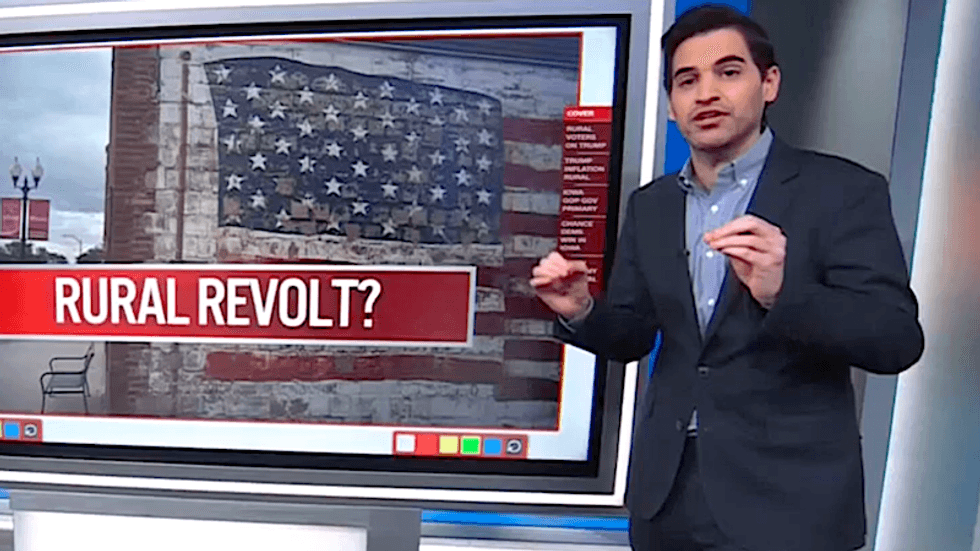
President Donald Trump is facing a "rural revolt" as a result of his policies, according to a new data analysis.The soon-to-be-80-year-old president was re-elected in 2024 on his promise to improve the economy, but voters aren't happy with the job he's done so far, and many of his policies are directly hurting farmers and voters in the rural areas that have backed him in all three elections."Iowa has been traditionally a field of dreams for the president of United States," said CNN's Harry Enten. "But it's quickly turning into potentially a field of nightmares. There seems to be a rural revolt going on in this country against Donald Trump. Take a look here: Rural voters and Trump, look, according to Fox News, he was easily winning them back in October of 2024 versus Kamala Harris, 18 points ahead. The exit poll even had it a bigger margin.""But look at where he is now – whoo!" Enten exclaimed. "Down there underwater, underneath the cornfields. He's now 14 points underwater. That's over a 30-point switcheroo against the president."The explanation for that reversal is fairly simple, according to Enten."Simply put, it's the economy, it's inflation," he said. "Take a look at this: You thought that that switcheroo was big, how about this one? Rural voters on Trump and inflation versus Kamala Harris. He was more trusted by 37 points. Now he is 19 points underwater with rural voters on inflation. That is an over 50-point switcheroo against the president of the United States. Rural voters, like the rest of the country, turning against Trump on the key issue that got him elected to a second term back in 2024."Anger at the president has flowed down ballot to Republican congressional candidates and gubernatorial races, Enten said."You know, Donald Trump went and he has won all of these primaries," he said. "The candidates he endorsed have won all of these primaries, did not happen in Iowa. Well, just talk about Iowa Republicans here. The gubernatorial primary he endorsed Randy Feenstra, congressman from Iowa, and Feenstra actually won the absentee vote in that state by 15 points. Trump endorsed late, but the other candidate, Zach Lahn, look at this, he actually won those who voted on Election Day who knew about Trump's endorsement. In fact, they were considerably more favorable to Lahn than they were in a Feenstra, even after knowing that Trump had, in fact, backed Feenstra.""It seemed to me that Iowa Republicans said, 'You know what, we hear you, Donald Trump, but you know what? We're dismissing that message,' again, part of a larger picture in my mind of rural voters not tuning in to what Donald Trump is telling him at this point," Enten added.That shift against Trump is boosting Democratic chances in the midterm elections, Enten said."The last Democrat to win a Senate race in Iowa was all the way back in 2008," Enten said. "It was Tom Harkin. But what do we see here in terms of the Democrats' chances in Iowa and the governor's race and the Senate race? They have gone up like a rocket. We're now talking about Rob Sands running for governor with a greater than 50 percent chance, and it turns out that Josh Turek, who the Democratic establishment wanted, his chances have also been considerably rising at this point.""If all of a sudden you're able to put Iowa on the board, if you're a Democrat hoping to win back control of the United States Senate, that would be a massive piece of the puzzle, and the last time Iowa elected a Democratic governor was all the way back in 2006, and that looks like a more likely possibility than not," Enten added. - YouTube youtu.be
On May 26, 2026, Cuba received a 60,000-ton rice shipment from the Chinese Communist Party.
The post Trump Administration Getting the CCP Out of Cuba appeared first on The Gateway Pundit.
American democracy, writes political commentator Brian Beutler, is trapped in a precarious contradiction. On one hand, outrage against the corruption and harmful leadership of President Donald Trump has made it likely that he and his party will face backlash at the polls, but at the same time, the likelihood of that backlash provides Trump supporters with “fuel for further attempts to overturn elections.” This creates a situation in which “Trump has everything to lose by losing, and nothing to lose by attempting another coup.” And according to Beutler, the Supreme Court has been motivated to help him do it. “While his corruption will make it easier for Democrats to sweep the midterm elections, it will also make him more determined to steal back their victories,” Beutler explains. “That’s why the past month’s news read the way it did: A slush fund to buy a second insurrection. An election-denying prosecutor in North Carolina named Dan Bishop who’s up to god knows what. A promotion for the acting attorney general who’s promised Trump total loyalty. A new interim spy chief, chosen for his willingness to mine confidential government documents seeking dirt on Trump’s enemies. All while Trump increases the pace of looting, and abandons any pretense of trying to win the old-fashioned way.”More alarming still, says Beutler, is that Republicans in key positions “seem willing or eager to go along with him. His allies in state legislatures helped national Republicans steal perhaps five to 10 House seats through mid-Census gerrymandering. They were given a leg up by Republicans on the Virginia Supreme Court, which summarily voided a voter-approved pro-Democrat gerrymander, and by Republicans on the U.S. Supreme Court, who allowed southern Republican legislatures to redraw congressional maps in the middle of primary elections, creating new Republican seats just in time for the midterms.”And it is this meddling by the courts that Beutler argues should have Americans most concerned. As he notes, while in 2020, the Supreme Court and lower courts across the country rejected Trump’s efforts to overturn the election, now, the political landscape has changed, and “they, too, have everything to lose by losing, and nothing to lose by helping Trump complete his coup. In the winter of 2020, their interests diverged, or at least seemed divergent. Today, they are completely aligned.”When Trump staged his political comeback, says Beutler, he “gave the Republican justices a choice: you’re with me or you’re with the Democrats. They didn’t hesitate to pick a side. They went out of their way to protect Trump from political and criminal accountability for the January 6 insurrection. Then when Trump returned to power, they used their shadow docket to advance his interests by fiat, without explaining themselves to the public. And that was before their ruling in Callais, which transformed the Voting Rights Act from a statute that prohibited gerrymanders intended to disenfranchise black voters into a doctrine meant to encourage anti-black gerrymanders and forbid pro-minority gerrymanders.”They’re taking such action because “they can see the anti-Trump rebellion brewing, and they know it doesn’t just threaten their power. It threatens to consign them to the legal anticanon along with some of the country’s greatest historical villains. ... Every law student in America learns about the anticanon — the worst rulings in the Supreme Court’s history: Dred Scott, which upheld slavery. Plessy, which upheld segregation.” Now the Roberts Court has been adding its own decisions that will be decried by history, such as gutting the Voting Rights Act and “Trump v. United States, which transformed the presidency into a zone of lawlessness for would-be dictators.”Today, as Beutler explains, Republicans face a near-future where Democrats score big midterm wins, flipping key districts and states and maybe taking back the Senate, which would allow them to block Trump’s judicial nominees and agenda. “Now ask yourself,” Beutler wonders, “what wouldn’t Roberts and the other justices do to stop this?” In the face of such sweeping Democratic wins, forecasts Beutler, “Trump alleges fraud. So does the loser, Ken Paxton, who also happens to be [Texas’s] sitting attorney general. They race to federal court, claiming Paxton is the rightful victor. A Republican judge disqualifies enough ballots to flip the result. Democrats appeal. The appeal reaches the Supreme Court quickly. Control of the Senate, and thus the legitimacy of the entire U.S. government, hangs in the balance.”