RealClearPolitics - Homepage
Iran War Is an Ever-Expanding Catastrophe
Millions are being dragged into starvation, while people everywhere pay a Trump war tax. But there are plenty of powers who could bring him to heel
Center Right
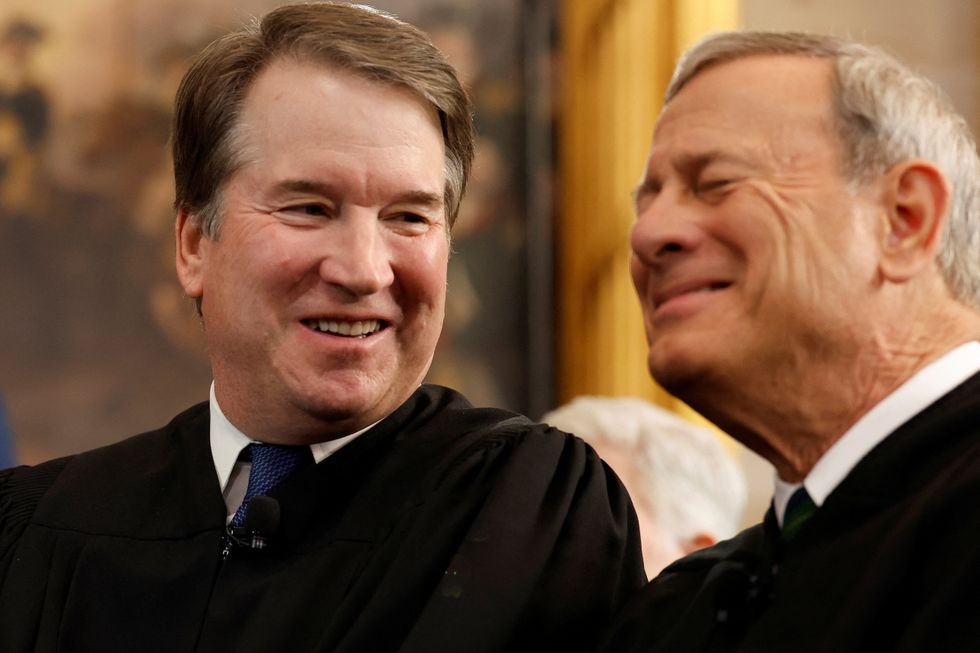
Is the United States headed for a second Civil War? According to a survey of likely midterm voters published by the Leadership Conference on Civil and Human Rights, 57% of Americans believe it is. Sixty-nine percent say democracy is under serious threat; and an equal percentage of nonwhite voters say they fear rising white supremacy.While President Donald Trump and his MAGA movement deserve the lion’s share of blame for such findings, the Supreme Court has done its part. Under the stewardship of Chief Justice John Roberts, the court has issued a blistering succession of dangerously polarizing rulings, ranging from presidential immunity, union organizing, the death penalty, environmental protection and gun control to affirmative action and abortion rights. The resulting jurisprudential carnage has accelerated the nation’s rupture into irreconcilable belligerent tribes and prompted speculation that we are headed for another existential conflict.The Roberts Court has taken a particularly malevolent interest in destroying the Voting Rights Act of 1965. Last month’s decision in Louisiana v. Callais gutted Section 2 of the landmark legislation, which was amended in 1982 to permit the Justice Department and private citizens to challenge election laws that have the effect of diluting minority voting power. The Roberts Court has taken a particularly malevolent interest in destroying the Voting Rights Act. The court’s 6-3 majority opinion by Samuel Alito invalidated Louisiana’s 2024 congressional map that created a second majority-Black congressional district to operate alongside the state’s five white-majority districts, roughly reflecting the size of Louisiana’s Black population. The ruling handed a victory to the lead plaintiff in the case, Phillip “Bert” Callais, an election denier and alleged conspiracy theorist who had attended the Jan. 6, 2021, “Stop the Steal” rally on the White House Ellipse that eventually snowballed into the insurrection at the Capitol. Barely concealing their racial animus, Callais and his co-plaintiffs described themselves in court filings as “non-African American voters” who were the victims of reverse discrimination. Louisiana has since moved to redraw its voting maps.With the demise of the “effects test,” future Section 2 plaintiffs will have to meet the nearly impossible burden of proving that redistricting maps were created with overt discriminatory intent rather than for political purposes. And as the court held in a 2019 opinion written by Roberts in Rucho v. Common Cause, political gerrymandering claims cannot be brought in federal courts because, as the Republican majority sees it, they present nonjusticiable “political questions.”Both Callais and Rucho built upon Roberts’ 2013 majority opinion in Shelby County v. Alabama gutting two other sections of the VRA that required state and local jurisdictions with histories of egregious voter discrimination to obtain advance federal approval — known as preclearance — before making changes to their election procedures. Like Alito in Callais, Roberts declared in Shelby that racial discrimination in voting was a thing of the past and thus special protections for minorities were no longer necessary. The combined effects of Shelby and Rucho have led to a proliferation of voting roll purges, onerous photo ID laws and limitations on mail-in ballots in red states across the country. Now, with Callais, election law experts predict that as many as 19 Democratic congressional seats in Tennessee, Alabama, Mississippi, South Carolina, Florida and Louisiana could be eliminated, returning the former states of the Confederacy to one-party rule.The court’s handiwork has sparked outrage and alarm. Rep. Bennie Thompson, the only Democrat in Mississippi’s congressional delegation, who will likely lose his seat to gerrymandering, has condemned Callais as “equivalent to a second Civil War.” Other observers have compared the current moment in the U.S. to the 1850s, when debates over the future of slavery eventually led to secession and war. Chief Justice Roberts has also drawncomparisons to Chief Justice Roger Taney, whose 1857 majority opinion in Dred Scott v. Sandford held that Black Americans had “no rights that the white man was bound to respect.” The Dred Scott decision helped precipitate the Civil War, and is widely considered the most infamous in the court’s history. Neutering the Voting Rights Act represents the culmination of Roberts’ lifelong calling. The parallels between Taney and Roberts are beyond hyperbole. Both men began their legal careers as zealous partisan political advocates.