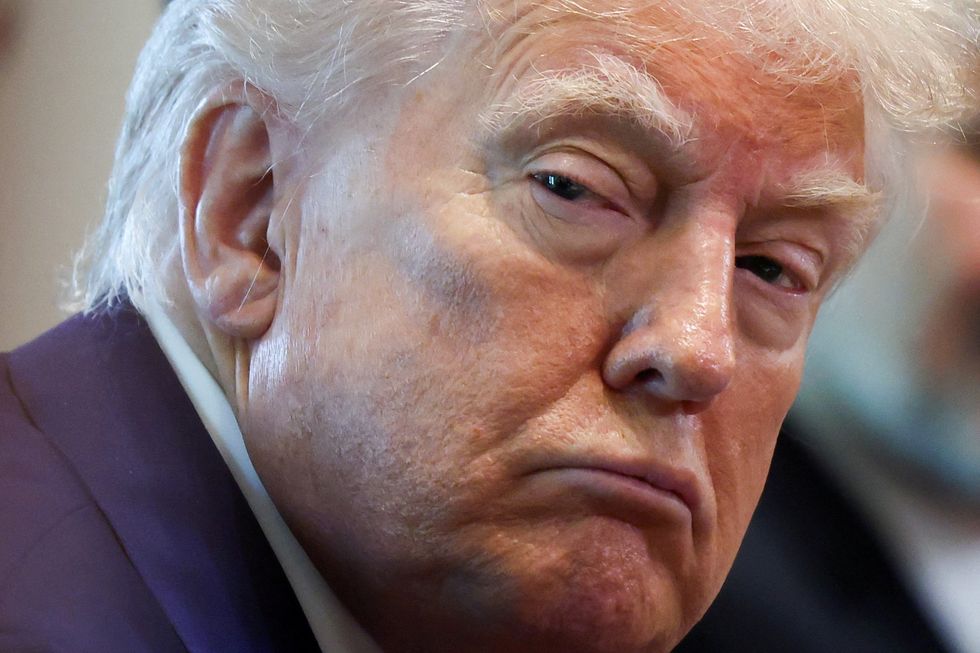
Trump goes on wild posting spree ahead of hospital visit: 'That's all I have to say'
Far Left
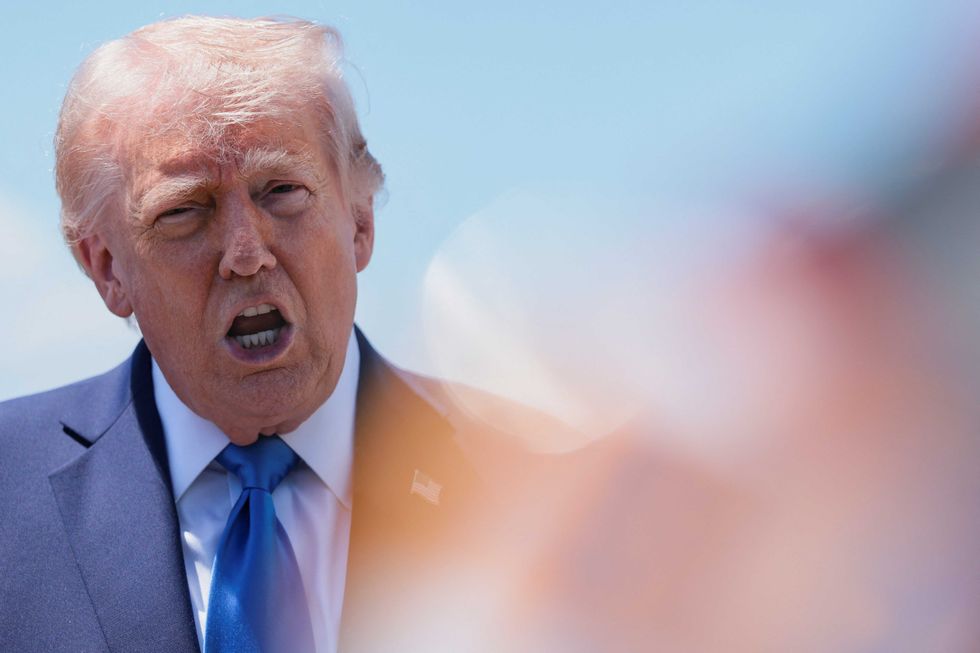
President Donald Trump unleashed a torrent of social media posts Tuesday morning before his scheduled trip to Walter Reed National Military Medical Center.The 79-year-old president made 19 posts between 5:52 a.m. and 7:29 a.m. on his Truth Social website, touching on a variety of topics and demonstrating that he spent the morning with an eye on Fox News."Great job on FoxNews by Alex Gray. Thanks Alex!!!" Trump posted at 6:07 a.m., in reference to segment that aired about an hour earlier with the former chief of staff for the National Security Council during his first presidency."Historian, and far beyond that, Victor Davis Hanson, is GREAT. That’s all I have to say. There is no further explanation needed. A fantastic man!" Trump posted at 7:26 a.m., although it's not clear what prompted his praise for the conservative commentator.The president started his early morning posting spree by sharing a post from the Women For Trump account criticizing former President Barack Obama's nuclear deal with Iran, which was characterized as "sent tons of cash to fund nukes – treason."He shared other posts praising his deal-making abilities and urging followers to trust him, while another said "stay with me deplorables, you'll love how this movie ends."Another post from a QAnon-coded supporter featured an AI-generated image of former President Joe Biden wearing pajamas and sleeping at the Resolute Desk as Obama and Hillary Clinton hover behind him, son Hunter Biden snorts cocaine from the desk and a woman partially out of frame signs a document.Trump linked to two reports from the right-wing Just the News conspiracy clearinghouse, and another post addressed concerns aired on social media Monday when he stopped and appeared to inspect White House pillars for nearly six minutes."The only president who knows how to fix the White House," stated the post, which showed a photo of him touching a column while surrounded by Secret Service agents.Trump's visit to the hospital – announced as a "routine annual dental and medical assessment" – will be his third in 13 months, and he has faced questions about his age, swollen ankles and bruised hands, as well as his repeated boasts about taking cognitive tests.
President Donald Trump's top economic adviser Kevin Hassett claimed that American consumers are "optimistic" in an interview with Fox News on Tuesday, prompting people to push back online.Hassett was responding to reports that skyrocketing gas prices amid the Iran war and the rising cost of living have sent consumer confidence plummeting. Earlier this month, he praised how credit card spending was "through the roof" for higher-priced gasoline."The thing that I've seen when I look at credit card data and other things that I can get for the private sector, is that while people have been spending more money at gas stations they've been spending more money on everything else, which means that they're very, very optimistic about the state of the economy — and they should be — if you look at GDP right now it's north of 4 percent," Hassett said. "And so despite this disruption, all the momentum that we've built with the Big Beautiful Bill and AI and everything else is really what the main economic story in the U.S. is."The internet didn't hold back from responding to Hassett's comments, with several political, economic and media experts weighing in."Americans are optimistically choosing between food and medicine," attorney and writer David R. Lurie wrote on Bluesky."Probably a top 5 entry in the Kevin Hassett hall of fame," reporter Jake Lahut, who covers the White House for New York Magazine, WIRED, Columbia Journalism Review and other outlets, wrote on Bluesky."When we stop beating you up, it's gonna feel GREAT," Village Voice writer Roy Edroso wrote on Bluesky."It is a day that ends in 'Y' so Hassett is out there lying on a national broadcast that consumers *love* the economy," Tahra Hoops, Director of Economic Analysis at tech industry trade group Chamber of Progress, wrote on X."Kevin is a firm believer in TALE: Trumpers Always Lie about Everything," Dean Baker, senior economist at the Center for Economic and Policy Research, wrote on X."Sometimes I wonder how these people sleep at night being such shameless creatures with no self respect. It’s truly remarkable stuff," content creator and political commentator Chris Mowrey, who has more than 83,000 followers, wrote on X.sometimes I wonder how these people sleep at night being such shameless creatures with no self respect. It’s truly remarkable stuff https://t.co/GsFq56k3pT— Chris Mowrey (@chrisdmowrey) May 26, 2026
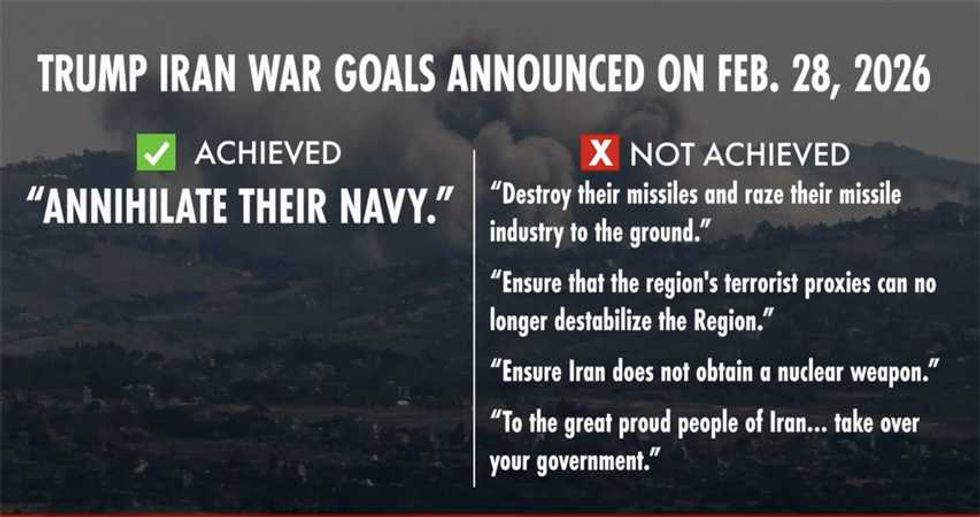
The number of goals Donald Trump set out on Feb. 28 when he launched the unprovoked attack on Iran was held up to the light by MS NOW’s David Rohde on Tuesday morning, who made clear the president's war so far has been a failure.Well beyond the Strait of Hormuz stalemate that has the Trump administration grasping for an answer, Rohde singled out five claims that the president made when he announced the attack, with only one coming to fruition -- and even that appears doubtful after this weekend's events.Speaking with “Morning Joe” co-host Jonathan Lemire, Rohde got right to the point as the producers displayed a graphic showing the administration coming up far short of its goals.“Remind us, please, about the goals that this administration first set out for this conflict and what has actually been achieved,” Lemire prompted his guest.“Look, I want to give credit to all the service members that are out there in particularly the day after Memorial Day, but this has been a disaster for this administration to have the Secretary of State [Marco Rubio], as we just saw him on his plane, trying to play down, almost trying to placate the Iranians and the American public about how this conflict has gone was extraordinary,” he began.“I looked up President Trump's speech on February 28th when he announced the war, so achieved: ‘annihilate their navy.‘ Maybe. I mean, I think that's generally true. But this morning, the New York Times has reported that there are hundreds of these speedboats and this — look, I believe the United States Navy, I don't believe the Iranians at all — if they're laying mines with one of these speedboats. That's why it was part of the attack yesterday; that's extraordinary. That shows how emboldened the Iranians are. So that's maybe achieved or partly achieved.”“And then everything else. 'Destroy their missiles,'” he continued. “The latest assessment is that 70% of Iran's missile capacity remains intact. They have knocked out some of the factories. But again, that is not an achievement. Overall, ensure the region's terrorist proxies no longer destabilize the region — That's not happening at all. That's not even part of these negotiations. And the missiles aren't either.”“Ensure that Iran does not obtain a nuclear weapon,” he continued. “That's not even part of the current negotiations that will come in this 60-day second round of talks. And then, most tragically, what he said to, as he said to ‘the great people of Iran, take over your government,’ and the regime remains in place.”“So it's astonishing to me that an American president is in this position,” he concluded. “And they just, you know, this administration … just continues to mismanage this war.” - YouTube youtu.be
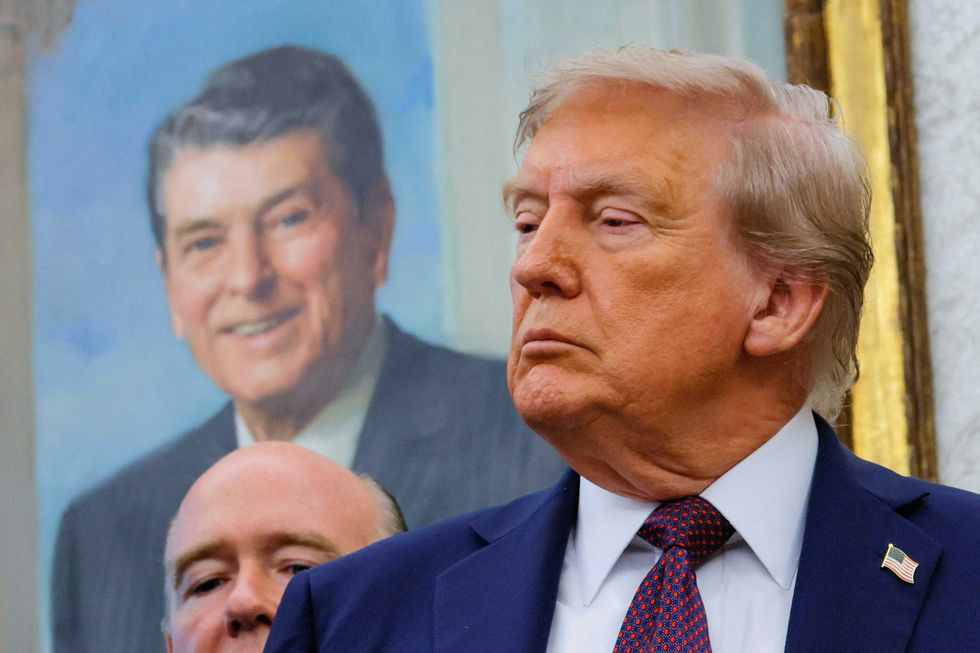
Despite an agreement to end the U.S. war against Iran appearing within reach on Saturday, the negotiations look poised to fail due to one critical “ability” President Donald Trump lacks, and one that former President Ronald Reagan demonstrated decisively during his first term in office, a political analyst and expert warned this week.Trump boasted on Saturday that a deal to end the war had “been largely negotiated," but within days, jeopardized his own negotiations by floating a last-minute demand to Middle East nations, as well as by authorizing new strikes targeting Iran on Monday.And yet, while Trump’s actions have been scrutinized for potentially compromising a path toward a negotiated settlement, Trita Parsi, co-founder of the Quincy Institute for Responsible Statecraft, warned on Monday that the president was not the “greatest threat” to achieving peace.“In recent days, it was not the Persian Gulf that emerged as the greatest threat to the agreement. It was Israel’s potential refusal to fully adhere to the regional ceasefire and halt its bombardment of Lebanon. That danger remains acute,” Parsi wrote in an analysis published on his Substack Monday.Iran has demanded that Israel halt its bombardment of southern Lebanon as a key condition in its negotiations with the Trump administration, a demand that Israel has largely ignored. On Friday, Israel launched what’s referred to as a “double tap” strike in southern Lebanon – following up an initial strike with a second to target emergency responders such as paramedics. More than 3,100 Lebanese have been killed by Israeli air strikes since early March and nearly 10,000 wounded, according to the Lebanese Health Ministry.To secure a peace deal, Trump could demand Israel’s compliance, much as he unsuccessfully tried to do in April when he explicitly demanded Israel halt its attacks on Lebanon. Israel strikes continued, however, with Parsi noting a similar scenario that occurred in 1982, though one that elicited a very different response by the U.S. president at the time.“Trump could still choose to put American interests first and compel Israel to comply, much as Ronald Reagan did in 1982 when he pressured Prime Minister Menachem Begin to halt Israel’s devastating assault on Lebanon,” Parsi wrote. “Reagan reportedly expressed outrage at the bombardment of Beirut, warning Begin that America’s support could not be taken for granted. Within hours, the bombing stopped. Trump, by contrast, has thus far shown little ability to ensure sustained Israeli compliance with his demands.”
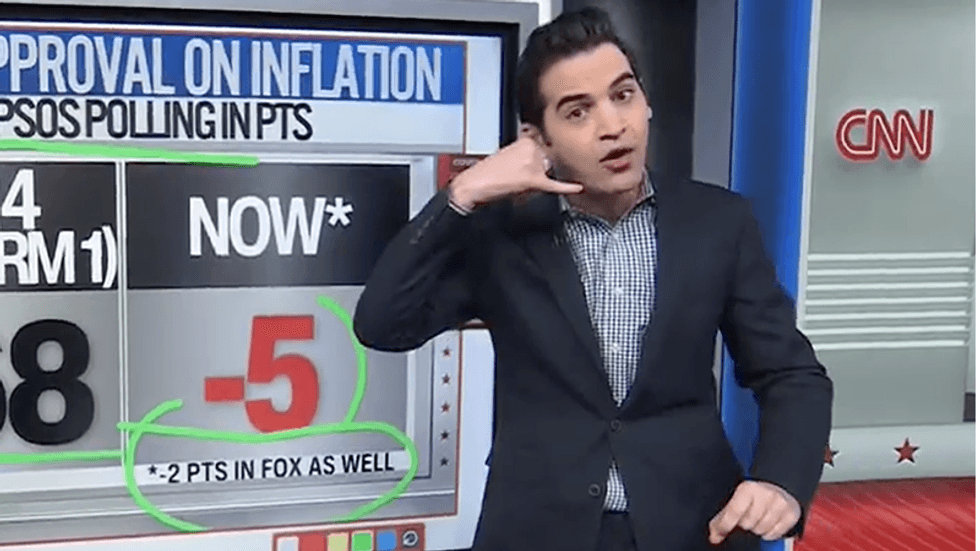
"The calls are coming from inside the house," CNN host John Berman said on Tuesday.CNN data analyst Harry Enten agreed."Why don't we talk about the key issue of inflation," Enten began. "And what are we talking about? We're talking about a complete collapse of the floor. Look at this. Republicans' net approval of Trump on inflation. You know, you go back when he was running for reelection back in 2024. For term number one, look at that net approval rating. It was plus 68 points in terms of how they viewed Republicans' views on inflation and Trump."Term number two is a different matter."Look at this! Collapse!" exclaimed Enten, citing the Ipsos poll. " ... There are now multiple polls showing that Donald John Trump is underwater within his own Republican Party."On gas prices, Enten said that Republicans are "calling again." The numbers last summer show a 51-point approval, while it has now shifted to minus four, a 55-point swing."This isn't just something about the center of the electorate. This is with Donald Trump's base as well. This is a huge shift. He's underwater again, the floor completely collapsing underneath," said Enten. "So, you know, we're talking about the collapsing floor, but, you know, if this is an old ruddy house that we don't really care about, then who really cares?" Enten said about the GOP's poor polls. "But this is the house that is most important because you take a look here. Okay, Republicans' top issue is the economy and the cost of living."In Jan. 2026, 43 percent of Republicans identified the cost of living as the most important issue. That is now 54 percent of Republicans who say it's important. "Multiple polls showing him underwater on inflation," Enten closed. "A very, very, creaky floor."
According to Fox News analyst Howard Kurtz, a change has come over congressional Republicans in recent days. Instead of rubberstamping President Donald Trump’s every demand and whim, a new dynamic has emerged. This time, and for the first time in his second term, “Trump did something beyond the pale and the brave Republicans are standing up to him.”“It's a revolt,” writes Kurtz. “Practically a revolution,” as Republicans are finally pushed to a point that “seems to be breaking, or at least loosening, Trump's iron grip on power.”Kurtz says that the key issue driving this change was “Trump's decision to use $1.8 billion largely for those convicted of crimes on Jan. 6,” which the Fox contributor argues was “the culmination of a five-year effort by the president to recast the protestors, who he had summoned to Washington and directed to march to the Capitol, as patriots, not lawbreakers. That is inconveniently contradicted by the relentless violence we all saw on our television screens as the riot unfolded. It was one of the darkest days in American history.”Many Republicans expressed disgust at what has been criticized as a “slush fund” immediately after it was announced, but according to Kurtz, things really “exploded” after Acting Attorney General Todd Blanche met with Senate Republicans. "My guess is there’re probably 45 senators in the room, at least half of them were blasting the attorney general… They were screaming at the acting attorney general," said Senator Ted Cruz (R-TX), calling it a "full-on revolt." And Senator Mitch McConnell (R-KY) put it like this: "So the nation’s top law enforcement official is asking for a slush fund to pay people who assault cops? Utterly stupid, morally wrong – Take your pick." Following the “fiery session” with Blanche, Republican leaders killed a vote that was scheduled the same day on one of their key priorities — funding immigration and border enforcement — rather than risk the possibility of having to vote on the slush fund, which would force them to give a public “yay” to the widely criticized idea or a “nay” to the president. At the same time, they also failed to approve $1 billion for Trump’s ballroom obsession. What’s more, for the first time, Republicans are broadly criticizing Trump’s plans regarding Iran. "Doesn’t make too much sense to me," said Senator Thom Tillis (R-NC). And said Senator Lindsey Graham (R-SC) — arguably the staunchest Iran war hawk in Congress — the current situation "makes one wonder why the war started to begin with." “Maybe the previously unthinkable idea of Republicans openly challenging Trump is catching on,” Kurtz concludes. “They're mad as hell, and they're not going to take it anymore.”
Minnesota led the country in farm bankruptcies during the first quarter of 2026, continuing last year’s steady nationwide climb that was particularly steep for Midwest farmers. Eight Minnesota farmers have already filed for bankruptcy this year, double the amount for the entire year of 2024.“I know a lot of farmers that are really struggling,” Bob Worth, who farms corn and soybeans in southwestern Minnesota, said in an interview.Worth, 74, was sitting in the driver’s seat of his planter, taking a brief pause from planting his 56th crop on his Lake Benton family farm.In over half a century of farming, Worth has seen a lot of ups and downs. Lately, it’s been much more down than up. With fertilizer and fuel costs on the rise as crop prices sink, the past few years have taken a toll on farmers.“It’s really this margin squeeze on an industry that already operates on extremely thin margins,” Samantha Ayoub, the agricultural economist who authored an American Farm Bureau Federation report on rising farm bankruptcies, said in an interview.Chapter 12 of the U.S. bankruptcy code was established after the 1980s farm crisis to help struggling family farmers reorganize their debts. Many filing for Chapter 12 continue to farm after filing for bankruptcy, though farm closures are also on the rise, according to the Farm Bureau report.Worth said that he knows plenty of farmers engaged in mediation steps that precede bankruptcy, and many who are just plain old quitting. “They just don’t want to lose any more money,” Worth said.When Worth first felt the pinch four years ago, he expected things to bounce back quickly and money to start flowing again. That never happened, he said, and now, reserves saved to get through tough times are running out.“It’s been a tough time for too long,” Worth said. Net farm income hit a low point in 2016, climbed to a peak in 2022 amidst pandemic-era federal relief, and is now again on the decline.Even on Worth’s long-established farm — free from the debts that younger producers often take on when starting out — Worth said his cash flow is in the negative. “That’s how serious this is,” he said. Young producers may be even worse off, both with less on the asset side of their balance sheet and without established relationships with lenders to get through tough times.The reality on the ground for farmers reminds Worth of what it was like during the 1980s farm crisis, when Minnesota’s total net farm income fell 58%, the number of farms in the state decreased by 13,592, and over 1,000 farmers facing foreclosure nationwide died by suicide. Having struggled with depression during that period, Worth knows firsthand that economic hardship can have a direct impact on farmers’ mental health.“Some really bad things are happening,” Worth said, citing suicides and domestic violence amongst farmers in his community.“It’s ugly,” Worth said. “But I survived.”Ayoub said many are drawing comparisons to the 1980s farm crisis from an economic perspective, but there are also key differences. For one, land prices are much better off for farmers now than they were in the 1980s. And farmers have tools now that didn’t exist in the 1980s, Worth said, like crop insurance programs implemented to protect farmers when they harvest a bad crop.For Worth, life experience is another factor that makes this moment feel different. “A lot of the farmers of my age have lived the 80s. We learned a lot in the 80s and what not to do.”Bob Worth and his son Jon Worth on their Lake Benton family farm, where they farm corn and beans. (Photo courtesy of Minnesota Soybean Growers Association)Bankruptcy filings are a lagging indicator, depicting the past few years — not months — of economic pressures on farmers. Worth looked back to inflation under the Biden administration as when input costs started to rise and squeeze margins, but cited policies under the Trump administration as making matters worse.“The trade war hasn’t helped a thing,” Worth said, referring in part to Trump’s tariffs on China, which have dampened demand for soybeans. According to the White House, China agreed during Trump’s recent visit with Chinese President Xi Jinping to buy $17 billion in U.S. agricultural products annually through 2028, still far below what it would purchase before the trade war.Kyle Jore, a Thief River Falls grain farmer, agricultural economist, and Secretary of the Minnesota Soybean Growers Association, said that while he has been able to find some new buyers, he is not selling at nearly the prices they were getting before the trade war.The war with Iran is adding insult to injury, pushing fertilizer to what Ayoub calls “near-record prices” in recent months and diesel fuel to $5 per gallon in parts of Minnesota.Jore, who like many farmers uses a diesel truck for towing, said he was filling up his tank recently when the pump turned off unexpectedly. The tank wasn’t full, but he had hit the price maximum.“We’re absolutely feeling it,” Jore said.