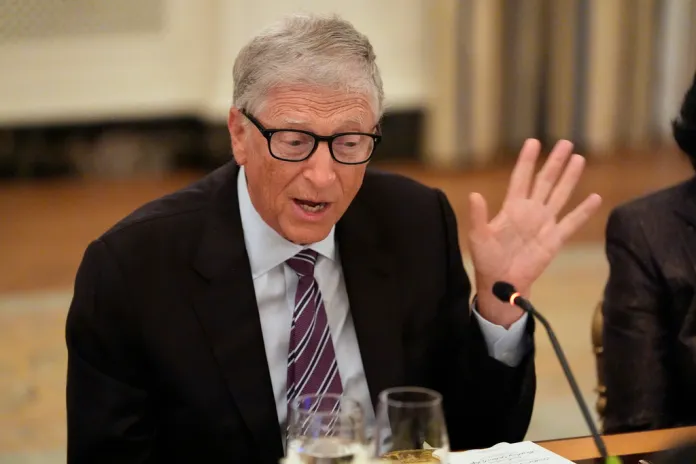
Bill Gates says Epstein wanted personal relationship, but he 'never reciprocated'
The Microsoft co-founder spent hours talking to lawmakers behind closed doors, where he also said Epstein used his marital infidelities to pressure him.

A damning New York Times report released on Wednesday raised new concerns about Acting Attorney General Todd Blanche and his involvement with the Epstein files.Blanche has come under fire over his role in "attempting to kill off the Epstein firestorm," just days after President Donald Trump formally nominated his former personal lawyer for permanent attorney general, The Daily Beast reported. Now, doubts were raised over whether he could be the top leader of the Justice Department ahead of his Senate confirmation hearing — and whether he could maintain his independence."Opponents argue he is not fit for the job, pointing to his handling of the Epstein files, which identified numerous victims but kept the names of potential co-conspirators hidden, as well as other controversies, such as Trump’s $1.8 billion 'anti-weaponization' slush fund and the backroom deal giving the president immunity from continuing IRS audits," The Beast reported.The bombshell reporting from Times reporters Maggie Haberman and Jonathan Swan is part of an upcoming book and includes multiple revelations about what happened within the Trump administration and includes Blanche's involvement as the then-deputy attorney general under former Attorney General Pam Bondi."Blanche and other Trump aides—including Vice President JD Vance, White House Chief of Staff Susie Wiles, Communications Director Steven Cheung and Press Secretary Karoline Leavitt—held a panicked meeting in the Situation Room in July last year, desperate to quell the MAGA civil war that had erupted over the administration’s failure to release the Epstein files," according to The Beast.In the meeting, Blanche reportedly offered two potential options."The first was to petition Federal District Courts in Florida and New York to unseal grand jury testimonies related to Jeffrey Epstein’s heinous sex trafficking crimes, as these were unlikely to contain any new information, and therefore, releasing them was unlikely to damage Trump," The Beast reported.Blanche likely knew that getting a federal judge to unseal grand jury material would be a tough move, The Beast reported."The second option was to have a Justice Department official interview Epstein’s accomplice, Ghislaine Maxwell, and release the transcript," according to The Beast.Blanche apparently volunteered to sit down with Maxwell. He has described her attorney, David Oscar Markus, as "a friend."
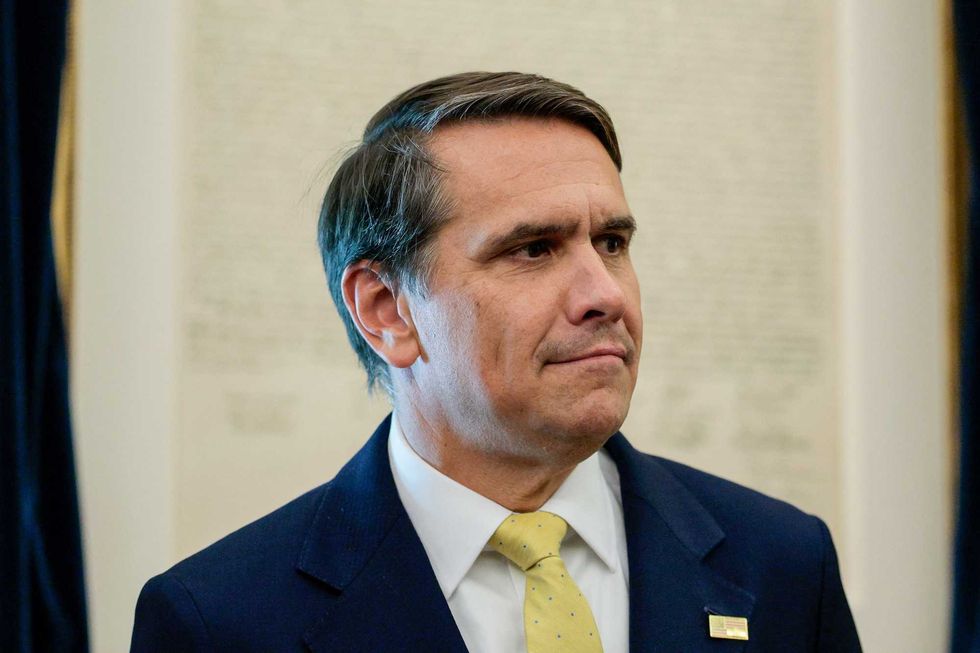
The Microsoft co-founder spent hours talking to lawmakers behind closed doors, where he also said Epstein used his marital infidelities to pressure him.
The Wall Street Journal is arguing that one detail matches its reporting about President Donald Trump's connection to Jeffrey Epstein.In a new legal filing, lawyers for Dow Jones, the company that owns the Wall Street Journal, argued that Trump "cannot" dispute that a signature appearing on a typewritten note and a sketch of a naked woman sent to Epstein resembles his own.Trump sued the Wall Street Journal over an article about a book of letters compiled for Epstein's 50th birthday in 2003. He alleged that the paper defamed him by noting that the letter and sketch bear his signature. Earlier this year, a court accepted the Journal's motion to dismiss because Trump couldn't prove actual malice in the article. Trump was able to revive a defamation claim, but Dow Jones's lawyers are again seeking to dismiss Trump's lawsuit in their new legal filing.The defense lawyers are telling the court to throw out Trump's lawsuit because "the article is true." After the Journal reviewed the letter and sketch with Trump's signature, Epstein's estate released the "Birthday Book" to the House Oversight Committee in September."The article is true because the description of the letter 'bearing Trump's name' in the article is an entirely accurate description of the letter as it appears in the Birthday Book," the filing read. "The article states that the Journal 'reviewed' the letter before publication and described its contents in detail (which exactly match the contents of the letter released by Congress)," the legal filing argued, adding that Trump doesn't even dispute the resemblance of his signature to the one in the birthday book "because he cannot."
Microsoft cofounder Bill Gates testified about his ties to Jeffrey Epstein in a closed-door House Oversight and Government Reform Committee hearing Wednesday, claiming that Epstein tried to use extramarital affairs to pressure him into maintaining their relationship. Rep. Robert Garcia (D-CA), the top Democrat on the oversight committee, told MS Now that as part of […]
Lawyer Alan Dershowitz on Wednesday said he wants “complete transparency” if he testifies before the House Oversight and Government Reform Committee as part of its probe into convicted sex offender Jeffrey Epstein. The committee’s chair, Rep. James Comer (R-Ky.), said earlier in the day that he would like to have Dershowitz and Acting Attorney General…
In April, the Supreme Court handed down a controversial decision which critics say “eviscerated” the Voting Rights Act. Now, according to new reporting from Vox, the impact of this decision is about to spread from the voting box to the workplace. Per Vox, “President Donald Trump’s Department of Justice released an opinion on Tuesday that, in the likely event it is embraced by a Republican-controlled federal judiciary, would make it significantly harder for plaintiffs who face employment discrimination to prevail in court.” It was notable that the opinion was signed by T. Elliot Gaiser, head of the Office of Legal Counsel and a former law clerk to Justice Samuel Alito, author of the Supreme Court’s recent decision in Louisiana v. Callais, which gutted a key provision of the Voting Rights Act. Essentially, Gaiser’s opinion argues that the same logic Alito used to attack voting rights can be applied to employment anti-discrimination law. According to Vox senior Supreme Court correspondent Ian Millhiser, “if you accept Alito’s opinion in Callais as legitimate, then Gaiser’s approach to employment discrimination is hardly a stretch. Indeed, it is the next logical move in the Republican Party’s broader campaign to weaken civil rights protections for racial minorities.”As Millhiser explains, “The 1982 law that Alito targeted in Callais provided that voting rights plaintiffs who challenged a state election law did not need to prove that state lawmakers acted with racist intent in order to prevail. Under that law, which was repealed by Callais, a state law that ‘results’ in voters having their right to vote diminished due to their race may also be challenged.” Now, because of the Supreme Court’s decision, voting districts can more or less be gerrymandered at will, even scrubbing Black districts entirely out of existence, because the language in Alito's opinion makes it nearly impossible to prove racist intent.Gaiser’s decision concerns a similar law regarding employment, and he’s making essentially the same argument raised by conservative justices: that a discrimination case can prevail only if racist or sexist intent is explicit. And given these similarities, says Millhiser, Gaiser’s claim “is likely to prevail before a Republican Supreme Court.”According to Millhiser, there are two upshots to this conclusion: “One is that it should be significantly harder for many employment discrimination plaintiffs to prevail. The other, which is potentially even more significant, is that elected officials should lose much of their power to remedy discrimination of all kinds, and the scope of civil rights law should be determined primarily by the Supreme Court.”As Millhiser explains, “both the Voting Rights Act’s results test and employment discrimination’s disparate impact test, after all, were enacted into law by Congress. But the Republican Party’s consistent position on civil rights laws is that democratically enacted civil rights laws must bow to the whims of Republican justices.”In essence, it is the position of conservatives on the court that “these difficult policy questions should be removed from the democratic process and given to a Republican judiciary.” Millhiser asserts that this should raise troubling questions as to “why six Republican lawyers in black robes have more insight into US civil rights policy than the people American voters elected to make these decisions.”
Rep. James Walkinshaw (D-Va.), a member of the House Oversight Committee, joins Meet the Press NOW to discuss what he heard from Microsoft co-founder Bill Gates during a congressional hearing over his relationship with sex offender Jeffrey Epstein.
Vice President JD Vance and President Donald Trump’s core team had deep disagreements over how to handle fallout from the Jeffrey Epstein case last year, according to a new book. Vance wanted “maximum transparency” regarding releasing a multitude of government files related to the deceased convicted sex offender when the case blew up in the […]