Stephen Miller in peril as uncovered FBI docs put his secret deeds in judge's crosshairs
Far Left
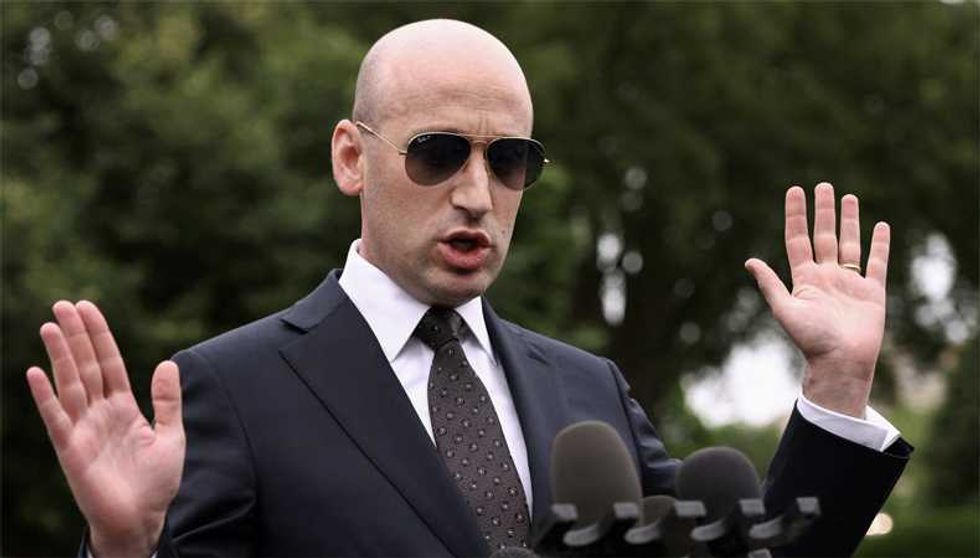
The secrets Stephen Miller has kept about his role in the Trump administration may finally be revealed after a judge was handed a key FBI report.Miller, President Donald Trump's deputy chief of staff, has long shielded his White House communications from disclosure under executive privilege. Now, a court filing in federal court in Alabama threatens to crack that wall open.The Southern Poverty Law Center — a civil rights organization the Trump administration indicted on fraud charges — obtained the FBI report through the normal discovery process. It shows the government's case against the SPLC appears to trace directly back to Miller.The report reads almost word-for-word like a letter conservative groups sent Miller complaining about the SPLC's "Hate Map," which tracks hate groups across America. Six passages match so closely they're sometimes identical.Miller's ire at the SPLC dates back to 2019, when the organization published a series of pieces on hundreds of emails Miller sent to Breitbart News showing he had promoted white nationalist websites and literature.After conservative activist Charlie Kirk was assassinated, Miller vowed to use "every resource" at the Justice Department and the Department of Homeland Security to "identify, disrupt, dismantle and destroy" liberal activist networks. Federal agencies then piled onto a local investigation of a retired activist who had posted flyers near his Arlington home. His communications about that were kept secret under executive privilege.National security journalist Marcy Wheeler wrote on Emptywheel that the government handed SPLC — represented by attorney Abbe Lowell — proof that "Stephen Miller's grievance about being exposed as an extremist somehow led a prosecutor to test a theory whether pointing that out is itself inherently fraudulent."The SPLC's lawyers are now asking the court to hand over all communications between Miller and the Justice Department about the organization.
A federal judge quashed an attempt by the Justice Department to subpoena Minnesota Gov. Tim Walz and other top officials in the state, alleging that it was an attempt to harass political rivals.
The latest in judicial activism found a Biden-appointed judge seemingly declaring the country “belongs to any random alien on planet earth” after blocking an executive order. “We […]
A U.S. District Judge ruled the Trump administration's use of grand jury subpoenas against Minnesota state and local officials was retaliatory and unlawful, finding no legitimate investigatory justification for them.
A federal judge on Monday blocked the Trump administration’s overhaul of an immigration verification system to check voter eligibility across the nation, striking down a central pillar of the government’s efforts to exercise more federal control over elections.This article was originally published by Votebeat, a nonprofit news organization covering local election administration and voting access.The judge cited Texas’ use of the Systematic Alien Verification for Entitlements, or SAVE, database, which flagged several voters who were actually citizens as noncitizens, as evidence that it threatened both privacy and voting rights less than five months before the November midterm election.“The federal government has knowingly trampled on the privacy rights of American citizens in a manner that threatens the sacred right to vote,” Judge Sparkle Sooknanan said in her 75-page ruling. “This Court cannot stand idly by while that happens.”Sooknanan’s decision does not eliminate SAVE, a decades-old immigration-status verification program. But it blocks the Trump administration’s 2025 overhaul of the system, which made it easier for states to check their voter rolls against the federal database, which includes individuals’ citizenship status and Social Security numbers. Election officials have found that the modified database, however, is prone to error, something Sooknanan referenced in her decision. Federal officials, she wrote, “haphazardly combined and repurposed the private information of millions of Americans, including citizenship data that they knew to be unreliable.”The ruling could strengthen challenges by voters who were removed, flagged, or placed under review by the system.“States have partnered with the federal government to access the database and are actively removing United States citizens from voter rolls based on inaccurate information,” the judge wrote.Voting rights groups, Trump administration react to rulingThe case was filed by the League of Women Voters and other groups who argued that the SAVE system was inaccurate and that using it to check voter rolls violated citizen privacy rights. “Today’s decision is a resounding victory for voters,” said Marcia Johnson, chief of activation and justice for the League of Women Voters. “Efforts to create a federal voter database to facilitate voter purges threaten the fundamental right at the heart of our democracy.” Justin Levitt, a professor at Loyola Law School who worked in the White House on democracy and voting rights issues under President Joe Biden, agreed that voters would benefit from the ruling.“This provides incremental reassurance that they won’t be inaccurately singled out and have to jump through even more hoops to vote,” he said. “It stops the use of a deeply flawed process to cause trouble for real eligible citizens.”However, James Percival, the general counsel at the Department of Homeland Security, which maintains the SAVE database, criticized the ruling as a misguided effort to block the Trump administration from trying to address voter fraud.“It’s amazing how hard the Left will fight to stop us from solving problems they insist do not exist,” Percival said in a statement. The Justice Department did not immediately respond to requests for comment. Michael Morley, a professor at the Florida State University College of Law and faculty director of the FSU Election Law Center, said the ruling prevents the federal government from using all the information at its disposal to ensure that only eligible voters take part in elections.“It seems to leave the government in a somewhat tenuous position of being able to provide citizenship data to states for voting purposes that is less accurate than it otherwise would be,” he said. “It restricts the government’s ability to take advantage of all of the most accurate sources of information it has in order, in most cases, to confirm people’s citizenship status.” Judge cites Texas’ use of SAVE database in rulingTexas intervened as a defendant in the case since it had been actively using SAVE to verify the citizenship status of its more than 18 million registered voters. The state gained access to the database in March 2025 after signing a memorandum of agreement with the Department of Homeland Security. In October, the Texas Secretary of State’s Office announced SAVE had flagged 2,724 people as “potential noncitizens” and sent the list to county election officials to investigate. That process involved mailing letters to each person flagged, requesting additional information to verify their citizenship. If county officials received no response after 30 days, the person’s registration was canceled. Some voters who responded to the notices turned out to be U.S. citizens after all; others had their registrations canceled, although a specific number hasn’t been released.
The U.S. has temporarily lifted oil sanctions on Iran as peace talks continue. And, a federal judge ruled that the Trump administration's data system, known as SAVE, is unlawful.
A total of seven domestic terrorists are now charged in conspiracy to commit murder at the historic freedom celebration on the South Lawn.
The post FBI Makes Two More ARRESTS in Plot to Turn Trump’s White House UFC Event Into a Mass-Casualty Attack appeared first on The Gateway Pundit.