Four Presidents, One Bicentennial
How Richard Nixon, Gerald Ford, Jimmy Carter, and Ronald Reagan intersected with the nation’s 200th birthday in 1976

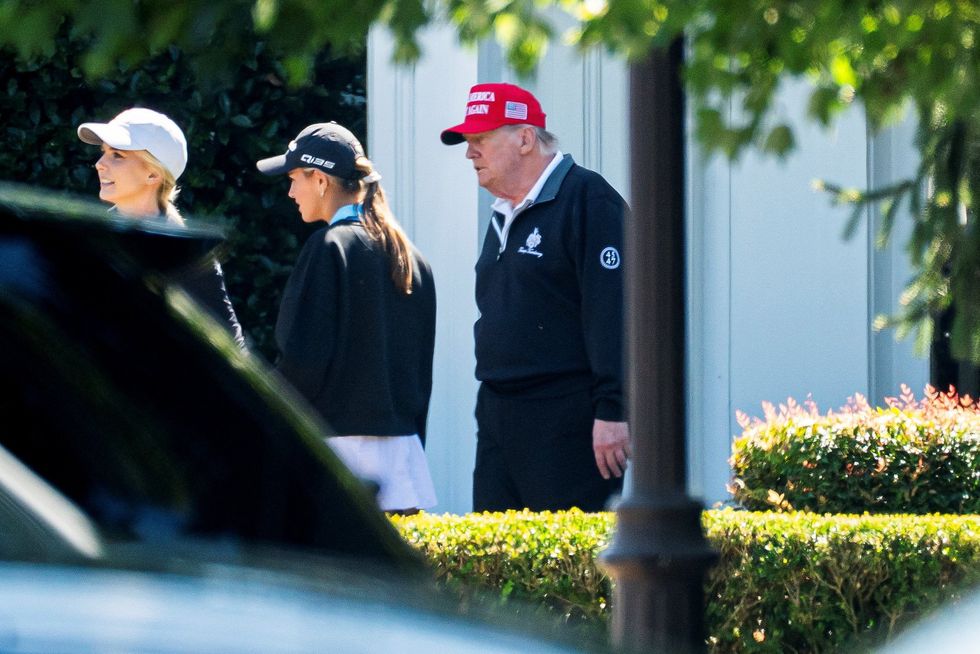
President Donald Trump spent more than an hour and a half on a rainy Sunday morning inspecting renovation plans for a federal golf course in Washington, D.C. — a side project that drew mockery online, particularly given that it came just days after he blocked a housing relief bill.The outing was documented in real time by White House pool reporters and amplified by critics who saw the priorities on display as telling.Pool reporter Gerren Keith Gaynor reported that Trump was spotted getting out of his motorcade Sunday morning to visit East Potomac Golf Links, where he reviewed blueprints of likely renovations alongside Interior Secretary Doug Burgum. CNN's Liz Landers, also in the pool, reported that the president drove into East Potomac Park in the rain and eventually got out to look along the Washington Channel, ultimately spending more than 90 minutes on site and at one point standing on the golf course itself with aides and Burgum.C-SPAN's Howard Mortman noted that Trump and Burgum were presented with blueprints labeled "East Potomac Golf Links," and that the president "at times pointed toward the press." Pool reports later noted the presence of golf course designer Tom Fazio, who is working on the president's project.The progressive account PatriotTakes drew the contrast that animated much of the online reaction, noting that Trump was "inspecting federal golf course renovations today after blocking a housing relief bill just a few days ago."Columnist Sophia A. Nelson questioned why the president was personally involved in such projects at all."What is up with all of these renovations and projects? Presidents do not do this," Nelson wrote.The golf course stop was not the only construction-related errand of the morning. Gaynor reported that after surveying the course, Trump's motorcade took a route by the Lincoln Memorial and across the Arlington Memorial Bridge, presumably to view where his planned arch is to be built in the capital.Politico's Dan Diamond added more detail on the president's growing list of personal beautification projects, reporting that a White House official said Trump had also walked through Lafayette Park to "personally check on the restoration progress." Diamond had earlier reported on what he described as a new Trump "side project" — wanting Lafayette Square to feature exactly 47 trees to match his standing as the 47th president.The account Bad Fox Graphics took a sharper swing, casting the Burgum huddle as the two men "plotting" to remake Washington with "more Trump-themed construction," including a permanent perimeter fence around Lafayette Square "to keep the riff-raff out."The cumulative picture — a president devoting a rainy Sunday to golf course blueprints, tree counts, and arch sites while a housing relief measure lay dead at his own hand — proved irresistible to critics, who framed it as a vivid snapshot of where the president's attention lies.Trump is inspecting federal golf course renovations today after blocking a housing relief bill just a few days ago https://t.co/ODWVgehvlm— PatriotTakes 🇺🇸 (@patriottakes) June 28, 2026
How Richard Nixon, Gerald Ford, Jimmy Carter, and Ronald Reagan intersected with the nation’s 200th birthday in 1976
President Donald Trump says he is nominating Lance Schroyer as the next director of Immigration and Customs Enforcement.
The Supreme Court's final week of the term is shaping up to be a blockbuster, with several remaining cases carrying major implications regarding the scope of President Trump's power. The big picture: Three of the eight cases awaiting ruling hinge on what Trump — and future presidents — can or can't do in office, including determining who gets to be an American and what checks there are for a president's ability to fire federal officials. Trump is no stranger to pushing the limits as commander in chief, and told "The Axios Show" last week that there are "no limits" to his power in office since going to war with Iran. But federal courts have demarcated the limits to what a president can do, often to Trump's ire. Driving the news: Perhaps the biggest decision remaining before the court is Trump's attempt to end birthright citizenship.Immigration advocacy groups and constitutional scholars tell Axios that the Constitution's 14th Amendment and subsequent legal precedent clearly protect the right to citizenship for children born in the U.S.But if the court were to gut those protections, there would be "mass chaos at every hospital in the United States," warns Todd Schulte, the president of immigration and criminal justice advocacy group FWD.us."A patchwork level of citizenship loss and stateless children being born across the United States would fundamentally alter the day-to-day lives of tens of millions of Americans," he adds.At oral arguments earlier this year, key justices appeared skeptical of the government's case, but no one knows how they will ultimately rule.Meanwhile, the court is also weighing whether the central bank and independent agency commissioners are insulated from the president's political whims to say, "You're Fired!""Trump has attempted to exercise an extremely aggressive and expansive view of presidential authority, under which he can ignore or rewrite laws that Congress has passed and even rewrite the Constitution itself," says Thomas Wolf, the director of democracy initiatives at the Brennan Center.The court appeared skeptical of Trump's ability to boot Cook, whose attorneys argued siding with the president would undermine the Fed's independence.But the court seemed more open to Trump firing FTC members, which would be a blow to a 90-year-old precedent guarding independent agency commissioners from political firings.The stakes of the Supreme Court's other upcoming decisions are also immensely high. Here's what else is on the justices' plate:Election lawThe Supreme Court must weigh in on a dispute over a Mississippi law allowing election officials to count mail-in ballots received up to five days after Election Day.Striking down Mississippi's law could have implications for other states that have similar grace periods.Also outstanding is a decision on a Republican challenge to limits on how much money political parties can spend in coordination with candidates.The Supreme Court upheld coordinated party expenditure limits in 2001.Trans athletesThe court has outstanding cases over transgender athlete bans in Idaho and West Virginia, and the conservative justices seemed poised to uphold the bans.The court's decision could enshrine that Title IX does not mean transgender athletes can compete in sports aligning with their gender identity.Geofencing and the Fourth AmendmentThe justices were also posed with a question over whether a geofence warrant that led to a robbery conviction violated the Fourth Amendment, which protects people from unreasonable searches or seizures.Per Brookings, the court does not seem poised to categorically reject or uphold the constitutionality of such warrants.Go deeper: Supreme Court backs Trump on stricter asylum rules
President Donald Trump's unveiling of a redesigned U.S. passport — complete with a "welcome" message and an image of himself — drew ridicule this week, with critics arguing the greeting makes no sense on a document meant for Americans traveling abroad.Trump had posted an image of what he called the new commemorative passport, marking the country's 250th anniversary, writing: "The U.S.A.'s New Passport, which says, 'Welcome, but be good!' President DJT." The design featured a photo of the president alongside patriotic imagery.The anti-Trump conservative outlet The Bulwark seized on the "welcome" framing in a segment by host Tim Miller, who questioned whether the president grasped the basic purpose of the document.In the video, Miller noted that Trump had updated the passport with the message "Welcome, but be good," then raised the obvious problem."This raises the question, does Donald Trump know what a passport is for? Welcome to who? The US passport is for Americans. We use it to go other places," Miller said.He framed the confusion as cause for concern about the president's faculties, in a line The Bulwark highlighted: "It's pretty concerning that the President of the United States either is so stupid that he doesn't know what a passport is or that his mentals are declining at such a rate that he's forgotten."Miller went on to mock the image of the president on the document, describing "a glowering president reminding Americans welcome in your own house, in your own country" — before working in a reference to Trump's legal history with the aside, "I've been indicted several times."He closed with a note of resignation: "This is it, I guess. This is real life."Conservative commentator and Bulwark contributor Bill Kristol also amplified the segment, calling Miller's take "very good" and adding his own variation on the critique."Trump clearly doesn't understand that a passport is for Americans, since the message he's delivering is suitable for a visa for foreigners," Kristol wrote.
House Speaker Mike Johnson (R-La.) on Sunday said he will send the bipartisan housing bill passed overwhelmingly by both chambers of Congress to President Trump on Monday. Trump last week said he would not sign the bill, despite the support from both parties, unless the Senate first takes action on elections legislation that is opposed…
Democratic Rep. Suhas Subramanyam (Va.) on Sunday criticized President Trump for canceling the signing of a bipartisan housing bill. “I don’t know with this president, because he’s said that he doesn’t care about rising costs,” Subramanyam told host Chris Stirewalt on NewsNation’s “The Hill Sunday,” regarding whether he expects Trump to sign the bill this…
Trump canceled the signing of the 21st Century Road to Housing Act on Wednesday, despite the legislation gaining passage through both chambers of Congress via overwhelming, veto-proof majorities.
President Donald Trump's late-night tirade against journalist Maggie Haberman over her new book backfired in real time this week, as critics — including a fellow conservative — seized on the attack to mock the president and, in at least one case, boost sales of the very book he was trashing.Trump had unloaded on Haberman in an all-caps Truth Social post, dismissing the book as "mostly made up" and deriding the New York Times reporter as a "third rate writer," while repeatedly mangling her name as "Magot Hagerman."CNN anchor Jake Tapper responded by flipping the attack into free promotion for the book, "Regime Change," co-authored by Haberman and Jonathan Swan."Disagree, Mr. President!" Tapper wrote. "REGIME CHANGE by @maggieNYT and @jonathanvswan is a great and fascinating read. Maggie is a great writer and intellect and was right about you and the elections, and much more!" He then added a link so readers could buy the book.Some of the sharpest commentary came from the right. Matthew RJ Brodsky, a conservative foreign policy analyst, pointed out the obvious flaw in Trump's claim that Haberman was irrelevant."Trump literally calls her all the time," Brodsky wrote. "Another self-own."Writer Brent Snyder delivered an extended takedown, opening with a dig at the president's eating habits."Oh, Donny Two-Scoops, bless your fragile little heart," Snyder wrote, before characterizing the post as "another all-caps meltdown over a book you clearly couldn't put down fast enough to 'brief' on it."Snyder went on to skewer Trump's central accusation, arguing the "mostly made up" charge was rich "coming from the guy who turned 'alternative facts' into a business model." He defended Haberman as a chronicler of Trump's "lies, the chaos, the ego-fueled disasters," and needled the president over his repeated misspelling of her name: "At least spell her name right while having a meltdown, champ."He also took aim at Trump's election boasts, writing that the president "lost in 2020. Spectacularly," and was now "crowing about 2024 like a toddler who finally won a participation trophy after throwing tantrums for four years." On Trump's insistence that no incriminating audio tapes exist, Snyder wrote that the denial came "from the man whose own recordings have sunk him before."Others kept it brief. The account David Gallant, @GallantDG, summed up the likely commercial effect of the president's outburst in three words: "Another best seller."The collective response underscored a familiar dynamic: Trump's attempts to bury a critical book often serve only to amplify it, handing the author a wave of publicity that money can't buy — and, as Tapper demonstrated, a direct sales link to go with it.