Dems delete Memorial Day post using US service members’ deaths to criticize Trump: ‘Disgusting’
"Never forget Democrats used fallen soldiers to score political points and for clicks. The most disgusting thing I have ever witnessed!"

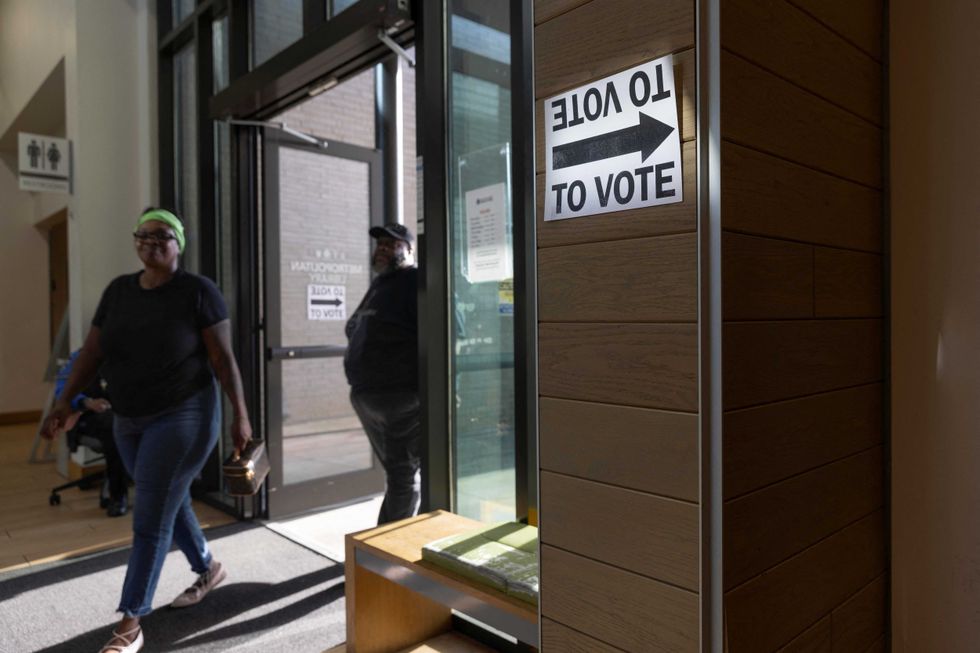
Last week’s primary election didn’t feature any races with both a Democrat and a Republican on the ballot, but Georgia Democrats still feel like they won.If you are one of the more than 2 million Georgians who cast a ballot, you will likely recall the poll worker asking you to choose a Democratic, Republican or nonpartisan ballot.In all, Democrats pulled more than 1 million ballots to Republicans’ nearly 940,000, or about 52.6% to 45.4%.Charlie Bailey, celebrates May 3, 2025, after being elected as chairman of the Democratic Party of Georgia, replacing Atlanta U.S. Rep. Nikema Williams. Stanley Dunlap/Georgia RecorderDemocratic Party of Georgia Chairman Charlie Bailey said that margin is the biggest for Democrats since 1998 and shows that voters are ready to line up in November behind candidates like U.S. Sen. Jon Ossoff and former Atlanta Mayor Keisha Lance Bottoms, the Democratic nominees for U.S. Senate and Georgia governor.“It’s just another piece of evidence of growing Democratic momentum, the work of the party, the strength of Jon Ossoff, the strength of Keisha Lance Bottoms coming into this governor’s race,” he said. “People are fed up with (Republicans), and what those numbers in the primary tell you is that that momentum is building towards November, when they’re going to vote these Republicans out.”In 2018, a midterm year with President Donald Trump in the White House and an open race for Georgia governor at the top of the ticket, Republicans pulled more ballots than Democrats by about 52% to 48%.Comparing the number of ballots drawn is not a perfect measure. Some people choose the other party’s ballot because they live in an area dominated by that party and they want to have a say in local races, or because they want to promote a weaker opponent for their candidate in the general election.Sen. Jon Ossoff. Ross Williams/Georgia RecorderStill, the discrepancy spells good news for Democrats looking ahead to the Nov. 3 election, says Emory University political science professor Andra Gillespie.“What it connotes or implies is that Democratic candidates are capturing the imagination of voters in ways that, if this energy can be sustained, could be helpful for them in terms of flipping seats nationally, and in Republican states like Georgia, narrowing those margins between Democrats and Republicans, even in contests where Republicans are the odds-on favorite,” she said.Congressman Mike Collins and former coach Derek Dooley at their election night parties. Ross Williams/Georgia Recorder and Alander Rocha/Georgia RecorderThe difference in ballots is even more notable because Republicans had more high-profile races, said University of Georgia political science professor Trey Hood. No Democrat challenged incumbent U.S. Sen. Jon Ossoff, while Republicans had competitive races for U.S. Senate and Georgia governor at the top of the ticket.Hood said it’s also notable that Republicans who voted on Election Day did not outnumber Democrats by a large margin. Republicans only had about 4,000 more voters on Election Day than Democrats, about 508,000 to 504,000. Hood said that might signal a shift in GOP voter behavior, with more conservatives preferring to cast a ballot during Georgia’s three weeks of early voting.“I don’t know that we can expect to necessarily see a huge surge in Republican turnout on Election Day anymore,” he said.Voter demographics strong for DemocratsFormer Atlanta mayor Keisha Lance Bottoms gives a speech after winning the Democratic primary for governor outright. Jeff Amy/Georgia RecorderResults also show demographics that tend to favor Democratic candidates in Georgia had a strong showing.Statistically, Black voters in Georgia largely favor Democrats, and they made up nearly 32% of the vote.“If Black turnout was 31% in a general election, yeah, that would be probably a good Democratic year,” Hood said. “I mean, before now, the highest it’s ever been is about 29%. And the more Black turnout as a percentage of the total electorate, the less of the white share of the vote you have to draw off as a Democrat. So if that pattern held and Black turnout was 31% in the general, it would be big.”Rick Jackson and Burt Jones will face each other head to head in a June runoff. Photo credit: Ross Williams and Alander Rocha for the Georgia RecorderData from the secretary of state’s office also shows that the electorate was nearly 57% female and 43% male. That number is likely boosted by high turnout among Black women, who are registered to vote at a higher rate than Black men.Reality check?Still, the high Democratic turnout was not enough to land a pair of Democratic-aligned candidates on the state Supreme Court, and not everyone thinks the numbers show the wind is at Democrats’ back.Georgia Republican Party Chairman Josh McKoon said turnout in primary elections does not correlate with general election turnout.McKoon said he chalks up the ballot discrepancy to the typical midterm backlash to the party in...
"Never forget Democrats used fallen soldiers to score political points and for clicks. The most disgusting thing I have ever witnessed!"
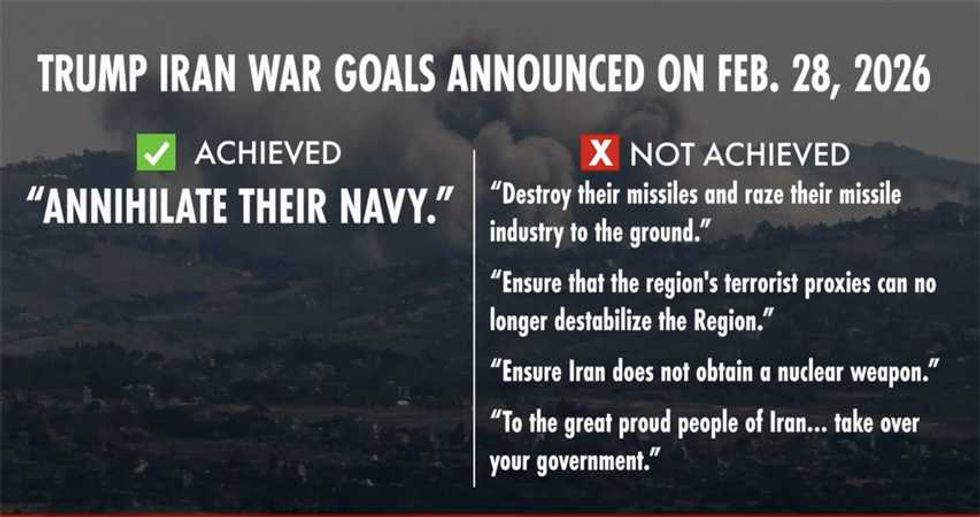
The number of goals Donald Trump set out on Feb. 28 when he launched the unprovoked attack on Iran was held up to the light by MS NOW’s David Rohde on Tuesday morning, who made clear the president's war so far has been a failure.Well beyond the Strait of Hormuz stalemate that has the Trump administration grasping for an answer, Rohde singled out five claims that the president made when he announced the attack, with only one coming to fruition -- and even that appears doubtful after this weekend's events.Speaking with “Morning Joe” co-host Jonathan Lemire, Rohde got right to the point as the producers displayed a graphic showing the administration coming up far short of its goals.“Remind us, please, about the goals that this administration first set out for this conflict and what has actually been achieved,” Lemire prompted his guest.“Look, I want to give credit to all the service members that are out there in particularly the day after Memorial Day, but this has been a disaster for this administration to have the Secretary of State [Marco Rubio], as we just saw him on his plane, trying to play down, almost trying to placate the Iranians and the American public about how this conflict has gone was extraordinary,” he began.“I looked up President Trump's speech on February 28th when he announced the war, so achieved: ‘annihilate their navy.‘ Maybe. I mean, I think that's generally true. But this morning, the New York Times has reported that there are hundreds of these speedboats and this — look, I believe the United States Navy, I don't believe the Iranians at all — if they're laying mines with one of these speedboats. That's why it was part of the attack yesterday; that's extraordinary. That shows how emboldened the Iranians are. So that's maybe achieved or partly achieved.”“And then everything else. 'Destroy their missiles,'” he continued. “The latest assessment is that 70% of Iran's missile capacity remains intact. They have knocked out some of the factories. But again, that is not an achievement. Overall, ensure the region's terrorist proxies no longer destabilize the region — That's not happening at all. That's not even part of these negotiations. And the missiles aren't either.”“Ensure that Iran does not obtain a nuclear weapon,” he continued. “That's not even part of the current negotiations that will come in this 60-day second round of talks. And then, most tragically, what he said to, as he said to ‘the great people of Iran, take over your government,’ and the regime remains in place.”“So it's astonishing to me that an American president is in this position,” he concluded. “And they just, you know, this administration … just continues to mismanage this war.” - YouTube youtu.be
According to Fox News analyst Howard Kurtz, a change has come over congressional Republicans in recent days. Instead of rubberstamping President Donald Trump’s every demand and whim, a new dynamic has emerged. This time, and for the first time in his second term, “Trump did something beyond the pale and the brave Republicans are standing up to him.”“It's a revolt,” writes Kurtz. “Practically a revolution,” as Republicans are finally pushed to a point that “seems to be breaking, or at least loosening, Trump's iron grip on power.”Kurtz says that the key issue driving this change was “Trump's decision to use $1.8 billion largely for those convicted of crimes on Jan. 6,” which the Fox contributor argues was “the culmination of a five-year effort by the president to recast the protestors, who he had summoned to Washington and directed to march to the Capitol, as patriots, not lawbreakers. That is inconveniently contradicted by the relentless violence we all saw on our television screens as the riot unfolded. It was one of the darkest days in American history.”Many Republicans expressed disgust at what has been criticized as a “slush fund” immediately after it was announced, but according to Kurtz, things really “exploded” after Acting Attorney General Todd Blanche met with Senate Republicans. "My guess is there’re probably 45 senators in the room, at least half of them were blasting the attorney general… They were screaming at the acting attorney general," said Senator Ted Cruz (R-TX), calling it a "full-on revolt." And Senator Mitch McConnell (R-KY) put it like this: "So the nation’s top law enforcement official is asking for a slush fund to pay people who assault cops? Utterly stupid, morally wrong – Take your pick." Following the “fiery session” with Blanche, Republican leaders killed a vote that was scheduled the same day on one of their key priorities — funding immigration and border enforcement — rather than risk the possibility of having to vote on the slush fund, which would force them to give a public “yay” to the widely criticized idea or a “nay” to the president. At the same time, they also failed to approve $1 billion for Trump’s ballroom obsession. What’s more, for the first time, Republicans are broadly criticizing Trump’s plans regarding Iran. "Doesn’t make too much sense to me," said Senator Thom Tillis (R-NC). And said Senator Lindsey Graham (R-SC) — arguably the staunchest Iran war hawk in Congress — the current situation "makes one wonder why the war started to begin with." “Maybe the previously unthinkable idea of Republicans openly challenging Trump is catching on,” Kurtz concludes. “They're mad as hell, and they're not going to take it anymore.”
Minnesota led the country in farm bankruptcies during the first quarter of 2026, continuing last year’s steady nationwide climb that was particularly steep for Midwest farmers. Eight Minnesota farmers have already filed for bankruptcy this year, double the amount for the entire year of 2024.“I know a lot of farmers that are really struggling,” Bob Worth, who farms corn and soybeans in southwestern Minnesota, said in an interview.Worth, 74, was sitting in the driver’s seat of his planter, taking a brief pause from planting his 56th crop on his Lake Benton family farm.In over half a century of farming, Worth has seen a lot of ups and downs. Lately, it’s been much more down than up. With fertilizer and fuel costs on the rise as crop prices sink, the past few years have taken a toll on farmers.“It’s really this margin squeeze on an industry that already operates on extremely thin margins,” Samantha Ayoub, the agricultural economist who authored an American Farm Bureau Federation report on rising farm bankruptcies, said in an interview.Chapter 12 of the U.S. bankruptcy code was established after the 1980s farm crisis to help struggling family farmers reorganize their debts. Many filing for Chapter 12 continue to farm after filing for bankruptcy, though farm closures are also on the rise, according to the Farm Bureau report.Worth said that he knows plenty of farmers engaged in mediation steps that precede bankruptcy, and many who are just plain old quitting. “They just don’t want to lose any more money,” Worth said.When Worth first felt the pinch four years ago, he expected things to bounce back quickly and money to start flowing again. That never happened, he said, and now, reserves saved to get through tough times are running out.“It’s been a tough time for too long,” Worth said. Net farm income hit a low point in 2016, climbed to a peak in 2022 amidst pandemic-era federal relief, and is now again on the decline.Even on Worth’s long-established farm — free from the debts that younger producers often take on when starting out — Worth said his cash flow is in the negative. “That’s how serious this is,” he said. Young producers may be even worse off, both with less on the asset side of their balance sheet and without established relationships with lenders to get through tough times.The reality on the ground for farmers reminds Worth of what it was like during the 1980s farm crisis, when Minnesota’s total net farm income fell 58%, the number of farms in the state decreased by 13,592, and over 1,000 farmers facing foreclosure nationwide died by suicide. Having struggled with depression during that period, Worth knows firsthand that economic hardship can have a direct impact on farmers’ mental health.“Some really bad things are happening,” Worth said, citing suicides and domestic violence amongst farmers in his community.“It’s ugly,” Worth said. “But I survived.”Ayoub said many are drawing comparisons to the 1980s farm crisis from an economic perspective, but there are also key differences. For one, land prices are much better off for farmers now than they were in the 1980s. And farmers have tools now that didn’t exist in the 1980s, Worth said, like crop insurance programs implemented to protect farmers when they harvest a bad crop.For Worth, life experience is another factor that makes this moment feel different. “A lot of the farmers of my age have lived the 80s. We learned a lot in the 80s and what not to do.”Bob Worth and his son Jon Worth on their Lake Benton family farm, where they farm corn and beans. (Photo courtesy of Minnesota Soybean Growers Association)Bankruptcy filings are a lagging indicator, depicting the past few years — not months — of economic pressures on farmers. Worth looked back to inflation under the Biden administration as when input costs started to rise and squeeze margins, but cited policies under the Trump administration as making matters worse.“The trade war hasn’t helped a thing,” Worth said, referring in part to Trump’s tariffs on China, which have dampened demand for soybeans. According to the White House, China agreed during Trump’s recent visit with Chinese President Xi Jinping to buy $17 billion in U.S. agricultural products annually through 2028, still far below what it would purchase before the trade war.Kyle Jore, a Thief River Falls grain farmer, agricultural economist, and Secretary of the Minnesota Soybean Growers Association, said that while he has been able to find some new buyers, he is not selling at nearly the prices they were getting before the trade war.The war with Iran is adding insult to injury, pushing fertilizer to what Ayoub calls “near-record prices” in recent months and diesel fuel to $5 per gallon in parts of Minnesota.Jore, who like many farmers uses a diesel truck for towing, said he was filling up his tank recently when the pump turned off unexpectedly. The tank wasn’t full, but he had hit the price maximum.“We’re absolutely feeling it,” Jore said.
Is President Trump’s grip on the party faltering? Tuesday’s Texas GOP primary race, particularly the contest between incumbent Sen. John Cornyn and state Attorney General Ken Paxton, will be a test. What comes next after the controversial autopsy on the Democratic Party’s 2024 losses? Join The Hill’s Amie Parnes and Editor in Chief Ian Swanson…
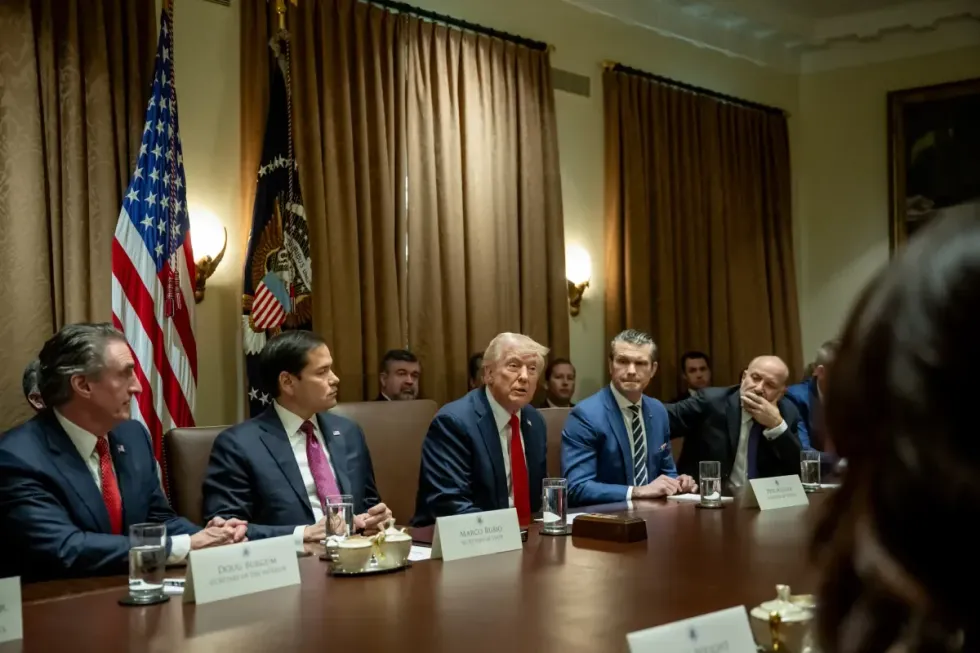
President Donald Trump's Cabinet meetings have become somewhat infamous for the various secretaries sucking up to him in any way they can think of, but now, an exhaustive analysis of video footage by the New York Times has confirmed the biggest kiss-up of the group.In a new report this week, the Times broke down trends apparent across all of Trump's second-term Cabinet meetings. Based on roughly 12 hours of examined footage, the outlet explained, flattery and exaggeration were the name of the game.“On average, at least one of every six sentences either flattered Mr. Trump, gave him credit or criticized his political opponents,” the report detailed. “Many of these statements are exaggerated or not factually accurate.”Amid that overall trend, one name rose to the top as the most eager to please the president: Secretary of State Marco Rubio. According to the report's findings, Rubio "flattered the president the most" out of the entire Cabinet, though this may be more to do with the fact that he also spoke the most across all of the meetings.“There’s only one leader in the world that’s capable of bringing the two sides to a table, and that’s our president, the president of the United States, President Trump,” Rubio said in one meeting, as highlighted by the Times' report. “The only chance we have for peace is through the president’s leadership.”Rubio at one point also called Trump the "only leader in the world that can help end" the Israel-Hamas conflict and the Sudanese civil war. Trailing Rubio in the Times' ranking were Treasury Secretary Scott Bessent, who once hailed Trump as having, "saved this country by making it the best place in the world to do business again," and Defense Secretary Pete Hegseth, who said that "no other president would have been willing to empower those warriors that way to be that effective," in the wake of the Venezuela operation earlier this year.As the Daily Beast noted about the situation in its own report, "The fact that Rubio has emerged as one of the most successful members of Trump’s Cabinet may not be a coincidence.""Rubio has now presided over a sweeping reorganization of foreign policy and dismantled the U.S. Agency for International Development, while helping steer Trump’s lightning invasion of Venezuela and war with Iran," the Daily Beast explained. "He’s also become the only official since Henry Kissinger to hold the post of secretary of state and national security adviser. Trump has even joked he might make Rubio, who is of Cuban heritage, the president of Cuba if his administration topples the communist island nation’s regime."It added: "That success has buoyed Rubio in the polls. A survey released earlier this month put him at 45.4 percent among Republican voters for the 2028 nomination—comfortably ahead of the previous favorite, Vice President JD Vance at just 29.6 percent, and Florida Governor Ron DeSantis at 11.2 percent."
Views and opinions expressed are solely those of the author. On a day when decent Americans paid tribute to the nation’s fallen heroes, Democrats were celebrating their […]
When Joe Biden defeated Donald Trump in Georgia in the United States' 2020 presidential election, there were two very different reactions among Republicans in the Peach State. Gov. Brian Kemp and Georgia Secretary of State Brad Raffensperger, much to Trump's chagrin, acknowledged Biden as the legitimate winner — while then- State Sen. Burt Jones (now lieutenant governor) promoted Trump's repeatedly debunked claim that Georgia was stolen from him. And according to New York Times reporters Danny Hakim and Richard Fausset, Georgia will have a major election denier in the governor's office if Jones replaces Kemp in January 2027.With Kemp term-limited, Georgia Republicans are having a gubernatorial primary race that finds Jones competing with Rick Jackson (described by Hakim and Fausset as a "brash, pro-Trump billionaire") for the nomination. A runoff primary election is scheduled for June 16."Burt Jones, the Republican frontrunner in the Georgia governor's race, presents his considerable efforts to overturn Donald J. Trump's election loss in 2020 as a badge of honor," Hakim and Fausset report in the Times. "On the stump, he even boasts about it…. Last week, Mr. Jones, with the help of an endorsement from President Trump, was the top vote-getter in the first round of Georgia's Republican primary for governor. "Jones, according to Hakim and Fausset, "still carries the baggage — or as some would have it, bragging rights" — from the 2020 election and played a major role in "efforts to keep Mr. Trump in power" even though he lost Georgia to Biden."Mr. Jones tried to organize a special state legislative session to overturn Mr. Trump's electoral loss," the New York Times reporters recall. "He helped arrange public hearings in the State Senate, where Rudolph W. Giuliani demonized Atlanta election workers and advanced false claims that the election had been stolen. He joined a fake Electoral College contingent from Georgia that sent its false votes to Washington as part of a multi-state effort to try to derail the certification of Joseph R. Biden Jr.'s victory."Hakim and Fausset continue, "He backed Texas litigation challenging his own state's election results…. If elected governor, Mr. Jones would join several Republican governors who are 2020 election deniers just as the Trump Administration is using the Justice Department to seize 2020 ballots and revive old conspiracies."When Trump "amped up his unsubstantiated claim of a stolen election" in 2020, there was "vigorous pushback from some state Republicans, including Gov. Brian Kemp, Lt. Gov. Geoff Duncan and Mr. Raffensperger." But Jones "attacked the state's Republican leaders, including Mr. Duncan, for asserting — accurately — that there was no credible evidence of widespread voter fraud."