GOP revolt grows: Republicans plot payback against Bondi for Epstein files mess
Source: Raw Story · Bias: Far Left
Summary
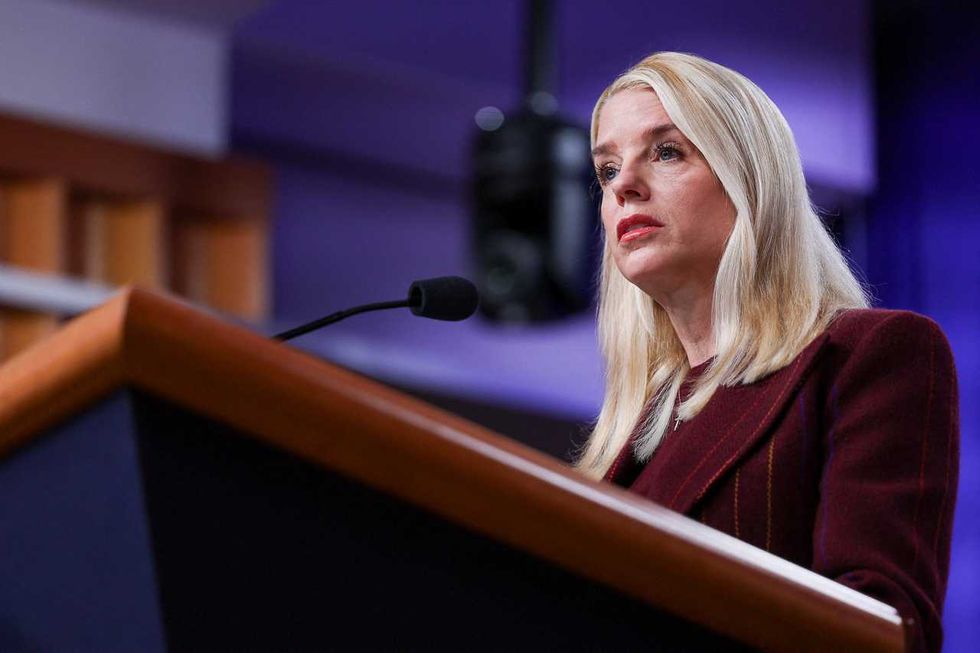
Kristi Noem's firing as Homeland Security Secretary could presage trouble for Attorney General Pam Bondi, whose future faces scrutiny following Trump's Cabinet purge after Republican concerns. Bondi has drawn fire for her handling of Epstein files and slow-walking their release. As many as 20 Republicans may support punitive action against the nation's top prosecutor, according to Politico. Five Republicans sided with Democrats to subpoena Bondi, who must testify before a House committee. Though Trump publicly praised Bondi during a Thursday Inter Miami event, stating she'll prove her toughness over the next three years, her political standing remains uncertain. The White House claims full confidence in her, but Rep. Tim Burchett noted she's "in the batter's box," suggesting her job security depends on performance. Democrats may now pivot focus to Bondi with Noem removed as the target.Watch the video below. Your browser does not support the video tag. roar-assets-auto.rbl.ms
GOP revolt grows: Republicans plot payback against Bondi for Epstein files mess
Far Left
Kristi Noem's firing as Homeland Security Secretary could presage trouble for Attorney General Pam Bondi, whose future faces scrutiny following Trump's Cabinet purge after Republican concerns. Bondi has drawn fire for her handling of Epstein files and slow-walking their release. As many as 20 Republicans may support punitive action against the nation's top prosecutor, according to Politico. Five Republicans sided with Democrats to subpoena Bondi, who must testify before a House committee. Though Trump publicly praised Bondi during a Thursday Inter Miami event, stating she'll prove her toughness over the next three years, her political standing remains uncertain. The White House claims full confidence in her, but Rep. Tim Burchett noted she's "in the batter's box," suggesting her job security depends on performance. Democrats may now pivot focus to Bondi with Noem removed as the target.Watch the video below. Your browser does not support the video tag. roar-assets-auto.rbl.ms
A Pennsylvania state representative is calling out Democrats after he was kicked off the House floor for wearing patriotic clothes. Rep. Eric Davanzo showed up to work […]
Resistance is mounting across the United States against the increasing use of surveillance tech company Flock Safety’s cameras, with a growing number of cities canceling contracts as the artificial intelligence-powered license plate readers are quietly being installed in thousands of locations nationwide.State and local police departments first used the Atlanta-based company’s automated license plate reader (ALPR) systems for standard law enforcement purposes, but they are now being employed for a much broader range of uses, including immigration-related searches and other actions supporting US Immigration and Customs Enforcement (ICE) during the Trump administration’s deadly anti-immigrant crackdown.“We have cameras that are used for everything from illegal dumping to drug houses to hotels that are just big problems,” Flock Safety engineer Kevin Cox told prospective customers during a demonstration of the company’s Condor Camera, according to a Thursday report in The Washington Times.“There are endless, endless uses for what we can do with these things,” Cox added.Those uses include spying on constitutionally protected protest activity and enforcing abortion bans by tracking pregnant people’s travel across states—even ones in which the medical procedure is legal.The ACLU—which recently launched a “Get the Flock Out” campaign to “fight creepy ALPR cameras”—says there are currently between 80,000 and 100,000 Flock devices installed nationwide that conduct more than 20 billion scans per month. More than 5,000 law enforcement agencies use the cameras, and some of them keep their locations a secret.“Flock’s ALPR cameras aren’t like your normal traffic cameras,” the ACLU explained. “This surveillance technology records and tracks every car that comes into view, and then an AI algorithm catalogs the make, model, color, license plate number, bumper stickers, and even scratches. This personal information is then uploaded into a nationwide database that any law enforcement agency with a Flock contract can search—with few regulations or oversight on how they use what they find.”The backlash against creeping state surveillance has even transcended the partisan divide.“I think our country is in a kind of uniquely anti-surveillance environment right now, which is to say that, in a time where it seems there is nothing that is not partisan, opposition to government surveillance is nonpartisan,” ACLU privacy and surveillance attorney Chad Marlow told The Washington Times on Thursday.There is growing action—both legal and otherwise—to end the use of ALPRs across the country.According to the public information project Ban Flock Cameras, 82 Flock contracts were terminated across 28 states between August 2021 and May 2026, with 39 of those cancellations occurring in the first five months of 2026 alone.Even Amazon-owned Ring announced earlier this year that it would stop doing business with Flock Safety.Susie O’Hara, a member of Santa Cruz, California’s nominally nonpartisan City Council, told WBUR earlier this year that she grew increasingly concerned about local use of eight Flock cameras last year after learning that police were sharing data gleaned from the cameras with the company’s national network without city officials’ knowledge, a violation of state laws banning the practice.O’Hara became increasingly convinced that Santa Cruz should cancel its Flock contract after an ICE agent fatally shot Renee Good, a US citizen, in Minneapolis in January.“I have goose bumps on my arms thinking about the absolute chaos that was happening in Minneapolis,” she said. “And just the absolute insanity of what we were seeing... It was totally clear to me that we should in no way consciously be in this system at all—just no way.”Less than a week after Good’s killing, the Santa Cruz City Council voted to terminate the city’s Flock contract, becoming the first municipality in California to do so.“For us, the threat to our civil liberties was greater than any benefit we could get from the flawed product,” Santa Cruz Mayor Fred Keeley told KQED at the time.Chad Kemp, who represents District 32 on the nonpartisan Dane County Board of Supervisors in Wisconsin—which in April voted to stop funding two dozen cameras leased from Flock—told The Washington Times that “there’s a public safety issue here, but there is also a privacy issue.”“There are serious concerns about individuals who can be monitored without their knowledge, or if it is even constitutional or ethical to track people without a warrant,” he added.At the national level, US Reps. Robert Garcia (D-Calif.) and Raja Krishnamoorthi (D-Ill.) last year launched an investigation into the use of Flock cameras to track pregnant people across state lines for abortion care and to conduct unauthorized immigration enforcement operations.Krishnamoorthi and Sen.
Major American corporations that benefited from tax cuts enacted last year by President Donald Trump and congressional Republicans are donating to the campaigns of GOP lawmakers who made the windfall possible.A report published Friday by Unrig Our Economy spotlights seven House Republicans who voted for the sprawling and unpopular GOP budget package, which extended tax breaks for corporations and wealthy Americans while inflicting unprecedented cuts on Medicaid and federal nutrition assistance—with disastrous consequences for millions of low-income families across the country.Rep. Mariannette Miller-Meeks (R-Iowa), one of the lawmakers featured in the new report, has received campaign donations from corporate PACs representing 3M, Amazon, Walmart, AT&T, and other companies that collectively received billions of dollars in tax breaks from the Republican law, which restored a provision allowing businesses to immediately write off new investments.Amazon saw its US income taxes fall by more than half last year due to the GOP law, even as the company’s profits grew. Unrig Our Economy noted that Amazon, whose PAC donated thousands to the Republicans spotlighted in the new report, has an effective federal tax rate of 1.37% following enactment of the budget law.Miller-Meeks, who has received at least $57,000 in donations from the PACs of companies that benefited from the 2025 law, issued a statement Thursday bragging about supporting “the largest tax cuts in American history,” not mentioning that the benefits will disproportionately flow to profitable corporations and the richest people in the country.“Thanks to the Republican tax law, corporations are receiving tax breaks, House Republicans are getting campaign cash, and working families are getting stuck with the bill,” the report states.Another Republican lawmaker featured in the report, Rob Bresnahan of Pennsylvania, received $2,500 in campaign donations from the PAC of FirstEnergy, which reaped $500 million in depreciation deductions thanks to the GOP tax law.“Bresnahan voted to give FirstEnergy hundreds of millions in tax breaks even after the company raised utility prices for his constituents,” Unrig Our Economy’s report observes.The report also points out that Bresnahan “owned stock in every single one” of the companies who contributed PAC money to his campaign following passage of the Republican budget package last summer.“This comes after Bresnahan has already faced scrutiny for dumping stock in Medicaid providers and selling off bonds in Pennsylvania hospitals before voting to slash Medicaid and put rural hospitals at risk,” the report notes.Leor Tal, Unrig Our Economy’s campaign director, said in a statement that “one year ago, House Republicans ripped away healthcare and food assistance from millions of Americans, so that corporations could get massive tax breaks.”“Now, many of those companies are dishing out PAC money to the Republicans listed in this report,” said Tal. “Republicans in Congress sold out many of their own constituents to help corporations get even richer. It’s time that House Republicans step up, do the right thing, and start fighting for working Americans—not giant corporations.”
Republicans are criticizing New York City Mayor Zohran Mamdani (D) after he suggested residents set their thermostats to 78 degrees to help conserve energy in the city as it braces for triple-digit temperatures this weekend. “New York: it’s hot out there, and the power grid is working overtime to keep us cool. Set your AC…
The Justice Department (DOJ) declined on Thursday to release additional unredacted records from its investigation into convicted sex offender Jeffrey Epstein, telling a federal judge that it has already adequately complied with the law. The DOJ’s response came in the final hours of a court-ordered deadline to remove redactions in at least a dozen documents…
Trump administration officials reportedly believed that the Israeli government intended to assassinate Iran’s top negotiators—including the country’s foreign minister—during peace talks with the US in an effort to sabotage diplomatic progress.The New York Times reported Thursday that “American concerns about the targeting of two particular Iranian officials—Abbas Araghchi, Iran’s foreign minister, and Mohammad Bagher Ghalibaf, the speaker of the Parliament—spiked during delicate ceasefire negotiations that began in April.” In response, the US “went so far as to ask other countries in the region to warn Iran about the possibility Israel could target the two officials,” according to the Times, which cited unnamed current and former American officials.The US and Israel have killed dozens of top Iranian officials since launching their illegal joint war in late February. But the allied countries reportedly removed Araghchi and Ghalibaf from their target list in late March, opening the possibility of high-level negotiations to end the war.But Israel remained bent on targeting the negotiators, according to the Times, whose reporting was later corroborated by The Washington Post.The Times detailed one dramatic incident in April, when Ghalibaf was planning to travel to Pakistan’s capital to meet with US Vice President JD Vance:Pakistani fighter jets escorted the Iranian airplanes carrying a delegation of more than 70 Iranians from the border of Iran to Islamabad and back again when the session was over.But on the way back to Tehran, an Israeli security threat emerged.Iran’s security forces notified the plane carrying Mr. Ghalibaf back to Tehran that they had picked up intelligence that Israel planned to attack the plane and that two Israeli fighter jets had entered Iran’s airspace from its western border near Iraq, the two officials said.Mahdi Mohammadi, a senior adviser for Mr. Ghalibaf, who accompanied him to Islamabad, confirmed this account on his social media page. The plane made an emergency landing in the city of Mashhad, Iran’s closest airport to the Pakistani border, and the Iranian delegation traveled some eight hours by land back to Tehran, Mr. Mohammadi and the two officials said.The Post reported that “cracks emerged” between the US and Israeli approaches to the war following Israel’s assassination of top Iranian national security official Ali Larijani in March.“They’ve wiped out everybody,” Trump told reporters in late March, suggesting Israel’s assassination campaign was making it difficult to find potential negotiating partners.Trita Parsi, executive vice president of the Quincy Institute for Responsible Statecraft, wrote in response to the new reporting that “Israel is a state that, on paper, is a US partner, but in reality is so extreme in its obsession to undermine US diplomacy that it even tries to assassinate those the US engages with in crucial negotiations.”“I can’t recall a government as terrified of peace as the one running Israel,” Parsi added.At present, the Israeli government—led by Prime Minister Benjamin Netanyahu—is endangering tenuous US-Iran peace talks with its continued occupation of and assault on Lebanon, which Iran has highlighted as a key factor in the negotiations.Visiting occupied southern Lebanon earlier this week, Netanyahu declared to Israeli troops that “our insistence is that we will not leave... until the threat is removed.”Parsi wrote earlier this week that “beyond his long-standing desire to use American force to subjugate Iran to Israeli domination and achieve a regional balance favorable to Israel,” Netanyahu “now also has stark political and personal reasons to restart the war” with Iran.“The [US and Iran’s memorandum of understanding] has come at a steep political cost for Netanyahu,” wrote Parsi. “His prospects for reelection in October are weaker than they have been in months. Once seen as the Israeli leader uniquely capable of delivering President Trump, he now confronts the prospect that both the war and the ensuing diplomacy will leave Israel in a strategically weaker position—undermining the very case he has made for his leadership.”“And of course,” Parsi added, “if he loses the elections, he will likely spend the next few years in jail, as he will lose his immunity as prime minister and face trial over corruption charges.”The story was published in partnership with Common Dreams, read the original here.